
Ukrainian researchers have dissected the Russian pseudo-legal system molecule by molecule, through which the regime kidnaps Ukrainian civilians, deprives them of freedom, and holds them in secret prisons incommunicado — without contact with relatives, lawyers, and the outside world.
In Russia’s war against Ukraine, there is a topic that remains less visible than the front, missiles, drones, and prisoner exchanges.
These are Ukrainian civilians.
Not soldiers.
Not combatants.
Not people captured on the battlefield.
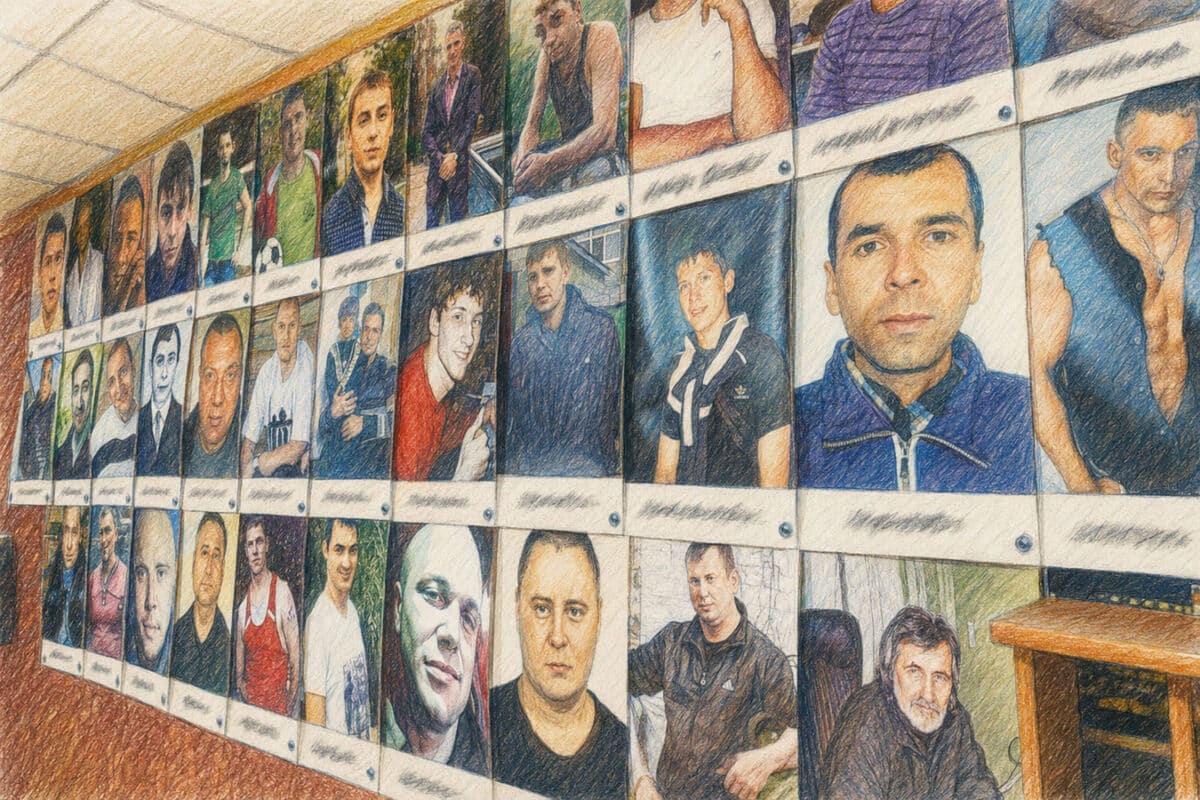
We are talking about civilians whom Russian military, FSB, occupation structures, or associated security forces detained in occupied territories, at filtration points, in their own homes, on the streets, at checkpoints — and then effectively erased from the legal field.
The article by Maria Kugel in The Moscow Times on July 2, 2026, describes this not as chaos of individual abductions, but as a pseudo-legal system created by the Russian regime. Ukrainian researchers call it “shadow law”: a secret construct that allows Ukrainian civilians to be held incommunicado for years — without contact, without a lawyer, without access to family, and without a clear status.
Not missing persons, but people held by the state
One of the main problems of this topic is language.
When a person disappears in an occupied territory, they are often called “missing.” Formally, this may be true: the family does not know where they are, whether they are alive, whether there are charges, or if there is any document of detention.
But in essence, in many cases, it is not about the unknown, but about enforced disappearance.
A person is taken by a state or occupation structure. After that, the same state refuses to acknowledge the very fact of detention, hides the location, does not allow contact with relatives, and does not permit independent oversight.
This is no longer just a “disappearance.”
This is a mechanism of terror.
According to an estimate cited by The Moscow Times, about 16,000 Ukrainian non-combatants may be in places of forced detention: in pre-trial detention centers, colonies, prisons in occupied territories of Ukraine and in Russia itself. Exact data is not available precisely because the Russian regime conceals this system.
Ukrainian organizations — the Expert Group “Sova,” the Center for Civil Liberties, and the “War Archive” project — have prepared an analytical report on the illegal deprivation of liberty of citizens of Ukraine and other countries by Russian occupation forces. It analyzes 8,221 cases from February 2022 to December 2025. Separate publications on the report emphasize: these are only confirmed cases, not the full picture.
How the Russian scheme works
The essence of the scheme looks especially cynical.
Russia verbally refers to the norms of international humanitarian law, but in practice does not distinguish between military and civilians. For the occupation machine, a Ukrainian becomes a suspicious object: “enemy,” “rebel,” “accomplice,” “threat.”
The Moscow Times describes that civilians could be processed through orders of military commandants of Russian garrisons. These structures belong to the military police of the Russian Ministry of Defense. In essence, the Russian military administration gained the ability to detain people, extend detention periods, and transfer them to FSIN facilities by virtually their own decisions.
This is not a normal legal procedure.
This is an imitation of law.
A person does not receive a clear status. Their family does not receive a clear answer. International organizations do not gain access.
And Russian state bodies gain a convenient mechanism: they can hold a civilian for years, not acknowledge their existence in the system, and then either remain silent further or retroactively turn them into an accused in cases of “terrorism,” “espionage,” or “treason.”
Thus arises a terrifying zone between war and prison.
Formally, the person is not a prisoner of war.
Formally, they are not an ordinary prisoner.
Formally, they may not have a case at all.
But in fact, they are in the hands of a state that uses them as a hostage.
Why this is a crime of a special scale
International humanitarian law distinguishes between military and civilians for a reason. It is the basis of human protection during war.
A prisoner of war has one legal regime.
A civilian, even if the occupying force considers them dangerous, has another regime. They cannot simply disappear in prison. If the state speaks of internment, there must be a procedure, grounds, the possibility of appeal, control of detention conditions, and contact with the outside world.
Russia, according to human rights activists, does not do this.
Moreover, people are held in FSIN facilities, although for civilians in a situation of armed conflict, the prison model itself is a gross violation. The Moscow Times indicates that Ukrainians may be held in separate blocks, rooms, or floors, and the number of such locations may be in the hundreds.
Here it is important to understand the main thing: it is not only about cruelty.
It is about the bureaucratization of abduction.
Russian terrorists do not just capture people. The state creates documents, instructions, secret decisions, internal routes between security structures and the prison system for this.
And this is what makes the system especially dangerous.
When a crime is turned into an administrative procedure, it becomes massive, sustainable, and reproducible.
Why this is important for Israel
For the Israeli audience, this topic should not sound like a distant Ukrainian tragedy.
Israel understands well what civilian hostages, family uncertainty, lack of access to detained people, and the attempt of a terrorist or state machine to use living people as a tool of pressure mean.
Of course, the Ukrainian and Israeli contexts are different.
But the principle is the same: if the world allows civilians to be turned into invisible hostages, such practice quickly becomes part of international reality.
NAnews — Israel News | Nikk.Agency writes about Ukraine not out of abstract solidarity, but because this war shows how modern authoritarian regimes destroy basic security rules.
Today these are Ukrainian civilians in occupied territories.
Tomorrow a similar logic can be applied anywhere: against minorities, residents of disputed territories, political opponents, journalists, activists, random people who found themselves “in the wrong place.”
For Israel, which itself lives in a space of war, hostages, international pressure, and the struggle for the right to protect citizens, the issue of Ukrainian civilians in Russian secret prisons is not an alien topic.
It is a question of whether there will remain any boundary between war and the hunt for peaceful populations.
Exchanges do not solve the problem
Prisoner exchanges often become news.
They are shown, leaders talk about them, they are accompanied by photos of returning home.
With civilians, it is different.
According to data cited by The Moscow Times, by mid-June about 9,400 people had been returned, but among them only 458 were civilians. Meanwhile, the number of detained Ukrainian non-combatants, according to researchers, already exceeds the number of Ukrainian prisoners of war remaining in Russia several times over.
This means that there is no such visible mechanism for the return of civilians.
A soldier can get on the exchange list.
A civilian often does not even get on a recognized list.
It is as if they do not exist.
This is why the topic of incommunicado is so terrifying: a person may be alive, may be in a specific institution, may wait years for trial or not have a case at all, but for the family and the outside world, they remain in the dark.
What the world should do
The main conclusion from The Moscow Times material and the report of Ukrainian human rights activists: it is necessary to document not only individual crimes but the system itself.
It is not enough to say: “here is another abducted person.”
It is necessary to record who detained, who signed orders, who transferred to pre-trial detention, who responded to relatives, who refused correspondence, who concealed data, who ensured isolation, who applied torture, who retroactively turned a civilian into an accused.
Responsibility should be not only personal but also institutional.
The focus should be on the FSB, FSIN, the military police of the Russian Ministry of Defense, the Investigative Committee, the prosecutor’s office, military commandants, and all links that make this system possible.
Publications on the report directly speak of the mass and systemic nature of such detentions and that such crimes are not “excesses of performers,” but are related to the state policy of the Russian regime.
Sanctions in this case are not a symbolic gesture.
They are a tool of pressure on a system that will not open or stop voluntarily.
Lists of performers are needed.
International investigations are needed.
Cases in Ukrainian courts are needed.
Universal jurisdiction in other countries is needed.
Constant work with the families of the disappeared is needed.
Access of international organizations to places of detention is needed.
And political recognition is needed: Ukrainian civilians in Russian secret prisons are not a side effect of war, but a separate direction of Russian state policy.
Shadow law as the face of the Russian war
There is no randomness in this story.
Russian aggression against Ukraine has long gone beyond the front. It includes deportations, filtration, torture, destruction of cities, abduction of children, pressure on identity, and now — a large-scale system of secret civilian detention.
“Shadow law” is an accurate name.
Because this is not lawlessness in its pure form.
It is worse.
It is lawlessness that has donned the form of law.
Secret decrees, internal instructions, commandant orders, prosecutor’s responses, FSIN blocks, filtration formulations, closed cases, and state silence — all this forms a mechanism where a person disappears not despite the system, but because of the system.
This is why this material is important.
It shows that the fight for Ukrainian civilians is not only a humanitarian issue. It is a question of the future of international law.
If a state is allowed to secretly detain thousands of civilians and call it “filtration” or “countering a special military operation,” then the very concept of protecting the civilian population becomes an empty sound.
And therefore, the task of Ukraine, Israel, Europe, and all countries that understand the value of civilian security is not to let this practice become the new norm.
Because behind each such “incommunicado” is not abstract statistics.
There is a person.
A family.
A name.
And a state that decided it can erase all three points from reality.
