
Rosa Tapanova on September 16, 2026, showed the finished copies of the book, wrote a preface to it, and explained why “Babi Yar” should take up more space in Ukrainian schools. The history of this text itself became part of the history of memory: a twelve-year-old witness to the occupation, Soviet censorship, a manuscript on film, millions of readers of the abridged version, and the complete book that had to be taken out of the USSR.
Author: Victoria Katsman
On September 16, 2026, the director of the National Historical and Memorial Reserve “Babi Yar” Rosa Tapanova spoke about the new Ukrainian edition of Anatoly Kuznetsov’s documentary novel “Babi Yar”.
“The book that revealed the truth about the Holocaust and the history of Kyiv to me.
A book I often return to when I doubt and make decisions on projects.
This year, each of us will be able to read Anatoly Kuznetsov’s book “Babi Yar” in Ukrainian.
Once, I didn’t even dream of writing a preface to this book. Now it is an honor for me.”
In her publication, Tapanova outlined several key thoughts:
- Kuznetsov’s book once became one of the texts through which she truly understood the scale of the Holocaust and the history of Kyiv during the occupation;
- she perceives the new Ukrainian edition not just as a reissue, but as a return to Kyiv of one of the most important testimonies about Babi Yar;
- Kuznetsov began documenting his experiences as a teenager, and his early notes later formed the basis of the book;
- the mass shootings on September 29–30, 1941, when 33,771 Kyiv Jews were killed, were only the beginning: Babi Yar was used as a place of executions later;
- after the war, the Soviet system blurred the specifically Jewish component of the tragedy, replacing it with a general formula about “Soviet citizens”;
- the same system interfered with Kuznetsov’s text: the 1966 publication came out after serious censorship, and the full version was later taken out of the USSR by the writer;
- therefore, for Tapanova, the history of “Babi Yar” is simultaneously the history of the crime itself and the history of the struggle for memory about it;
- the reserve wants the book to occupy a more prominent place in the school study of the Holocaust and Babi Yar;
- Tapanova attaches special importance to the fact that the first notes were made by a teenager: the current schoolchild encounters not only a historical document in the book but also the voice of their peer;
- in the finale, she connects the preservation of historical memory with the responsibility of modern society — not to allow the erasure of the names of the dead, the substitution of the meaning of what happened, and forcing witnesses to remain silent.
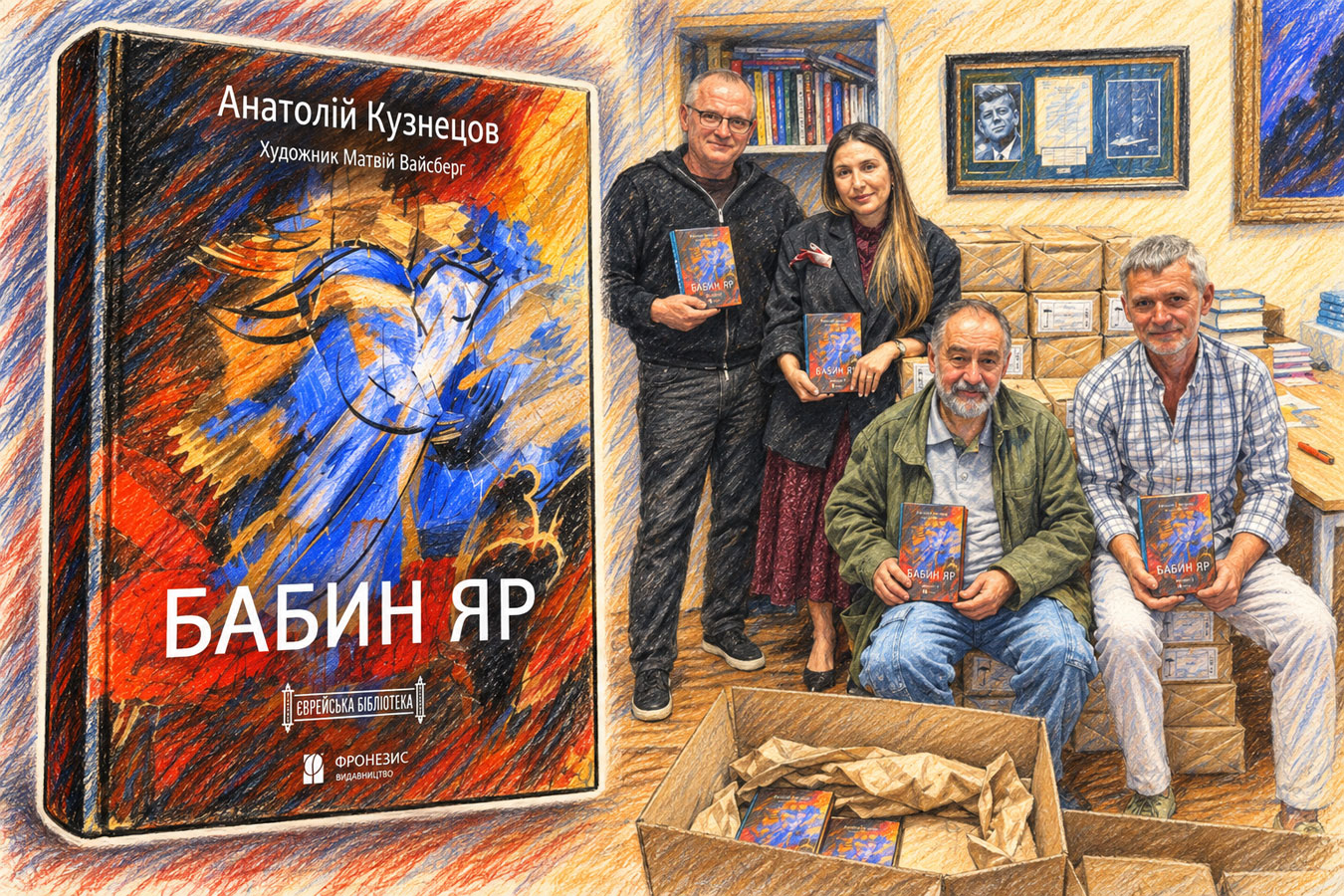
The book is printed. In the photo published by Tapanova along with the post, several people hold finished copies, behind them are boxes with the print run, and more books are visible in open packaging. Therefore, the inscription “not for sale” (September 16, 2026), which still remains on the card of one of the Ukrainian bookstores, only speaks about the sales status at a specific seller, not the absence of the book itself.
The new edition was released by “Fronesis”. The catalog lists 2026, 400 pages, hardcover, Ukrainian language, black and white illustrations by Matvey Weisberg, and ISBN 978-617-95415-7-5.
The preface was written by Rosa Tapanova herself — the director of the National Historical and Memorial Reserve “Babi Yar” in Kyiv. For the Israeli reader, it should be explained that this is not just a park or a single monument. It is a state Ukrainian institution responsible for preserving the historical space of Babi Yar, researching its history, and working with the memory of the people who were killed here during the Nazi occupation of Kyiv.
The reserve was established by a resolution of the Cabinet of Ministers of Ukraine on March 1, 2007 as the State Historical and Memorial Reserve “Babi Yar”. In February 2010, President Viktor Yushchenko granted it national status — precisely with the wording about the significance of this place for perpetuating the memory of the victims of Nazi persecution. Today, this institution is part of the state system for the protection of Ukraine’s cultural heritage.
It is located in Kyiv, in the Dorogozhichi and Syrets area, around the historical ravine of Babi Yar. The official address of the reserve is 44 Yuriya Ilyenka Street, very close to the Dorogozhichi metro station. However, the historical space of Babi Yar is much larger than one modern site: before the Soviet redevelopment, it was a huge ravine with branches that stretched towards Kurenivka. Nearby were Jewish, Orthodox, and military cemeteries, the Kirillov Psychiatric Hospital, and during the German occupation — the Syrets concentration camp.
Therefore, Babi Yar today is a whole map of memory, not just one monument. Here is the “Menorah”, installed in 1991 in memory of the destroyed Jews of Kyiv; a monument to the children shot in Babi Yar; a cross in memory of the killed members of the OUN; memorial signs to the prisoners of the Syrets concentration camp, the shot patients of the psychiatric hospital, and other groups of victims. The “Road of Sorrow” passes through the territory, leading to the “Menorah”.
On the slopes is also the symbolic synagogue “Place for Reflection”, which unfolds like a wooden book. Its interior refers to the destroyed synagogues of Eastern Europe, and the ceiling reproduces the starry sky over Kyiv on September 29, 1941. But there is a nuance here that is often lost in publications: this synagogue was created in 2021 by the Babi Yar Holocaust Memorial Center, not the state reserve.
These are generally two different structures, although they work with the same historical space and can participate in joint events. The National Historical and Memorial Reserve “Babi Yar” is a state Ukrainian institution created in 2007. The Babi Yar Holocaust Memorial Center is a separate charitable project, the fund of which was registered in Kyiv in 2016. For the Israeli reader, this distinction is especially useful: in the news, both names are often shortened simply to “Babi Yar”, making it easy to assume they refer to one organization.
The work of the reserve today is much broader than the content of monuments. It conducts historical research, collects archival documents and family testimonies, organizes exhibitions and memorial ceremonies, and arranges tours and educational programs. The reserve directly appeals to Kyiv residents to pass on the names of those shot, information about the dead, witnesses’ memories, and items found in Babi Yar — materials are collected, including for a future memorial museum.
The institution also has a permanent connection with Israel and Jewish organizations. Among its partners, the official website names the Embassy of Israel in Ukraine, the Israeli Cultural Center “Nativ”, the Ukrainian Center for Holocaust Studies, the Jewish Council of Ukraine, and international research organizations. Therefore, the current edition of Kuznetsov for the reserve is not a separate book project that accidentally appeared for the anniversary, but part of a broader effort: to return to Babi Yar the names, documents, testimonies, and the Jewish component of the tragedy that the Soviet system tried for decades to dissolve in the impersonal formula of “Soviet citizens”.
Rosa Tapanova herself begins the preface not with the history of the institution she heads, nor with an anniversary speech. She writes that it was Kuznetsov’s book that once revealed the truth about the Holocaust and the history of Kyiv to her and that she still returns to this text when she doubts or makes decisions on reserve projects.
Twelve years old — when Babi Yar began. Fourteen — when the notebook appeared
Anatoly Kuznetsov was born in Kyiv in 1929 and grew up in Kurenivka, very close to Babi Yar. When German troops occupied Kyiv in September 1941, he was twelve years old.
From here, confusion sometimes arises. In one place, it speaks of a twelve-year-old boy, in another — of a fourteen-year-old author of the first notes. There is no contradiction here.
At twelve, Kuznetsov found himself inside occupied Kyiv and lived near the site of mass murders. And at about fourteen, he began systematically recording his experiences. Later, the author himself called this early text the first version of the future book. Researchers of the history of “Babi Yar” confirm: the teenage notes became one of the initial layers of the documentary novel.
He was not a historian who came to the archive decades later and restored the picture from folders. At first, he was a child inside this story.
Then, to his own memories, were added the stories of relatives, witnesses, people who survived the occupation, documents, meetings with survivors. Thus, the personal notebook gradually turned into one of the most famous books about the Nazi occupation of Kyiv.
Kuznetsov himself begins it almost provocatively simply: “Everything in this book is true.”
33,771 people in two days — and Babi Yar did not end after September 30
On September 29 and 30, 1941, SS units and German police, with the participation of auxiliary forces, killed 33,771 Jews in Babi Yar.
This number is fundamental. It did not appear decades later as a result of approximate calculations: it was contained in the German operational report of the Einsatzgruppe. The United States Holocaust Memorial Museum cites exactly 33,771 killed over these two days.
But Babi Yar did not end on the evening of September 30.
Until 1943, the ravine continued to be used as a site for mass executions. Here, the remaining Jews, Roma, Soviet prisoners of war, psychiatric hospital patients, and other people were killed. The total estimate of the number of victims during the occupation period is about 100,000 people. This cautious figure is used by many researchers and memorial institutions.
In the description of the new “Fronesis” edition, an estimate of about 150,000 dead is mentioned
Earlier, NAnews — News of Israel | Nikk.Agency separately reported on the modern research work around this place — from archives and family stories to the public “Research Space” that the reserve launched in the summer of 2026. More about the “Research Space” in Babi Yar
What is important for the Israeli reader to understand about the “Holocaust by bullets”
For Israel, Babi Yar is not a local Ukrainian story and not one of the many monuments of World War II.
It is one of the main symbols of what historians call the “Holocaust by bullets”.
Most of the mass murders of Jews in the occupied territories of the USSR did not occur in the gas chambers of Auschwitz or Treblinka. People were led out of cities and towns into forests, quarries, ravines, anti-tank ditches, and shot there, sometimes literally a few kilometers from their homes.
That is why Babi Yar is so important for Israeli memory. For a huge number of families in Israel, the history of the Shoah is connected with Ukraine, Belarus, Lithuania, Latvia, Moldova, and other territories of the former USSR — places where a person could die not in a death camp with a preserved transport number, but in a nameless pit near their own city.
We recently wrote about another Ukrainian memory project — the “Drawn Prayers” exhibition, where the destroyed and disappearing Jewish heritage of Bukovina is literally being pieced back together through wall paintings, photographs, and digital models. A very similar thought was expressed there: the Jewish history of Ukraine is not “the history of strangers who once lived here,” but part of the history of the country itself. “Drawn Prayers”: how the heritage of Bukovina synagogues is being saved in Kyiv
Then the victims began to be deprived of their names
After the return of Soviet power, another story began. Those killed in Babi Yar gradually turned into “peaceful Soviet citizens” in official language.
Formally, this expression was not false: among the victims were indeed people of different nationalities and categories. But it erased the main meaning of the shootings on September 29–30, 1941 — on these two days, people were killed precisely as Jews.
The first major Soviet state monument in Babi Yar appeared only in 1976. The Jewish identity of the main group of the first victims was not separately emphasized in its official formula.
The Menorah monument in memory of the destroyed Jews appeared already in independent Ukraine — on September 29, 1991.
And this was not just a dispute around monuments. Even in the 1960s, people tried to return the place its Jewish name from below, without state permission.
NAnews recently detailed the first unofficial mass commemoration in Babi Yar in September 1966. People came without a sanctioned script, Ivan Dzyuba spoke there, and Dina Pronicheva, a survivor of the shooting, was present — one of the key witnesses whose story was included in Kuznetsov’s book. The Soviet authorities perceived such gatherings as a dangerous combination of “Jewish” and “Ukrainian nationalism”. How the first memory rally in Babi Yar took place in 1966
And even earlier, in 1965, the competition for a full-fledged memorial to the victims of Babi Yar was effectively stifled. We have a separate material dedicated to this story about the unrealized monument project and how the state imitated a public conversation, not allowing it to go beyond permitted boundaries. Soviet ban on memory: the history of the Babi Yar memorial of 1965
It was into this environment that Kuznetsov’s book fell.
Two million copies — but not quite that book
In 1965, Kuznetsov submitted the manuscript for publication. In 1966, “Babi Yar” appeared in the Moscow magazine “Yunost”, in issues 8–10.
Only this was no longer the fully author’s text.
The novel underwent serious editorial and state censorship. Researchers of the book’s history note the removal of fragments where the Jewish specificity of Babi Yar was particularly evident, where the Holodomor, the Stalinist system, the attitude of residents towards Soviet power were discussed, and where the Nazi and Soviet experiences were too close to each other.
Tapanova in her preface gives this a very harsh formula: the crime happened twice — first in the ravine, then in the printing house.
Of course, physical mass murder and censorship are not equal in scale and nature. The meaning of her phrase is different: after the destruction of people, a struggle began over how they were allowed to be remembered.
There is also a figure here that is constantly misreported.
The censored version was indeed seen by about two million readers. But two million is the circulation of the magazine “Yunost”, not a separate book by Kuznetsov.
When “Molodaya Gvardiya” released “Babi Yar” as a separate edition in 1967, it was about approximately 150,000 copies. The fact itself does not become less from this — millions of people read the book. Only the state had already decided in advance which pages they were not allowed to read.
Kuznetsov took the real book out on film
In 1969, Anatoly Kuznetsov found himself in the United Kingdom and refused to return to the USSR.
He took with him film rolls with the full text of “Babi Yar”. This is not a late legend around the writer: the history of the films is confirmed by studies of the publication fate of the novel and by Kuznetsov himself.
In 1970, the full Russian version with restored fragments was published by the émigré publishing house “Posev” under the name A. Anatoli. In the same year, an English translation appeared in London and New York.
Therefore, the widespread formula “the full version was first published in London” should be slightly clarified. In London in 1970, the full English text indeed appeared. The Russian author’s version of the same year is associated with “Posev”.
But the most interesting thing Kuznetsov did was within the text itself.
Regular font, italics, square brackets
He did not just return what was cut out. He left the reader the opportunity to see the censorship operation itself.
Regular font printed what was allowed in “Yunost”.
Italics — what Soviet censorship threw out.
In square brackets — fragments that Kuznetsov added after the first publication.
This turns “Babi Yar” into a strange document of two eras at once. Within one book remains Kyiv under German occupation — and next to it, literally on the same pages, the Soviet system of the sixties, which decides what memory can be allowed into print.
French researcher Frédérique Leichter-Flack later called such a construction a “political palimpsest”.
For a reader who has not encountered this term: a palimpsest is called an old manuscript from which the previous text was erased to write a new one over it. Only with Kuznetsov, the first layer could not be completely erased.
The French edition of 2011 returned another layer
In 2011, the publisher Robert Laffont prepared a new French edition of “Babi Yar”.
Researcher Annie Epelboin re-examined the old translation, restored missing parts, and wrote a large preface. Already in 2012, Frédérique Leichter-Flack analyzed this version as an example of the very “political palimpsest”.
In other words, the history of censorship became not a note for specialists. It turned into one of the central features of the book itself.
Tapanova writes that “Babi Yar” was translated in many countries and that in the West it is placed alongside Anne Frank’s diary and Elie Wiesel’s “Night”. Here it is important to leave this precisely as her assessment and international literary context, not to turn it into a formal ranking of Holocaust books.
For Ukraine, she highlights another: Kuznetsov is a Kyivan. He wrote about familiar streets, his own district, and the city that had recently existed around him with a normal life.
This is not the first edition in Ukrainian — and this is also important
The new 2026 edition should not be called the first Ukrainian “Babi Yar”.
The full version in Ukrainian was first presented back in 2008. The Ukrainian print run of the “Samit-Kniga” publishing house was 5,000 copies, and the press of that time directly wrote about the first full Ukrainian edition of the novel.
Library catalogs also record a Ukrainian-language edition of 2009 — 351 pages, and in other bibliographic descriptions, 367–368 pages are mentioned. There is no point in arguing about the “correct year”: the presentation and first appearance of the Ukrainian version relate to 2008, the library recording of a specific edition — also to 2009.
Therefore, the current book is not the first translation, but a new return.
And this time the word “return” works especially well: in Tapanova’s photo, the books are indeed already lying in boxes in Kyiv.
Who was next to the new edition
In her publication, Rosa Tapanova noted the Jewish Confederation of Ukraine, the official Babyn Yar project, artist Matvey Weisberg, Inna Ioffe, the “Fronesis” publishing house, Denis Denisenko, and Boris Lozhkin.
Matvey Weisberg is officially listed as the illustrator of the new edition. At the beginning of 2026, the reserve already held a large exhibition “In Search of Lost Meaning” with him, dedicated to the memory of the Holocaust; the idea was proposed by Rosa Tapanova. Among the institutional partners were the Embassy of Israel, the Honorary Consulate of Israel, and the Israeli Cultural Center NATIV.
Boris Lozhkin is currently the president of the Jewish Confederation of Ukraine, Inna Ioffe is its director. Ioffe has been leading the organization since 2010.
The JCU has been engaged in Holocaust memory projects and Ukrainian Righteous Among the Nations for many years. In working on books and documenting such stories, data from Israel’s “Yad Vashem” is also used.
For the Israeli reader, there is a clear connection here: the Ukrainian book about Babi Yar does not appear in an isolated literary bubble. Nearby are Ukrainian Jewish organizations, people working with Holocaust memory, and structures that constantly interact with Israel.
“Phronesis” has already made a book that was simultaneously released in Kyiv and Jerusalem.
There is another connection that is a pity to lose.
In 2025, “Phronesis” released the Ukrainian edition of Natan Sharansky’s memoirs “Fear No Evil.” The presentation was held simultaneously in Kyiv and Jerusalem; in the Ukrainian part, Roza Tapanova participated, and in the Israeli part, Sharansky himself, the Ukrainian ambassador, Knesset deputies, and representatives of Israeli media.
We then told this story in detail separately. How Natan Sharansky’s book was first published in Ukrainian and presented simultaneously in Kyiv and Jerusalem
Therefore, the new edition of Kuznetsov fits well into the already existing line — translation and return to the Ukrainian space of texts related simultaneously to the Soviet experience, Jewish history, and personal resistance to the system.
Denis Denisenko was also noted by Tapanova. He is associated with the communication environment Ideas & Strategy, which organized the Sharansky presentation together with “Phronesis.” But his specific role in the current edition of Kuznetsov is not named in the post — attributing it independently would already be superfluous.
Why Tapanova wants to return Kuznetsov to school
A separate part of her preface is dedicated to teenagers.
The reserve, writes Tapanova, is working on including the novel in the school curriculum and increasing the number of hours for the topic of the Holocaust and Babyn Yar.
A nuance is needed here. Kuznetsov’s book and materials about it have long been present in the Ukrainian educational and methodological environment. For example, in the official educational project “Babyn Yar: Memory Against the Background of History,” the novel is listed among the recommended literature for teachers.
Therefore, the 2026 initiative is more correctly understood not as “until now, Kuznetsov was not known in school at all.” According to Tapanova’s wording, it is about a more serious status of the book itself and more time for studying the Holocaust and Babyn Yar.
And her argument here is strong precisely pedagogically, without a slogan.
A modern fourteen-year-old student opens a text, the first version of which was started by another fourteen-year-old teenager. Not a professor from the department, not a minister at a ceremony, not a person on a bronze pedestal.
A boy who understood: if not recorded, part of what was seen may disappear.
From Babyn Yar to the current war — this is already Tapanova’s position
At the end of the preface, Roza Tapanova goes beyond the history of the Holocaust.
She writes about the USSR as a system that collapsed but did not go through an analogue of Nuremberg for Stalin’s crimes, recalls the Gulag and Holodomor, and then connects the unprocessed imperial legacy with modern Russia.
It is important not to present this part as Kuznetsov’s words or as a neutral historical reference. This is Tapanova’s current position.
The fact from which she starts is beyond doubt: on February 24, 2022, Russian armed forces launched a full-scale armed attack on Ukraine — this is the wording used by the UN Human Rights Monitoring Mission.
Then Tapanova offers a parallel. In her opinion, the mechanism is repeated: violence is accompanied by a struggle for the naming of events, for the memory of the dead, for the right to determine what “really happened.”
And here Kuznetsov’s “Babyn Yar” really provides material for such a conversation, even if one argues with the scale of historical analogies. In his book, the reader physically sees what the state erased from the testimony.
Why this plot is especially Israeli
In Israel, they are accustomed to treating the memory of the Holocaust not as a set of anniversary dates.
There are names. Family stories. Testimonies. A page of testimony in “Yad Vashem.” Sometimes one photograph or address is all that remains of a person.
The Soviet model of memory largely worked the opposite: to gather different deceased into a common category, remove national specificity, leave a safe state formula.
Therefore, the dispute around Babyn Yar is quite easily understood by an Israeli. If a Jew was killed precisely because he was a Jew, it cannot be removed from the wording twenty years later just because the state is uncomfortable with a separate Jewish tragedy.
In this sense, the new edition of Kuznetsov stands alongside what Ukraine is doing today with other layers of Jewish heritage. It is no coincidence that just a few days ago we wrote in NANews about the Kyiv exhibition of Bukovinian synagogues — there is the same attempt to return specific names, places, and history instead of the impersonal formula “once someone lived here.” Not a foreign story: Jewish synagogues of Bukovina and Ukrainian memory
The book has returned. The work with memory — no, it has not ended
The reserve itself in 2026 is engaged not only in commemorative ceremonies.
There are exhibitions, research programs, work with family archives, and personal stories. Tapanova repeatedly speaks of “living memory” — not a museum where everything is already laid out in showcases, but a place where documents and testimonies continue to be found, discussed, clarified.
There is also another symbolic layer: 2026 is the year of the 85th anniversary of the mass shootings in Babyn Yar.
On September 29, the 11th International March of Memory is to take place in Kyiv — along the road that in 1941 thousands of Kyiv Jews walked to the place of murder. We also told about this separately. Eighty-five years later, the same road: Babyn Yar Memory March 2026
Therefore, the boxes with the new edition of Kuznetsov in Tapanova’s photograph are not just a publishing news.
In 1941, a boy heard gunfire near his home.
At fourteen, he began to write it down.
In 1966, the state allowed him to tell not everything.
In 1969, he took the full text out of the USSR on film.
In 1970, the world received an uncensored version.
In 2008–2009, the full “Babyn Yar” appeared in Ukrainian.
And in September 2026, boxes with the new Ukrainian edition are already standing in Kyiv.
Kuznetsov finished the book with a wish for the reader of peace and freedom. Of course, he could not know who would hold it in their hands eight decades later and in what Ukraine it would be read.
But one thing he seems to have understood very early: memory does not preserve itself.
Someone must record it. And then — not let it be erased again.
