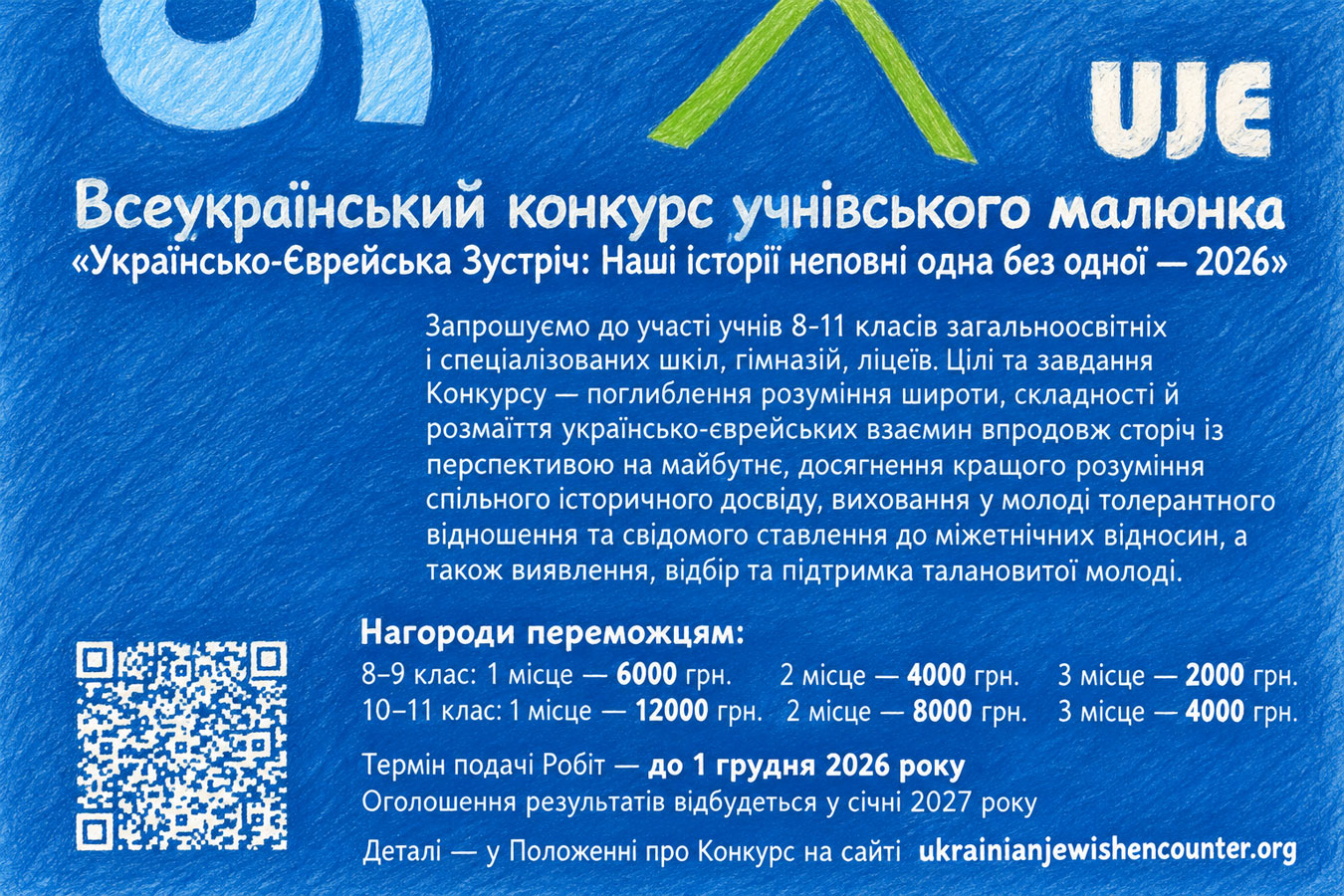
Ukrainian schoolchildren are invited to tell about the shared history of Ukrainians and Jews without an essay, exam, or pre-prepared ‘correct answer’ — with a single drawing. Until December 1, 2026, submissions are open for the All-Ukrainian competition ‘Ukrainian-Jewish Encounter: Our Stories Are Incomplete Without Each Other — 2026‘, with a maximum cash prize of 12,000 hryvnias — approximately ₪824.
Author: Pavel Shveiko
The competition itself started much earlier: Ukrainian Jewish Encounter announced it back on April 14, 2026, in September the project was separately presented to schoolchildren and teachers in Lviv, and the organizers plan to announce the results of the current competition in January 2027.
Behind the brief announcement lies a rather detailed provision. It specifies not only who can participate and how much the winners will receive, but also what the drawing should be like, where to send the original, and what will happen to the rights to the work after participation.
Not just ‘friendship of peoples’
The organizer of the competition is the public organization ‘Ukrainian-Jewish Encounter’ under the patronage of the Canadian non-governmental organization Ukrainian Jewish Encounter, or UJE.
For the Israeli reader, it is useful to immediately explain the context here. UJE is engaged in studying and popularizing the history of Ukrainian-Jewish relations, supports educational, research, and cultural projects, and works not only in Ukraine but also with representatives of Israel and the diaspora.
And the task of the current competition is formulated much more broadly than the proposal to draw a conditional menorah next to an embroidered shirt.
Schoolchildren are invited to delve into the centuries-old Ukrainian-Jewish relations — in their diversity and complexity, common historical experience, and how this history can be perceived today. Among the goals of the competition, the organizers also mention a more conscious attitude of youth towards interethnic relations.
Thus, the plot does not necessarily have to be a ceremonial picture of friendship. It can be a specific person, an old synagogue building, literature, family history, the Holocaust, religious tradition, or the history of one’s own city.
That is why the competition unexpectedly intersects with what NAnews reported literally the day before. In the Ukrainian part of Wiki Loves Monuments, a separate nomination ‘Jewish Heritage’ has been held for the ninth year in a row. Its list already includes more than 1,400 synagogues, cemeteries, public buildings, memorial sites, and other objects of Jewish and Karaite heritage in Ukraine.
For a schoolchild, one of these objects may well be not somewhere in a textbook, but on the next street.
Who can participate
The competition is aimed at students in grades 8–11 of general and specialized schools, gymnasiums, and lyceums. The condition is formulated so that children who study or studied in the relevant classes during 2026 can participate.
Works will be divided into two age categories — grades 8–9 and 10–11. In each, an international professional jury will determine the first, second, and third places.
But sending a picture by email will not work.
The organizers need a physical original of the drawing in A3 format. A frame is not required and, according to the provision, it should not be used. Pencils, oil, watercolor, acrylic, gouache, and other artistic techniques are allowed.
On the back, the author’s name and surname must be written. Along with the work, a completed paper questionnaire with personal data and a brief description of the drawing idea — in Ukrainian in printed letters — is enclosed in the package.
The drawing will have to be sent to Kyiv
The participant sends the original by courier delivery at their own expense to Kyiv — to Khreshchatyk, 29, office 50, to the organization ‘Ukrainian-Jewish Encounter’. The contact person in the official provision is Svetlana Grinevich.
There is one more requirement that is better checked in advance. The work must be new: it should not have participated in other competitions, been exhibited, or publicly demonstrated before.
After the competition ends, the drawings are not returned to the authors.
At first glance, these are technical details, but it is precisely on them that unpleasant surprises usually arise. If a child has already shown the work at a school exhibition or the family expects to get the original back later, the provision should be carefully read before sending the package.
Parents should pay attention to the rights to the work
There is also a more serious point in the document. By submitting a drawing to the competition, the participant accepts the conditions for processing personal data and the conditions regarding the rights to the competition work itself.
The wording of the provision provides for the transfer to the organizer of the material object and exclusive property rights to the competition work. For a minor author, it is especially reasonable to read this section together with parents before participating.
There is no need to turn a regular school competition into a legal thriller. But hiding such a condition behind the phrase ‘details on the organizer’s website’ would also be strange.
NAnews — News of Israel | Nikk.Agency usually pays attention to such details: sometimes a few lines of the official provision are more important to the participant than all the promotional text around the competition.
From 2000 to 12,000 hryvnias
In the junior group — students in grades 8–9 — the winner will receive 6000 UAH (about ₪412). The second place is awarded 4000 UAH (about ₪275), and the third — 2000 UAH (about ₪137).
For students in grades 10–11, the amounts are twice as high. First place — 12,000 UAH (about ₪824), second — 8000 UAH (about ₪549), third — 4000 UAH (about ₪275).
The conversion to shekels here is approximate, to make it easier for the Israeli reader to understand the size of the prize: the hryvnia exchange rate changes. In addition to money, winners are promised diplomas and thematic literature, and other participants — participant diplomas and books.
The last day for submitting works is December 1, 2026. Works sent after the deadline will not be accepted, and the organizers plan to announce the winners’ names in January 2027.
What last year’s winners drew
Last year’s results show that there is indeed no single correct interpretation of the theme for the jury.
In the category of grades 8–9, first place went to Yulia Oliynyk from Cherkasy with the drawing ‘Dialogue of Two Worlds: Sholem Aleichem and Ivan Franko’. For the Israeli reader, Ivan Franko may be a less familiar name: he is one of the greatest Ukrainian writers and public figures of the late 19th — early 20th century.
And Sholem Aleichem, born in the territory of present-day Ukraine, became one of the classics of Yiddish literature. His stories about Tevye the Dairyman later formed the basis of the famous ‘Fiddler on the Roof’.
Second place among the younger participants went to Anastasia Klopotovska from Zhytomyr with ‘Tree of Friendship’, and third to Oleksandra Kovtunovych from Zhytomyr with the work ‘Auschwitz — We Will Never Forget’.
Among the older schoolchildren, first place went to Oleksandra Radko from Poltava region with the drawing ‘Two Stories — One Language of Light’. The next were works ‘Love Unites Nations’ and ‘Friendship Forever’.
Thus, in one competition, Franko, Sholem Aleichem, Auschwitz, and an almost abstract conversation about the relations of two peoples were side by side. For a school project, the range is quite wide.
In Israel, this story may turn out to be a family one
Formally, the competition remains Ukrainian. There is no separate Israeli category in the provision, and it concerns students of Ukrainian schools.
But the historical geography of the competition does not end at the border of Ukraine.
For many families in Israel, Kyiv, Odesa, Berdychiv, Uman, Chernivtsi, Medzhybizh, Mukachevo, Belz, or hundreds of significantly smaller Ukrainian towns and villages are the cities of parents, grandparents, and great-grandparents. There were Jewish communities, schools, and synagogues, cemeteries, and sometimes houses still stand that are connected to the family history of today’s Israelis.
And not all of this heritage has been well preserved.
NAnews has already published a list compiled by the United Jewish Community of Ukraine of Jewish objects destroyed or damaged during the Russian aggression. It includes synagogues, schools, community buildings, cemeteries, and memorial sites — about 40 objects in different regions of the country.
Due to the war, the question ‘what will remain after us’ for Ukrainian Jewish heritage has ceased to be exclusively historical. An old photograph of a building now sometimes has to be used as evidence of what it was like before the Russian strike.
Sometimes it all starts with one street
The most interesting thing about such a competition may happen even before the drawing appears.
A child decides to depict an old building and begins to find out why it has such large windows. Learns that a hundred years ago there was a synagogue there. Then it turns out that a Jewish cemetery existed nearby, and in an old photograph of the central square, half of the signs are written in a language that almost no one hears in this city today.
Matzevah — a Jewish tombstone — is a fairly familiar word for the Israeli reader, while a Ukrainian schoolchild may learn it for the first time precisely in the process of such work. And vice versa: Ukrainian names, historical events, or local geography, obvious to a child in Ukraine, may require explanation to their peer in Israel.
In this sense, the common historical plot works both ways.
Babi Yar shows why one version of history is not enough
There is a topic where this conversation is especially visible. Babi Yar in Israel is primarily associated with the mass murder of Kyiv Jews by the Nazis in September 1941 and is one of the symbols of the Holocaust.
But in Ukraine, it is simultaneously the history of Kyiv itself, the people who lived nearby, the Soviet silencing of the Jewish component of the tragedy, and the long return of memory.
In September, NAnews reported how a new Ukrainian edition of Anatoly Kuznetsov’s documentary novel ‘Babi Yar’ was published in Kyiv. Kuznetsov experienced the occupation of Kyiv as a child, began recording what he saw and heard, and when the book first appeared in the USSR in 1966, the text underwent serious censorship interference.
Later, the writer managed to take the full version of the manuscript out of the Soviet Union.
This is perhaps a good example of why the formula ‘our stories are incomplete without each other’ is needed at all. Sometimes the problem is not the absence of facts, but that different societies have seen only separate pieces of the same past for decades.
From April 2026 to January 2027
The current competition Ukrainian Jewish Encounter officially announced on April 14, 2026. In September, it was separately presented in Lviv during the XXXIII BookForum, in the fall the organizers continued accepting works, and the deadline is set for December 1.
In January 2027, the names of six winners — three in each age group — should appear.
But the cash prize may not be the most interesting thing here.
To draw Sholem Aleichem, an old synagogue, the Holocaust, or the history of the Jews of their city, a schoolchild will first have to understand what exactly they are drawing. Find an old photograph, ask parents or a teacher, open a map, learn the name of a person who once lived in the neighboring house.
And somewhere in Israel, a person may see the name of this very city and remember that it was from there that their family once came.
Then the phrase ‘Our stories are incomplete without each other’ ceases to be the name of a school competition and begins to sound completely different.