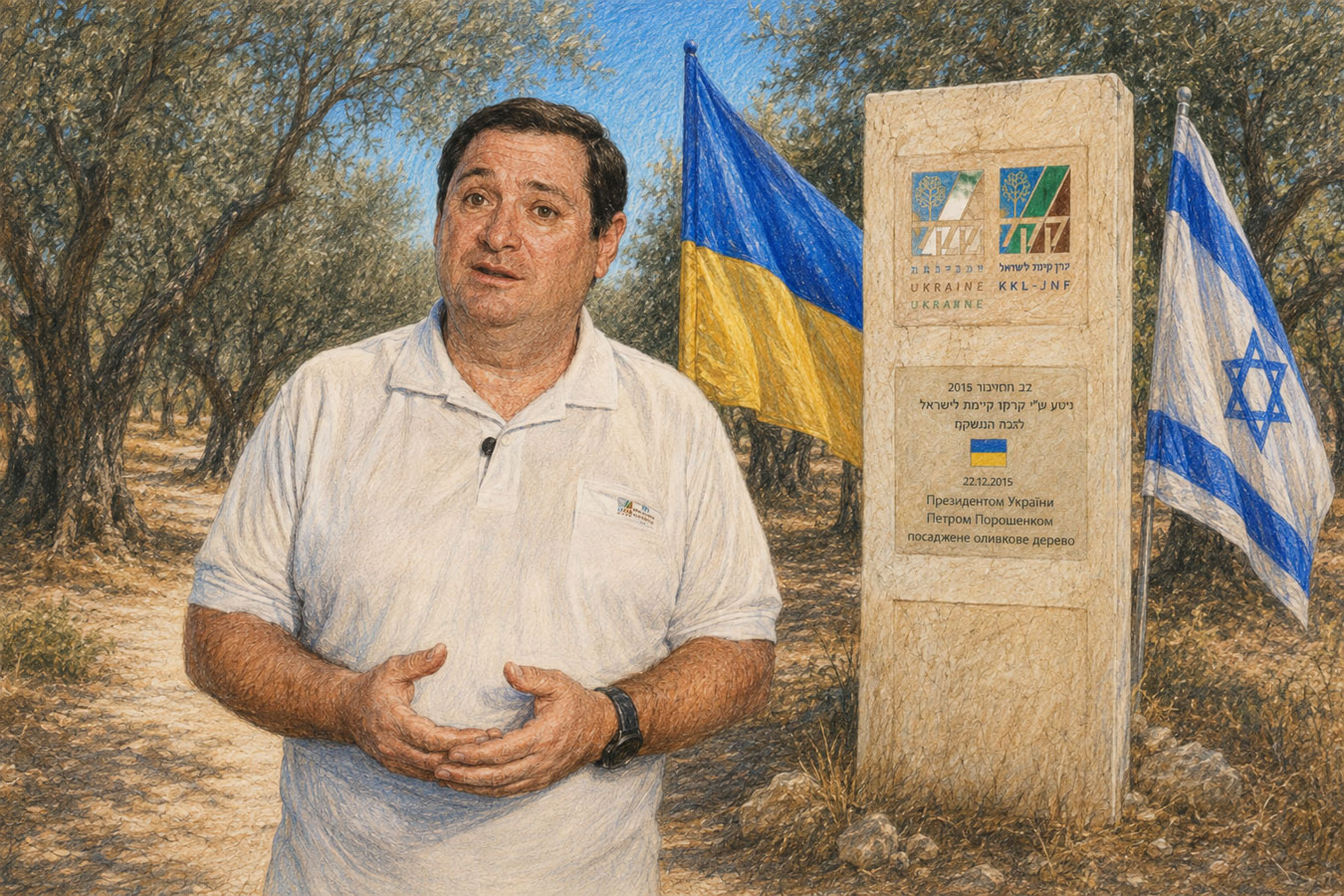
On August 23, 2026, the CEO of JNF-KKL Eurasia, Igal Yasinov, recorded a congratulatory message in Ukrainian to Ukraine from the ‘Ukraine’ forest in Israel’s Negev. I checked the history of this place—from the Odessa Grove of 2014 and Petro Poroshenko’s olive tree to the memorial stele, fires near Dorot, and the old Google Maps point by which the Ukrainian section can be searched today.
Author of NANews – Israel News: Pavel Shveyko
On August 23, 2026, on the eve of Ukraine’s Independence Day, the CEO of JNF-KKL Eurasia, Igal Yasinov, recorded an address to Ukrainians from the ‘Ukraine’ forest in the Negev. At first glance, it’s a few minutes of festive video. But the place chosen for the recording changes the meaning of the address: Yasinov stands among the trees of a project he was involved in more than ten years ago. The official website of JNF-KKL Eurasia still lists his position as the organization’s CEO.
“Look around, trees grow slowly, but they withstand storms.
This is exactly how Israel is. This is exactly how Ukraine is. This is exactly how people are, who continue to build the future even under shelling.
Today I congratulate the worthy Kharkiv, I congratulate Ukraine on Independence Day. I greet everyone who believes in freedom more strongly than the enemies believe in their weapons.
Eternal memory to those who gave their lives for freedom. Glory to the heroes defending Ukraine today. Glory to the heroes defending Israel today. Glory to Ukraine and glory to Israel.
Peace to our countries. And may the day come when our children know the sound of the wind in the trees better than the sound of sirens.
Friends, we are united. Victory to us!”
JNF-KKL is the Jewish National Fund, in Hebrew קרן קיימת לישראל, Keren Kayemet Le-Israel. The organization has existed since 1901; today its areas include forests and the environment, water, land development, education, tourism, and research projects. Therefore, the word ‘forest’ in this story is not a conditional name for a monument: it is indeed about a KKL project within the Dorot forest massif in the Sha’ar HaNegev Regional Council. KKL itself has called it both יער אוקראינה-דורות — ‘Ukraine-Dorot Forest’ and ‘Ukraine Grove’ within the Dorot forest at different times.
I was born and raised in Ukraine, and Israel became my new home.
Therefore, for NANews — Israel News, I decided not to limit myself to retelling the congratulation. I compared the transcript of the current video with KKL materials from 2015, 2017, and 2018, the ‘Ukrainians in Israel’ page about the planting on April 6, 2016, publications of the World Odessa Club about the events of 2014, and reports from Israeli media about the fires in the Dorot forest.
The biography of Yasinov himself also turned out to be part of this story: Kharkiv in his address is not a Ukrainian city chosen by an editor, but the place of his birth.
It is in such a comparison that details are discovered that are not in the short congratulation. For example, in December 2015, KKL planned to transfer the presidential olive tree to the Ukrainian forest for the upcoming Tu BiShvat, but the documented planting took place only on April 6, 2016. And the official KKL material from 2018 again tells about the transfer of one of the olives to Dorot. This is no longer a smooth anniversary chronicle, but a story where documents from different years have to be read side by side.
Why August 23 turned out to be no less important for a native of Kharkiv than the 24th
Yasinov’s address does not start with Kyiv or even Independence Day. He talks about Kharkiv: the city where he was born, where liberation from Nazi occupation was once celebrated, and which during the current war lives again under sirens and explosions. In the video transcript, it sounds: ‘August 23 for Kharkiv is not just a date.’ After this, Yasinov talks about the ability of Kharkiv residents to withstand ‘then’ and ‘now’.
The Israeli reader needs context here. August 23 in Kharkiv traditionally marks City Day and the day of liberation from Nazi occupation in 1943. Ukrainian official regional sources continue to associate this date with both events. At the same time, there is a separate historical discussion around the wording ‘liberation on August 23’: the fighting around the city did not end in one moment, so today Ukrainian historians discuss how accurately the Soviet calendar formula describes what happened on the ground. For Yasinov’s speech, something else is more important: for a person of his generation, this date has been part of Kharkiv’s memory for decades.
And on August 24, 1991, the Verkhovna Rada of the Ukrainian SSR adopted the Act of Declaration of Independence of Ukraine. This is not analogous to Israel’s Yom Ha’atzmaut in calendar logic—the two countries have completely different historical trajectories—but for an Israeli, the function of the holiday is clear: it is the main state day of modern Ukraine. In 2026, it marks 35 years since the adoption of the Act.
Therefore, the sequence in the address is not accidental: on August 23, Yasinov remembers his city, and then talks about the state. ‘And the next day Ukraine will celebrate Independence Day,’ he continues. In his speech, the holiday is immediately associated not with a parade or official protocol, but with the price of freedom during the war.
Former Knesset member from Kharkiv: who is Igal Yasinov
Igal Yasinov was born on April 27, 1966, in Kharkiv, then part of the Ukrainian SSR, and repatriated to Israel in 1993 from independent Ukraine. He is now 60 years old. In the current video, he says he has lived in Israel, ‘in Holy Jerusalem,’ for more than 33 years, and draws a personal conclusion from this: Kharkiv and Jerusalem are closer to each other today than they seem on the map.
Before his current work at KKL, Yasinov went through Israeli parliamentary politics. In the elections on January 28, 2003, the secular party ‘Shinui’ received 15 mandates; Yasinov was fifteenth on its list and entered the 16th Knesset. For a reader who does not remember the political map of Israel in the early 2000s: ‘Shinui’ was a secular middle-class party that advocated, among other things, for limiting religious pressure on civil life. Yasinov himself spoke about ecology, student rights, reservists, and workers’ rights in interviews before the elections.
In the Knesset, he also dealt with aliyah issues. Here the word aliyah means the repatriation of Jews to Israel based on the Law of Return. On the current official KKL page, among Yasinov’s previous positions, chairmanship in the structure supporting scientist-repatriates is indicated; he was also part of the leadership of the organization of teacher-repatriates. Therefore, working with immigrants from the former USSR appeared in his biography long before his current position at JNF-KKL Eurasia.
His political career ended quite unusually. On February 1, 2006, Yasinov left ‘Shinui’ and created the ‘Ha-Olim’ faction—the name can be translated as ‘Repatriates’. During the same period, it merged into the ‘National Unity — Our Home Israel’ bloc, after which ‘Our Home Israel’ separated into an independent parliamentary faction. The official Knesset database maintains this sequence by dates.
After parliamentary politics, his work became increasingly connected with KKL. Over the years, he held leadership positions in the fund, and today the official structure of JNF-KKL Eurasia calls him the CEO. Therefore, the phrase from the current video ‘I had the honor of leading its creation’ about the ‘Ukraine’ forest, I decided to verify not as a beautiful memory of a former politician, but by the documents of the time itself.
From the Odessa Grove to 1200 dunams: how the Ukrainian forest appeared in the Negev
The first trace leads to April 2014, and this is important: the official ‘Ukraine Forest’ project took shape later, but Ukrainian trees appeared in this place earlier. On April 23, during the international OdessAviv festival, the creation of the Odessa Grove began in the north of the Negev, designed for about a thousand trees. Publications of the World Odessa Club and ‘Evening Odessa’ of that time directly call it the beginning of the future Ukrainian forest.
It is here that a direct connection with Yasinov appears.
The World Odessa Club wrote that the decision to lay the Ukraine forest was made at the initiative of the former Kharkiv resident Igal Yasinov, who headed the relevant direction of the fund, and the Odessa Grove became the first stage. The head of the Israeli branch of the club, documentary filmmaker Boris Sobolev, insisted on the grove project and, according to the club itself and the Odessa press, paid for the planting of a thousand trees. This allows us to draw an important line: Sobolev’s funding of the Odessa Grove is documented, but I found no basis to attribute to him the funding of the entire future ‘Ukraine Forest’.
The first olive tree was planted in honor of Mikhail Zhvanetsky. The ceremony was attended by Yasinov, Sobolev, and a representative of the World Odessa Club, Arkady Kreimer; there also appeared a tree on behalf of Odessa and a tree in memory of Boris Litvak, an Odessa philanthropist, creator of the famous Children’s Rehabilitation Center ‘House with an Angel’. In one of the reports of that time, an almost everyday detail was preserved: when Yasinov was asked what connection he himself had to Odessa, he replied that his grandmother Sofia Mostovaya was an opera singer there.
Why Odessa became the first city within the Ukrainian project is explained not only by the activity of the modern Odessa community. In today’s video, Yasinov also mentions two other people. In Odessa, Yona Krementsky was born, elected as the first head of KKL after the fund’s creation in 1901; KKL writes that he led it until 1907 and was one of the people who turned the idea of a national fund into a practical organization.
There, too, was born Ze’ev Jabotinsky, one of the most influential Zionist leaders of the 20th century, founder of Revisionist Zionism and the BETAR movement. For the Israeli reader, Jabotinsky is well known from the streets, parks, and political history of the country; the connection of the first head of KKL with Odessa is much less known.
But it is important not to confuse causes and later explanations. Sources from 2014 show the direct role of the World Odessa Club and Sobolev in the appearance of the grove. The historical link with Krementsky and Jabotinsky is real, but I did not find a 2014 document in which it is named as the reason for the choice of name. In the current address, Yasinov adds this historical layer twelve years later.
In December 2015, the scale becomes different.
The official JNF-KKL already writes about the ‘Ukraine Forest’ with an area of 1200 dunams in the Sha’ar HaNegev Regional Council. For an Israeli, a dunam is a familiar unit of area; 1200 dunams correspond to about 120 hectares, and it was the figure of 120 hectares that Ukrainian reports on the project cited. In publications from the Ukrainian side of those years, it was called the first forest in Israel dedicated to another state.
On December 22, 2015, the President of Ukraine Petro Poroshenko planted an olive tree during an official visit in the Grove of Nations of the Jerusalem Forest. This is another object, in Jerusalem, and should not be confused with Dorot. At the same time, Poroshenko planted an additional seedling in a special vessel; the official KKL reported that later the Ukrainian ambassador Gennady Nadolenko was to plant it in the יער אוקראינה-דורות, the ‘Ukraine-Dorot’ forest in Sha’ar HaNegev.
Here begins the first small mystery of chronology.
KKL in December 2015 wrote that Nadolenko would plant this seedling on the nearest Tu BiShvat—the Jewish New Year of Trees, when plantings are traditionally held in Israel. However, the source ‘Ukrainians in Israel‘ records the ceremony only on April 6, 2016. Tu BiShvat had already passed by that time. This means the original calendar changed, although the reasons for the postponement are not explained in the available publications.
On April 6, Nadolenko transplanted the presidential olive into the ground, and the staff of the Ukrainian embassy planted the first seedlings nearby, which became part of the ‘Ukraine Forest’. Yasinov then reported that by Ukraine’s Independence Day, it was planned to install a board with the forest’s name. A small post already stood at the presidential tree, which they planned to mark on Google Maps so that, as Yasinov said, anyone could find ‘a piece of Ukraine on Israeli soil’.
It turns out to be a rare opportunity to see the project not in hindsight. In 2014, participants only talked about the future Ukrainian forest. In December 2015, KKL already names the area and official location. In April 2016, embassy staff indeed stand there with seedlings, and Yasinov promises to put the name on the map. In August 2026, he is again among these trees—only now they do not need to be imagined as a plan.
Poroshenko’s olive, the Ukrainian language, and the fire in Dorot: the story after the first planting
The Ukrainian line of KKL continued beyond Dorot. On May 15, 2017, Ukrainian Prime Minister Volodymyr Groysman planted an olive tree in the Grove of Nations in Jerusalem. Yasinov led the ceremony and separately explained why it was held in Ukrainian: KKL wanted to show respect for the Ukrainian state and remind of the first head of the fund, Yona Krementsky, born in Odessa. This is an important detail—the Ukrainian language was used by KKL in an official ceremony long before the current congratulation.
The next documented date of the forest itself is October 29, 2018. The official JNF-KKL reported a ceremony in southern Israel in the Dorot forest and for the first time clearly formulated the project’s structure: ‘part of the Dorot forest massif is a specially planted grove bearing the name of Ukraine’. Therefore, arguing whether this is a ‘forest’ or a ‘grove’ is essentially pointless. The name ‘Ukraine Forest’ became attached to the project, and territorially the Ukrainian memorial part is located within the larger Dorot forest.
On that day, a memorial stele was unveiled at the site of the established olive tree associated with Poroshenko’s visit. Ambassador Gennady Nadolenko, staff of the Ukrainian embassy, representatives of KKL, the public, and the media were present. And here appears the second discrepancy between archival texts, which I would not cover up for the sake of a beautiful chronology.
The 2016 source directly states that Nadolenko already transplanted Poroshenko’s olive into the ground on April 6, 2016. KKL in the 2018 material formulates the story differently: it was decided to transplant one of the two olive trees planted by the president in Jerusalem in 2015 into the Ukrainian grove, after which it talks about the stele at the site where the tree took root. From the available texts, it is unclear whether it was about a second relocation of the tree within the project, about the other of the two olives, or just an inaccurate retrospective formulation by KKL. Therefore, the two dates—2016 and 2018—are better left as two documented stages, rather than inventing a missing explanation between them.
Another phrase from the current address also had to be checked separately. Yasinov says: ‘This forest also came under fire, but it withstood and continues to grow’. I did not find reliable confirmation of a direct rocket hit specifically in the Ukrainian grove after October 7, 2023, so such a conclusion cannot be made on behalf of the editorial office.
But the Dorot forest did indeed burn as a result of attacks from the Gaza Strip. In July 2018, Israeli media reported fires caused by incendiary balloons and kites; on July 30-31, a fire broke out in the Dorot Forest in the Sha’ar HaNegev Regional Council. The fires were extinguished by firefighters, KKL staff, and aviation. Thus, a forest massif affected by attacks, of which the Ukrainian grove is a part, is documented; a separate hit directly on the Ukrainian stele or presidential olive is not documented.
For NANews — Israel News, this distinction is fundamental. The speaker’s phrase remains part of his address, while the fact we verified has narrower boundaries. As soon as these two things are mixed, the symbolic story begins to replace the documentary one.
Where the ‘Ukraine’ forest is located and how to find the Ukrainian grove yourself
The most practical part of this story has been preserved thanks to publications from April 2016. When Yasinov said that Poroshenko’s tree would appear on Google Maps, the Ukrainian embassy indeed provided a link to a point near the Ukrainian section. The old ZN UA publication preserved the message about the link itself; the coordinates of the historical point are 31.5215, 34.6711.
Here it is on Google Maps – https://maps.app.goo.gl/cTrRY59ii1andyEQ7
You should orient yourself to Dorot Forest — יער דורות, in the Sha’ar HaNegev Regional Council — מועצה אזורית שער הנגב, near Kibbutz Dorot. A regional council is an Israeli form of local government that unites several small settlements, mainly kibbutzim and moshavim; it is not a separate city. The area is located in the western part of the northern Negev, near Sderot and the Gaza Strip.
If the navigator does not understand ‘Ukraine forest in Israel’, it does not mean the object has disappeared. We tried searching for יער אוקראינה-דורות, then יער דורות, and for the memorial point itself, we entered the coordinates 31.5215, 34.6711. The last option is more reliable than the old name because small groves and memorial sites of KKL are not always displayed the same way in Google Maps and Waze.
That is why queries like ‘where is the Ukraine forest in Israel’, ‘Ukraine Dorot forest’, ‘how to get to the Ukraine forest in the Negev’, and the Hebrew יער אוקראינה-דורות can lead to materials that at first glance contradict each other. On the KKL 2015 page, the name ‘Ukraine-Dorot Forest’ appears, in 2016 Ukrainian sources simply talk about the ‘Ukraine Forest’, and in 2018 KKL itself clarifies that it is a Ukrainian grove within the Dorot forest massif. This is one location with historically formed name variants, not three different Ukrainian forests.
For a car trip, it is more reasonable to first build a route to Dorot / יער דורות, and the last kilometers — already to the historical point of the Ukrainian section. The area is connected to the regional road 334, passing near Dorot. We would not promise that an ordinary passenger car can always drive right up to the stele: we did not find a separate modern KKL tourist page describing the approach specifically to the Ukrainian grove.
We also checked the current KKL page with warnings for travelers on August 23, 2026. It lists a number of closures and restrictions in the southern forests, but there is no separate notification of the Dorot forest closure at the time of verification. This should still not be perceived as an indefinite guarantee: Sha’ar HaNegev is located near the Gaza Strip, so before the trip, it is necessary to recheck KKL messages and current Home Front Command instructions.
‘Kharkiv and Jerusalem are closer than they appear on the map’: what remained behind the festive congratulation
The most political part of the three-minute video begins after the personal story. Yasinov says that Ukrainians and Israelis know what an air raid alert is, waiting for news from loved ones on the front, night explosions, and the need to lead children to shelter. For an Israeli, this experience does not need to be translated into the language of abstractions: it is about the same minutes when the family goes to the mamad—a protected room in the apartment—or to a public shelter.
Then he says: ‘The same Iranian and Russian weapons in the hands of terrorists bring death’. After it, Yasinov puts Kharkiv, Jerusalem, Kyiv, Be’er Sheva, Sumy, and Tel Aviv in one row.
But the connection itself did not come out of nowhere. Russia and Iran have become military partners over the years of wars, and since 2022, Ukraine regularly faces Iranian-origin strike drones used by Russian forces. Israel, for its part, directly encounters Iranian weapons, technologies, and Tehran-supported armed structures. That Yasinov connects these two realities in one address is already the political content of the congratulation, which is lost if only the phrase ‘congratulated Ukrainians on the holiday’ is left from the video.
Equally important is where these words are spoken from.
Yasinov did not just come to a Ukrainian KKL event. In 2014, his name appears near the Odessa Grove and the idea of the future Ukrainian forest. In 2015, he participates in Poroshenko’s ceremony. In 2016, he explains how to find the new section on Google. In 2017, he conducts a ceremony with Prime Minister Groysman in Ukrainian. In 2026, he returns to this same plot already as the CEO of JNF-KKL Eurasia. This is a sequence that cannot be seen in the shortest video.
At the end of the address, Yasinov talks about trees: they grow slowly, withstand storms, and continue to grow. Then he wishes that children someday know the sound of the wind in the trees better than the sound of sirens.
After checking the archives, this phrase is perceived not as an independent metaphor. The first trees of the Odessa Grove were planted in April 2014; the official history of the large Ukrainian project continued in 2015-2016; in 2018, a stele appeared near the olive, and the Dorot forest in the same period indeed burned after incendiary attacks from Gaza. Therefore, the address on August 23, 2026, can be dated to one day, but the history of the place from which it was recorded is already more than twelve years.
Here is the ‘Ukraine’ forest on Google Maps – https://maps.app.goo.gl/cTrRY59ii1andyEQ7