
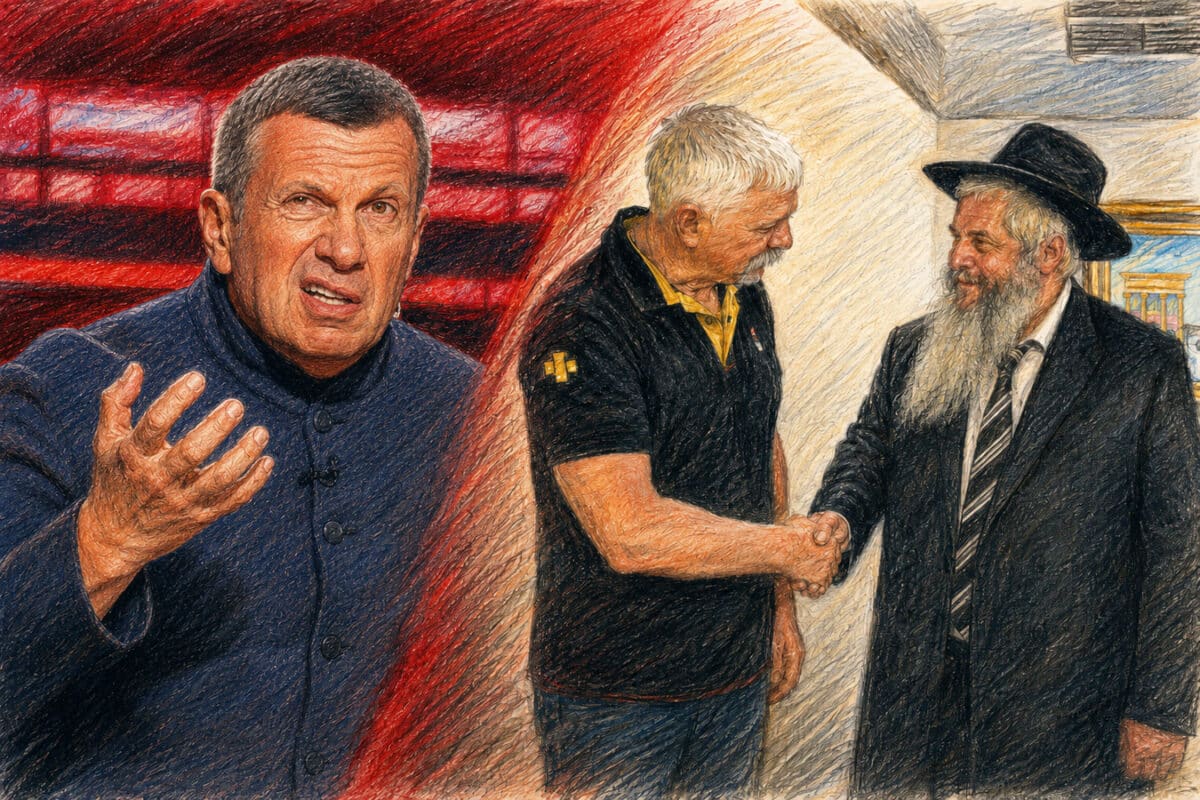
Russian “court” propagandist Vladimir Solovyov on the air of the program “Evening with Vladimir Solovyov” on June 30, 2026, attacked the Chief Rabbi of Ukraine Moshe Asman after his meeting with Dmitry Korchinsky.
At first glance, Solovyov tried to talk about the memory of the Holocaust, about the six million murdered Jews, about the painful pages of Ukrainian-Jewish history, and about the slogan “Glory to Ukraine.”
But this is only the outer shell.
In fact, the Holocaust in this fragment was used not for memory, not for mourning, and not for an honest conversation about the tragedy of the Jews.
It was inserted as a tool of attack.
Solovyov took the heaviest theme of Jewish history and turned it into a moral club to hit Moshe Asman, to question his rabbinical status, his Jewishness, and his right to speak on behalf of the community.
This is not a dispute about the Holocaust.
This is the use of the Holocaust to attempt public humiliation of the Chief Rabbi of Ukraine.
How the attack was constructed
The occasion was Moshe Asman’s meeting with Dmitry Korchinsky in the synagogue.
In the published fragment, Asman thanks Korchinsky for the visit, says that the conflict around the statement of the Israeli embassy has been resolved, and calls what happened a misunderstanding.
Korchinsky, for his part, claims that the Israeli embassy was “misled” and explains that “Nazi aesthetics are not the aesthetics of brotherhood.” According to him, for Ukraine, the two greatest calamities of the 20th century were communism and Nazism, and both these ideologies are repugnant to him.
This could have been the subject of a difficult conversation.
It could have been discussed how appropriate the meeting was.
It could have been debated whether Asman acted correctly when he tried to defuse the conflict around the statement of the Israeli embassy.
It could have been separately discussed about Korchinsky, his political biography, the perception of Ukrainian slogans in the Jewish community, the memory of the Holocaust, and how Ukrainian-Israeli relations should take into account historical pain.
But Solovyov chose not to have a conversation.
He chose humiliation.
First, he stated that he “looks at what is happening with horror” and that after the war, according to him, “it may come to Jewish pogroms in Ukraine.”
Then he moved on to a crude sexualized insult to Asman, claiming that he allegedly “licks Korchinsky,” and then used an even more obscene phrase.
After this, Solovyov made the main propagandist move: he led to a personal insult through the memory of the Holocaust.
He stated:
“A person who represents 6 million murdered shakes hands with the heir of scoundrels who glorify those who killed Jews and repeats the slogan under which we, Jews, were killed. So how, as a Jew, should I relate to this fat pig?”
Then he added:
“Does he consider himself a rabbi? A beard does not make a goat a rabbi. Does he consider himself a Jew? He betrayed the Jewish people, as Zelensky did.”
In the end, he used another crude Yiddish expression — drek mit fefer, literally “shit with pepper.”
In this context, it sounded not like a joke or a language game, but as a continuation of one line: to try to deprive the rabbi of dignity, to try to publicly humiliate him and show the audience that he can not only be criticized but “despised.”
This is how propaganda works: first, a sacred and painful topic is taken, then through it, a moral right to hatred is created, and then this right is used for personal reprisal.
In this case, the Holocaust did not become a subject of memory.
It became a tool of attack.
Whom exactly Solovyov tried to humiliate
Moshe Reuven Asman is not a random commentator and not a person who accidentally found himself in the Jewish theme.
He was born in Leningrad in 1966, participated in the refusenik movement, and in 1987 received permission to leave the USSR for Israel. The official biography of the Office of the Chief Rabbi of Ukraine states that in Israel, Asman received rabbinical ordination, worked with Russian-speaking Jews, voluntarily served in the IDF, and since 1990 has supported Israeli soldiers during wars.
In 1995, Asman moved to Kyiv and began to restore Jewish life around the Brodsky Synagogue, which in Soviet times had been turned into a puppet theater. There he participated in the revival of the community, the creation of charitable infrastructure, Jewish education, assistance to those in need, medical and community support.
During the Russian war against Ukraine, Asman remained in the country.
He is engaged in humanitarian aid, evacuation, support of Jewish communities, and publicly speaks out against Russian aggression.
Asman calls Russian statements about the “denazification” of Ukraine a lie and says that Russian propaganda uses the Jewish theme to justify the war and emphasizes that Ukraine today is fighting not only for itself but also for Europe and the civilized world.
Asman is a citizen of Israel and Ukraine.
For the Israeli audience, this is fundamental.
Solovyov attacked not an abstract “Ukrainian rabbi,” but a person with a real Israeli biography, aliyah, service in the IDF, and many years of work for the Jewish community of Ukraine.
Against this background, Solovyov himself is especially indicative.
In October 2023, after the Hamas attack on Israel, he stated on the air:
“I want it to be very clear: I am a Jew, but not an Israeli. That is, I have no favorites except my homeland. My homeland is Russia.”
Solovyov himself separated his Jewish identity from Israeli responsibility.
He himself said: he is a Jew, but not an Israeli.
His homeland is Russia.
Open sources do not provide confirmed information about Solovyov having an Israeli passport.
Especially when he publicly attacks a person who has Israeli citizenship, Ukrainian citizenship, served in the IDF, and has been connected to Jewish life in Ukraine for many years.
Solovyov is not the voice of Jewry, but the voice of Putin’s propaganda
The main mistake is to perceive this episode as an “internal Jewish dispute.”
This is not a rabbinical discussion.
Not a dispute among Israelis about memory.
Not an honest conversation about the Holocaust.
This is an attack by a Russian state propagandist on a Jewish religious leader who openly opposes the Russian war and helps Ukraine.
Solovyov has long been one of the most recognizable faces of Kremlin propaganda.
He was included in sanctions lists after the start of the big war against Ukraine. OpenSanctions describes him as a propagandist and host of the Russia-1 and Rossiya 24 channels, and European sanctions documents link him to Russian state propaganda.
The Ukrainian project War & Sanctions indicates that Solovyov systematically spreads Kremlin narratives, supports aggression against Ukraine, and uses the media platform to justify the Russian war. It also cites his own rhetoric with threats and support for the destruction of Ukrainian cities.
Therefore, when Solovyov speaks about Asman, he does not speak as an independent Jewish commentator.
He speaks as an accomplice of Putin’s war.
As a person embedded in a system that justifies strikes on Ukrainian cities, the destruction of Ukrainian statehood, and the killing of civilians.
And it is this person who tries to teach the Chief Rabbi of Ukraine what Jewish memory is.
Why the Holocaust was used as a weapon here
The most important thing in this fragment is not only the rudeness.
And not even just the words “fat pig,” “goat,” “betrayed the Jewish people.”
The main thing is the way Solovyov leads to these words.
He does not just scold Asman.
He first inserts the Holocaust.
Talks about six million murdered.
Talks about those who killed Jews.
Talks about the slogan under which, according to his version, “we, Jews, were killed.”
And only after that does he utter the insult.
This is done not by chance.
The Holocaust is needed by him as moral cover.
He kind of tells the viewer: after such a topic, anything is possible.
You can insult.
You can humiliate.
You can deprive the rabbi of dignity.
You can question his Jewishness.
You can call him a traitor.
This is what makes the episode especially dangerous.
The memory of the Holocaust is used not to protect Jews.
It is used to attack a Jew.
Jewish tragedy is used not for a conversation about dignity.
It is used to destroy the dignity of a living rabbi.
Solovyov does not protect six million murdered when he calls the rabbi a “fat pig.”
He uses their memory as a stage trick.
As a political tool.
As a propaganda club.
What Jewish tradition says about this
In Jewish tradition, public humiliation of a rabbi is not ordinary rudeness.
There is the concept of מבזה תלמיד חכם — humiliating a Torah scholar.
A rabbi is not just a person with a personal opinion.
He is a bearer of religious knowledge, a representative of the community, and a person whose status is associated with respect for the Torah.
The commandment “stand up before the gray head and honor the face of the old man” from Vayikra / Leviticus 19:32 in Talmudic tradition refers not only to an elderly person. Tractate Kiddushin 32b explains this also as an obligation to respect חכם — a sage, a person who has acquired the wisdom of the Torah.
The Torah also prohibits verbal humiliation.
In Vayikra / Leviticus 19:14 it is said: “Do not curse the deaf.”
In traditional understanding, this is not only a literal prohibition to curse a person who cannot hear, but also a broader prohibition to use words as a weapon of humiliation.
In Vayikra / Leviticus 19:17 it is said: “Do not hate your brother in your heart; rebuke your neighbor and do not bear sin because of him.”
Here the word rebuke is important.
Jewish tradition does not prohibit debate.
It is possible to criticize a rabbi.
It is possible to disagree with his meeting.
It is possible to say that he made a mistake.
It is possible to ask him tough questions.
But reproach should not turn into the sin of hatred, shame, and insult.
This is exactly what Solovyov did.
He did not limit himself to criticizing the act.
He attempted to destroy the human and religious dignity of Asman.
Calling a rabbi a ‘fat pig’—especially in a Jewish context—means consciously choosing the most humiliating image. In Jewish culture, a pig is associated not just with a common insult, but with impurity and a demonstrative violation of the boundaries of kashrut.
Calling a rabbi a ‘goat’ and saying that ‘a beard does not make a goat a rabbi’ means publicly mocking the very religious form.
Saying that he ‘betrayed the Jewish people’ means attempting to deprive him not only of authority but also of belonging.
This is not how the memory of the Holocaust is protected.
This is how the memory of the Holocaust is used as a weapon against a living Jew and rabbi.
Punishment in tradition
The Talmudic tradition regards the humiliation of a Torah sage as a serious violation.
In the discussion of Sanhedrin 99b, a person who humiliates a Torah sage is associated with the category אפיקורוס—epikoros, that is, one who demonstratively undermines respect for the Torah and its bearers.
The tradition also has the concept of niduy—a social-religious excommunication that could be applied for disrespecting a Torah sage.
Its purpose is not revenge, but the restoration of boundaries: a person must understand the gravity of public humiliation, repent, and ask forgiveness from the one they insulted.
From this point of view, Solovyov’s words are not a ‘tough broadcast.’
This is public humiliation of a rabbi and a Torah sage.
Why this is important for Israel
NANews — Israel News | Nikk.Agency considers this episode precisely in the Israeli and Jewish context.
The problem is not only that Solovyov insulted Moshe Asman.
The problem is that a Russian propagandist, serving Putin’s war against Ukraine, tried to claim the right to speak on behalf of the Holocaust, Jewish memory, and the Jewish people.
He inserted the Holocaust not for memory, but for pressure.
Inserted six million killed not for mourning, but for an accusatory blow.
Inserted Jewish identity not for the protection of Jews, but to publicly humiliate another Jew.
This is how propaganda works: it takes sacred themes and turns them into a club.
But Jewish memory is not a club for the henchmen of Putin’s war.
The Holocaust cannot be used as a cover for insulting a rabbi.
Judaism cannot be turned into a license to humiliate another Jew.
And respect for the six million killed does not begin with the words ‘fat pig’ addressed to the living chief rabbi of Ukraine.
The story of Solovyov’s attack on Moshe Asman is not a private conflict and not another episode of rough Russian broadcasting.
It is an example of how Putin’s propaganda tries to appropriate Jewish memory, use the Holocaust against Ukraine, and simultaneously destroy the basic Jewish norm—respect for a person, a rabbi, a community, and the Torah.
That is why this episode is important for Israel.
Because it is not just about Asman.
It is about who has the right to speak on behalf of Jewish memory—and who turns it into a tool of Russian war.
Not the voice of a Jew, but the voice of Russian broadcasting
Solovyov is one of the most famous hosts of Russian state television. His program airs on the channel ‘Russia-1’, and he himself, after the start of the full-scale war against Ukraine, came under international sanctions. In the European Union’s sanction documents, he is described as a propagandist and host of the channels Russia-1 and Rossiya 24, responsible for supporting actions undermining the territorial integrity and independence of Ukraine.
The European Union included Solovyov in the sanctions lists on February 23, 2022, that is, a day before the start of Russia’s full-scale invasion of Ukraine.
After this, properties associated with him on Lake Como in Italy were seized. Russian and international media reported that these were villas worth about 8 million euros.
This context is important not to discuss Solovyov’s real estate separately from the topic of Asman. It is important because it shows: this is not about a neutral commentator on the Jewish theme, but about a person who is embedded in the Russian state propaganda system and has been serving its political line for many years.
Therefore, when Solovyov speaks about Israel, the Holocaust, Ukraine, or the Jewish people, this cannot be perceived separately from his main political framework: Russia is his homeland, the Russian agenda is his main loyalty, and the Jewish theme becomes an instrument of this agenda.
