
On July 17, 2026, the conference “To Live and Return with Memory. Krymchaks: Yesterday and Today” will be held at ANU — Museum of the Jewish People in Tel Aviv.
This event is dedicated to the history, culture, memory, and modernity of the Krymchaks — one of the smallest Jewish communities in the world and one of the indigenous peoples of Ukraine, formed on the territory of the Crimean Peninsula.
For the Israeli audience, this topic is important in several dimensions. It is Jewish history. It is the history of Crimea. It is a Ukrainian theme. And it is a conversation about a people who survived almost complete annihilation during the Nazi years, Soviet pressure, dispersion, loss of language, and yet retained the right to speak about themselves in their own voice.
Conference in Tel Aviv: when and where
The conference will take place on July 17, 2026, from 10:00 to 14:00 at ANU — Museum of the Jewish People.
The organizers are ANU — Museum of the Jewish People, the Association of Krymchaks of Israel, the Nadav Foundation, and the Euro-Asian Jewish Congress.
The event is timed to the fifth anniversary of the Association of Krymchaks of Israel.
The program includes presentations by researchers, a presentation of a new book, a discussion on the future of the Krymchak community, and a museum tour.
Participation is possible by prior registration.
Registration and details:
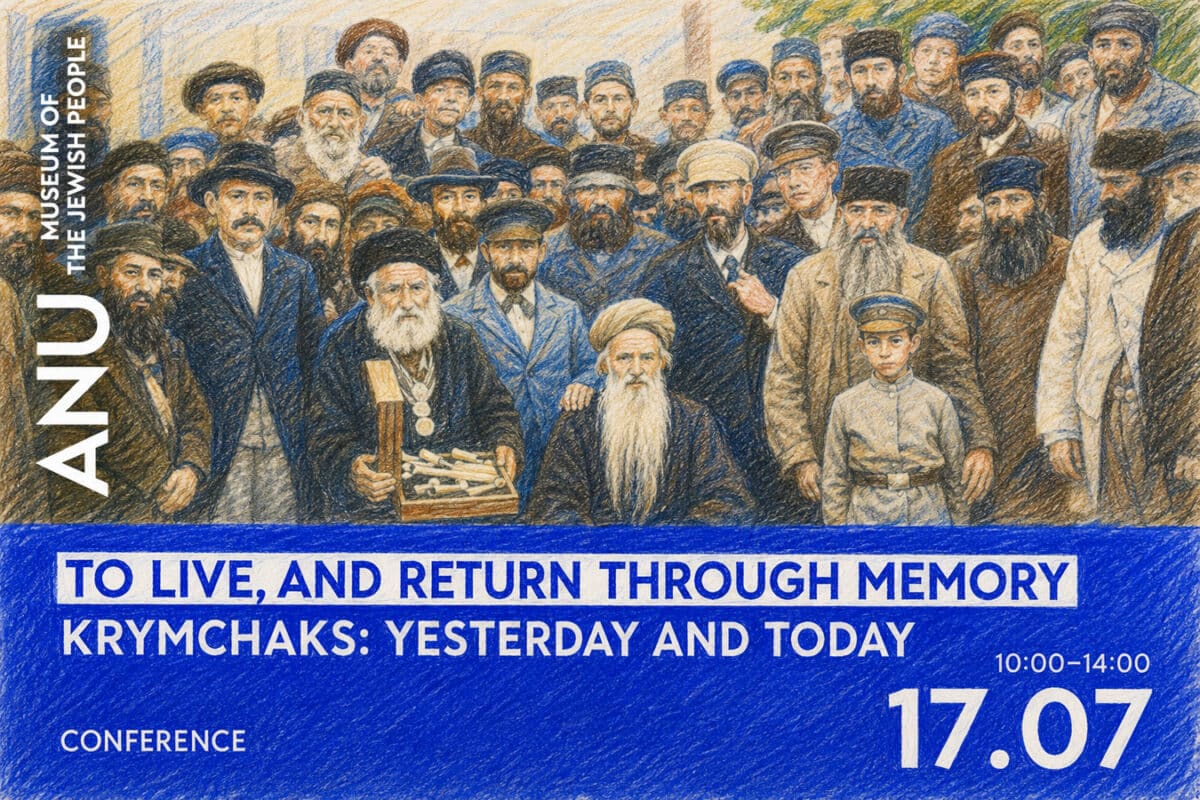
Krymchaks — the indigenous people of Ukraine and the Jewish community of Crimea
Krymchaks are a Jewish ethnolinguistic community historically formed in Crimea. They had their own religious and communal tradition, a unique language, family culture, and a memory of generations connected with Crimean cities and settlements.
But to speak of Krymchaks only as a “small Jewish community” is insufficient.
In the Ukrainian legal field, Krymchaks have a special status. The Law of Ukraine “On Indigenous Peoples of Ukraine” No. 1616-IX, adopted by the Verkhovna Rada on July 1, 2021, directly refers to the Crimean Tatars, Karaites, and Krymchaks as indigenous peoples of Ukraine.
This is a fundamentally important formulation.
The law defines an indigenous people of Ukraine as an autochthonous ethnic community that formed on the territory of Ukraine, has a distinctive language and culture, traditional, social, cultural, or representative bodies, recognizes itself as an indigenous people of Ukraine, is an ethnic minority within the country’s population, and does not have its own state formation outside Ukraine.
Krymchaks fully fit into this framework. Their historical homeland is Crimea. They have no other state that could be their national center. Therefore, preserving Krymchak memory, language, archives, family histories, and communal identity is not only a cultural issue but also a matter of protecting an indigenous people.
Why the law is important right now
After the Russian occupation of Crimea, the topic of the indigenous peoples of the peninsula became not only historical but also political, legal, and humanitarian.
Crimea is not an empty geographical point on the map and not an abstract territory for international negotiations. It is a land where peoples with their own history, language, religion, cemeteries, archives, family memory, and the right to their own name have lived for centuries.
Crimean Tatars, Karaites, and Krymchaks have gone through history differently, but they all share one thing: they formed precisely in Crimea and are connected to it not as visiting groups but as indigenous peoples of the peninsula.
For Ukraine, recognizing Krymchaks as an indigenous people is a way to legally and symbolically fix what Russian imperial and Soviet policy often tried to erase: Crimea has a multilayered history, and in this history, there is a Jewish Krymchak voice.
For Israel, this topic is also not external. Krymchaks are part of the Jewish world, but not in the usual large Ashkenazi or Sephardic framework. It is a small, unique community that has remained on the periphery of public attention for too long.
The Krymchak language and the 2026 law: why it is important for the future of the community
In 2026, the topic of Krymchaks received another important dimension — linguistic and legal.
On June 12, 2026, Ukrainian President Volodymyr Zelensky signed law No. 4699-IX, which updated Ukrainian legislation in connection with the new official translation of the European Charter for Regional or Minority Languages. This document is important not only as part of Ukraine’s language policy but also as a direct signal for small peoples and communities whose languages are under threat of extinction.
The essence of the law is not in the formal replacement of terms. Ukraine clarified the list of languages to which the provisions of the Charter apply and removed the Russian language as the language of the aggressor state. At the same time, the regime of support and special protection has been preserved and expanded for the languages of indigenous peoples and national communities of Ukraine.
For Krymchaks, it is fundamentally important that the Krymchak language is included in the updated list. Along with it, the Charter in Ukraine applies to Belarusian, Bulgarian, Gagauz, Hebrew, Yiddish, Karaim, Crimean Tatar, German, Neo-Greek, Polish, Romani, Rumeic, Romanian, Slovak, Hungarian, Urum, and Czech languages.
This is especially important in the context of Krymchaks.
The Krymchak language is not just a means of communication. It is part of the memory of a people formed in Crimea. Through language, family stories, religious and everyday traditions, place names, oral tales, intonations of older generations, and the very ability of the community to speak about themselves in their own words are preserved.
When the language of a small community disappears, not only vocabulary is lost. A whole way of remembering oneself disappears.
Therefore, the 2026 law should be considered together with another important Ukrainian decision — the recognition of Krymchaks as an indigenous people of Ukraine. In this linkage, a fundamental logic emerges: Krymchaks are recognized as an indigenous people of Crimea, and the Krymchak language is included in the updated system of protection for regional or minority languages.
For Ukraine, this is a confirmation that Crimea is not only a territory and not only a matter of international politics. It is the land of indigenous peoples, among whom is the Jewish Krymchak community.
For Israel, this is also an important signal. Krymchaks are part of the Jewish world, but their history does not fit into the usual large frameworks. It is a small community whose language, memory, and cultural tradition need protection no less than archives, books, and commemorative dates.
That is why the conference at ANU — Museum of the Jewish People is important not only as a cultural event. It takes place at a time when Krymchaks can be discussed on several levels: as a Jewish community of Crimea, as an indigenous people of Ukraine, and as a people whose language has received a separate place in the updated Ukrainian system of protection for linguistic heritage.
What will be in the conference program
The opening of the conference will be conducted by Rabbi Binyamin Minich.
Mikhail Gurdzhi will present the topic “Krymchaks Yesterday and Today” — with a book presentation and an illustrated historical overview of the community’s history.
Professor Shimon Yakerson will give a lecture on Jewish manuscripts of Crimea.
Dr. Velvl Chernin will talk about the process of de-Judaization of the Krymchak community in the late Soviet period.
Professor Zeev Khanin will present the topic of non-Ashkenazi communities of the former USSR in the countries of origin and diaspora.
The program also includes a video message from the head of the Krymchak community of Crimea, Maxim Volkov / Achkinazi, a panel discussion “Krymchak Community: Are There Prospects for Development?” and a tour of the ANU museum.
Not only the past but also the question of the future
The main question of such meetings is not only what happened before.
It is important to understand what will happen next.
Does the Krymchak community have the opportunity to preserve itself in Israel, Ukraine, and the diaspora? Can the younger generation be passed on the memory of the language, tradition, families, communal institutions, and the tragedy of the 20th century? How to ensure that Krymchaks do not remain only a topic for archives and narrow scientific conferences?
The panel discussion “Krymchak Community: Are There Prospects for Development?” precisely brings the conversation from the past to the present.
Because it is not only about memory. It is about the right of a people to continue to exist as a recognizable community, and not to dissolve into larger historical categories.
Why this is important for Israel, Ukraine, and the Jewish world
The history of Krymchaks shows how vulnerable small peoples and small Jewish communities can be.
When a community is small, it is harder to preserve the language. Harder to keep archives. Harder to pass on family memory to children. Harder to ensure that its tragedy does not disappear within larger historical themes.
That is why the conference at ANU is important not only for the descendants of Krymchaks. It is important for everyone who understands: Jewish history consists not only of large centers, famous rabbis, large communities, and famous names.
It also consists of small peoples, family stories, manuscripts, cemeteries, photographs, prayers, songs, and testimonies that can be lost in just one or two generations.
For Ukraine, Krymchaks are part of the history of Crimea and one of the indigenous peoples recognized by law.
For Israel, it is part of Jewish memory that requires more attention.
For the Jewish world, it is a reminder that preserving small communities is not a secondary task, but part of the overall responsibility for historical truth.
Crimea is not only geopolitics
Today, when Crimea remains at the center of war, occupation, and international politics, it is especially important to remember: Crimea is not only a territory.
It is a place where different peoples have lived for centuries.
It is a place where a special Jewish history existed.
It is a place where Krymchaks formed as a community, as a people, and as part of the Jewish world.
Therefore, the conversation about Krymchaks in Tel Aviv is not a narrow cultural poster. It is a conversation about memory, rights, identity, and responsibility.
The conference “To Live and Return with Memory. Krymchaks: Yesterday and Today” at ANU becomes an important event precisely because it brings Krymchaks back into the public space — not as a footnote in history, but as a living community with a past, present, and a question about the future.
NANovosti — News of Israel will continue to follow topics that connect Israel, Ukraine, Jewish communities, the history of Crimea, and the memory of indigenous peoples.
Briefly about the event
What: conference “To Live and Return with Memory. Krymchaks: Yesterday and Today”
When: July 17, 2026, 10:00–14:00
Where: ANU — Museum of the Jewish People, Tel Aviv
Topic: history, culture, memory, legal status, and future of the Krymchak community
Participation: by prior registration
Cost: 55 ₪
Registration and details:
NANovosti material on Krymchaks and Jews of Crimea:
11 декабря в Украине отмечается День памяти крымчаков и евреев Крыма — жертв нацизма
