
On November 7, 2026, the United States Central Command (CENTCOM) announced the creation of a special group Task Force Iron Gate — “Iron Gate.” Its task is to disrupt the supply of weapons, military technologies, and sanctioned goods to Iran through land borders and the Caspian Sea.
Author: Alexander Khmelnitsky
The Caspian direction in this announcement deserves special attention. It is here that the transport corridor between Russia and Iran passes, which has been used for military shipments for several years. Initially, Iranian weapons were delivered to the Russian army for the war against Ukraine. Now investigations by Western journalists point to reverse supplies — from Russia to Iran.
The connection of the new American initiative with the Ukrainian war is not mentioned in the official goal of the project. However, documents on shipments, EU sanction decisions, and the history of Iranian drone production in Russia help understand why the American decision goes far beyond the relations between Washington and Tehran.
What exactly are the Americans creating
By order of CENTCOM Commander Admiral Brad Cooper, a group of about 20 military and civilian specialists is being formed in Tampa, Florida.
It will interact with other American agencies to identify and limit the supply of modern weapons, dual-use technologies, and materials subject to sanctions. A separate direction is illegal financial flows that allow Iran to pay for foreign purchases.
According to Cooper, the task is to complicate the restoration of Iranian weapons factories and the replenishment of military stocks.
The American command claims that the existing naval blockade has already prevented Iran from exporting oil worth more than $25 billion — approximately 80 billion shekels. This is a CENTCOM estimate, which Reuters could not independently confirm.
However, the Caspian Sea is a completely different geographical situation.
Unlike the Persian Gulf, American warships cannot freely enter this closed water area. Its shores belong to Russia, Iran, Azerbaijan, Kazakhstan, and Turkmenistan.
Therefore, “Iron Gate” cannot yet be called a military blockade of the Caspian. It is about interagency work against shipments, intermediaries, and financial mechanisms that ensure Iranian military purchases. The deployment of American forces on Iran’s land borders has also not been announced.
The Caspian route has long been known as a channel for military supplies
On November 18, 2024, the Council of the European Union imposed restrictions related to the use of Caspian ports and ships for transporting Iranian weapons to Russia.
The sanctions list included Russian shipping companies MG Flot, VTS Broker, and Arapax. According to the EU’s official statement, their ships were involved in transporting Iranian weapons, ammunition, and drone components through the Caspian to supply Russian troops in Ukraine.
The restrictions also affected the Iranian state shipping company IRISL, as well as operations related to the use of Amirabad and Bandar Anzali ports.
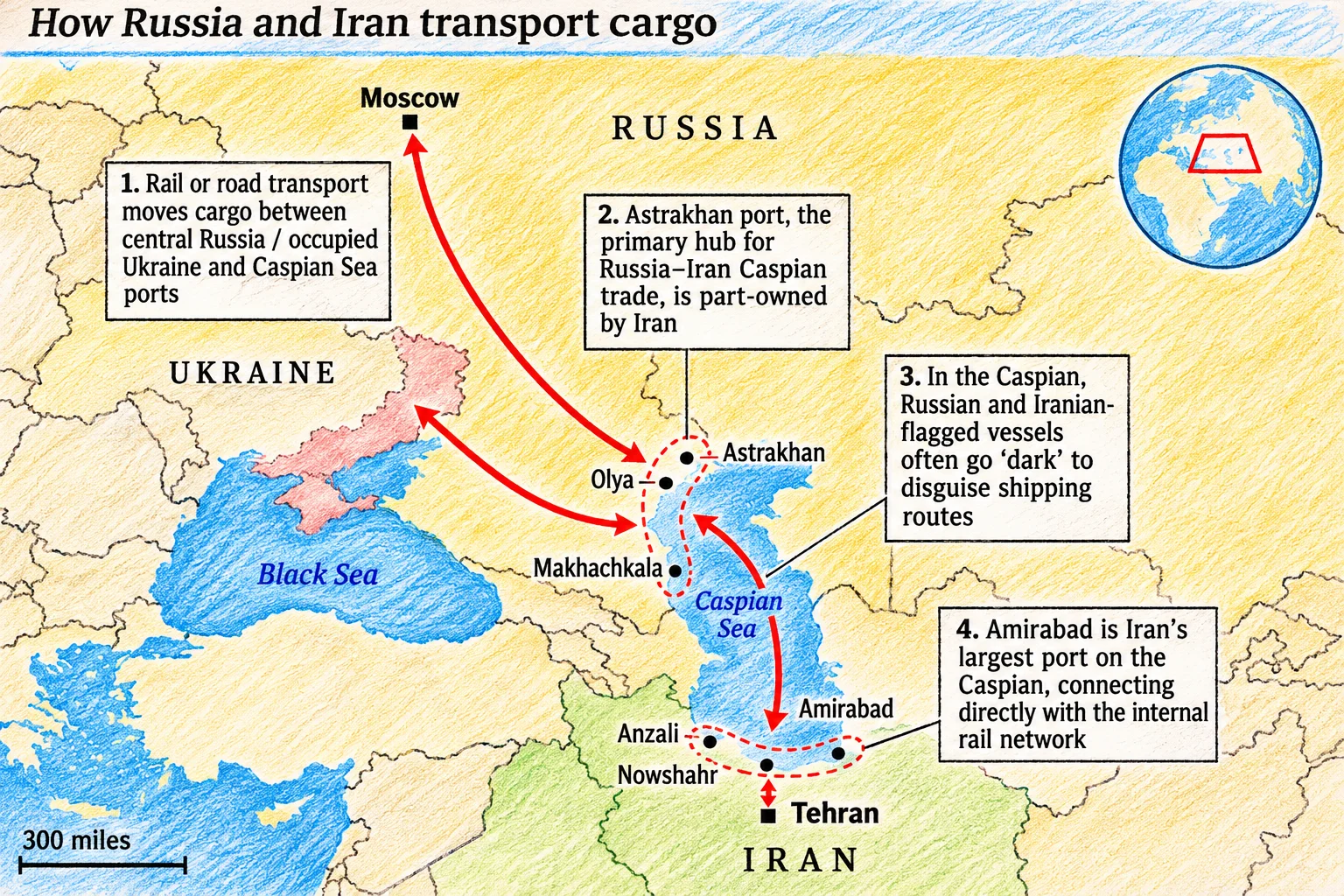
The geography of the route is quite simple. Russian ports Astrakhan, Olya, and Makhachkala are connected by sea transport with northern Iran. At the same time, the Caspian is part of a larger international transport corridor “North-South,” which Moscow is developing for trade with Iran and other Asian countries.
A significant part of the cargo here is completely civilian: grain, food, metals, equipment. Therefore, the entry of a Russian ship into an Iranian port does not in itself indicate military shipments.
But EU sanction documents show that military supplies along this route have already been established.
And the importance of the corridor continues to grow. According to Lloyd’s List, published on October 1, 2026, the number of active ships under Russian and Iranian flags in the Caspian in August increased by 21% compared to August of the previous year. Cargo capacity on the Russian-Iranian route increased by 36%.
This statistic applies to all trade, not just weapons. However, it shows how actively the direction is used, which has now come under the attention of the US.
Russia supplied Iran with detonators, and Tehran’s military network purchased equipment worth billions
On October 29, Reuters published an investigation prepared jointly with the Israeli-American analytical company 240 Analytics.
Journalists studied banking documents, customs records, corporate registries, and transport data. They identified more than 5,000 structures associated with the Iranian Ministry of Defense and Armed Forces.
These organizations use the designation MOD and numerical identifiers. Through foreign intermediaries, they purchase equipment, explosives, industrial components, and transport that can be used in military programs.
One of the structures, MOD 346428, imported goods worth $2.3 billion — about 7.3 billion shekels from January 2025 to June 2026.
The documents mention chemicals for rocket fuel production, aircraft engine parts, industrial equipment, and heavy trucks suitable for conversion into mobile missile launchers.
Especially significant are the discovered supplies from Russia.
Since the beginning of 2025, Reuters has identified five shipments of Russian detonators with a total value of $7.6 million — approximately 24.2 million shekels. The last identified shipment worth $1.9 million, or about 6.1 million shekels, arrived in June 2026.
Such devices can be used to initiate explosives, including in warheads of missiles and drones.
At the same time, the investigation does not allow us to assert that every imported component has already been used in specific Iranian weapons. Some goods fall into the dual-use category, and information about the origin of individual cargoes is based on customs declarations.
Nevertheless, the documents indicate the continuation of large-scale purchases even after the start of the American-Israeli war against Iran on February 28, 2026.
Sahara Thunder: direct connection with Russian ‘Shaheds’
For Ukraine, the most significant part of the Reuters investigation is related to the company Sahara Thunder.
Journalists found that it was among the end recipients of goods purchased through the Iranian military network.
The name of this company is already known from American sanction documents.
On April 25, 2024, the US Department of the Treasury reported that Sahara Thunder played an important role in organizing the production and supply of Iranian strike drones to Russia.
The same report mentioned the cooperation of the Iranian Ministry of Defense with the Russian special economic zone “Alabuga.” The contract value for the production of drones of Iranian design amounted to $1.75 billion — approximately 5.6 billion shekels.
We are talking about the Shahed family, which the Russian army uses for attacks against Ukrainian cities, energy infrastructure, and other targets. Over time, Russia mastered its own serial production of modified drones.
Therefore, it cannot be asserted that blocking Iranian supplies will automatically stop Russian air attacks.
But the connection discovered by Reuters between Sahara Thunder and the MOD network is important for another reason. It shows that the structure involved in the development of Russian strike drone production was simultaneously included in the Iranian military procurement system.
Russian-Iranian cooperation is not limited to the transfer of ready-made weapons. It involves equipment, components, production technologies, and the organization of supplies.
There is also new evidence of this cooperation.
On November 5, 2026, The Guardian published information from documents of the Russian defense enterprise “Vympel.” They indicate plans to supply Iran with 90 launchers for guided LMUR missiles used on combat helicopters.
The documents mention contract K-10 and a delivery schedule until December 2025. However, journalists were unable to confirm that all the launchers were indeed transferred to Tehran.
This is another example of how important it is to distinguish between discovered plans, confirmed shipments, and the actual use of weapons.
Israel and Ukraine have already struck at Caspian logistics facilities
For Israeli readers, the new American initiative has a very specific background.
On March 18, 2026, the Israeli Air Force attacked Iranian naval facilities in Bandar Anzali on the Caspian Sea. The IDF reported the destruction of ships, boats, and elements of naval infrastructure.
Later, The Wall Street Journal, citing informed sources, reported that the operation also affected the route of Russian supplies to Iran.
NANews thoroughly analyzed this strike and its significance for Moscow-Tehran cooperation. Then Israel, for the first time during the current war, attacked Iranian military facilities in the Caspian region.
On July 25, a Ukrainian operation followed.
Ukrainian President Volodymyr Zelensky announced strikes on a Russian military ship and vessels that, according to the Ukrainian side, were used for transporting military cargo related to Iran.
The SBU named among the targets the cargo ships Port Olya 2 and Begey. The exact composition of the cargo on board and the extent of the damage could not be independently established.
Tehran reported the defeat of an Iranian commercial ship and the death of a sailor. In August, Iranian representative Mohsen Rezaei stated that Iran was considering strikes on three targets in Ukraine. His claims were also considered in a separate NANews article.
As a result, the Caspian route was linked to military actions by several states.
Israel tried to weaken Iran’s military capabilities. Ukraine acted against logistics it considered part of the supply of the Russian army. Now the US is creating a structure to counter Iranian supplies through the same region.
There is no confirmation that these operations are parts of a single coordinated plan.
What “Iron Gate” can change for Russia, Ukraine, and Israel
The American project is being created simultaneously with the continuation of negotiations on the Iranian nuclear program and the conditions for ending the conflict.
On November 7, Qatar’s Prime Minister Mohammed bin Abdulrahman Al Thani confirmed the continuation of mediation between Washington and Tehran. Iran demands the easing of the blockade, lifting of sanctions, and unblocking of foreign funds. The US insists on including the nuclear issue in the negotiations.
In such a situation, “Iron Gate” can serve not only as a mechanism for controlling supplies but also as an additional means of pressure on Tehran.
For Russia, the consequences will depend on which shipments and settlement schemes fall under restrictions. If Washington manages to identify intermediaries, block payments, and complicate the delivery of military components, Russian-Iranian cooperation may become more expensive and complicated.
However, there is a limitation here: the American group does not automatically receive the right to detain any ships in the Caspian or stop cargo on the territory of neighboring states.
For Ukraine, something else is important. The more difficult it is for Russia and Iran to exchange weapons and technologies, the harder it is for them to maintain joint military programs. But Russia already produces its own strike drones, so the effect of new restrictions cannot be measured by simply reducing supplies from Tehran.
For Israel, the key question is whether the new American mechanism can slow down the restoration of Iranian missile and drone capabilities. These programs pose a direct threat to Israeli territory and allied military facilities in the region.
The history of the Caspian is not over yet. NANews has already written about Russian supplies of explosives, ammunition, and drone components to Iran. Now there is additional documentary evidence of the financial and procurement system that helps Tehran bypass restrictions.
“Iron Gate” has not yet blocked the Russian-Iranian corridor. But the US has officially included the Caspian Sea in the list of directions where they intend to prevent Iran’s military supplies.
The next indicator of the project’s effectiveness will not be new CENTCOM statements, but specific sanctions, identified supply chains, restrictions against intermediaries, and documented disruptions in the delivery of military goods.
Their consequences will be significant not only for Israel’s security but also for the ongoing war of Russia against Ukraine.
Add NANews to Google to follow our investigations and analytical materials on events linking Israel, Ukraine, and international security.
