
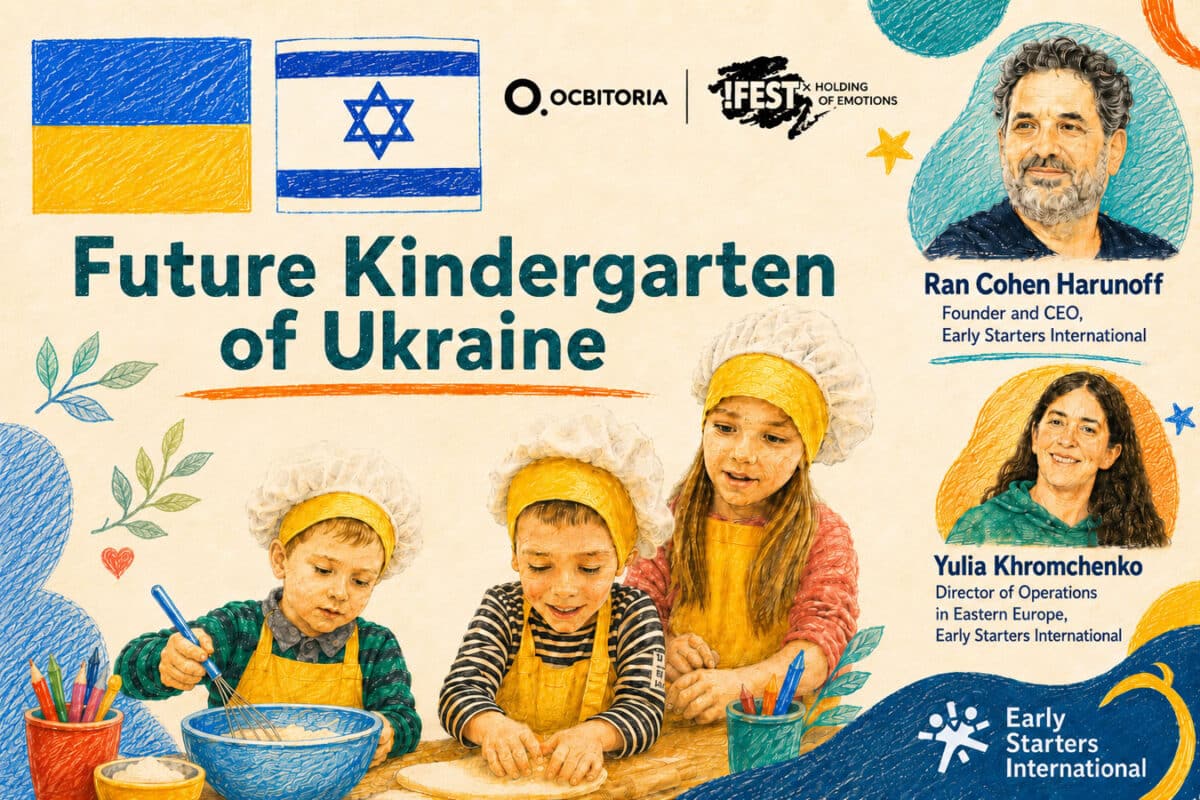
In Ukraine, against the backdrop of a full-scale war, a new model of preschool education is developing — “The Kindergarten of the Future of Ukraine”.
This is not just another humanitarian project or a beautiful pedagogical presentation for a conference. It is an attempt to change the very approach to early childhood in a country where millions of children already know what sirens, shelters, evacuation, loss of home, separation from loved ones, and living in a state of constant uncertainty mean.
The model was presented in Lviv as part of Teachers of the Future 2026 (Ukr. – “Вчителі майбутнього“)— one of the largest educational festivals in Ukraine. The event took place on June 18–19, 2026, gathering over 2500 educators, school leaders, educational managers, and speakers from different countries, with its main theme being “The Art of Shaping the Future”.
The uniqueness of the project lies in its creation by Ukrainian educators in collaboration with the Israeli organization Early Starters International. The Israeli experience here is important not as a formal sign of international support, but as a practical school for working with children growing up in conditions of anxiety, threat, and crisis.
Lviv, Teachers of the Future, and the presentation of the new model
The Teachers of the Future 2026 festival in Lviv became a platform where discussions were not only about school reform, digital tools, or teacher training. The focus was on a broader topic: how education can shape the future of a country living in wartime.
The festival was organized by “Освіторія” and Holding emotions “!FEST”. Among the event’s partners were mentioned Lviv City Council and Early Starters, which is important for understanding the connection between the city, Ukrainian educational structures, and the Israeli organization.
Among the top speakers announced at the Teachers of the Future 2026 festival were:
Zoya Litvin — head of the public union “Освіторія”, founder of Novopecherska School.
Oksen Lisovyi — Minister of Education and Science of Ukraine.
Svyatoslav Vakarchuk — musician, leader of the band “Okean Elzy”, public figure.
Volodymyr Mykolayenko — former mayor of Kherson.
Svitlana Tarabarova — singer, composer, songwriter, music producer.
Nadiya Kuzmychova — Deputy Minister of Education and Science of Ukraine.
Gintaras Steponavicius — former Minister of Education and Science of Lithuania, director of Cormack Consultancy Group.
Tetyana Vakulenko — director of the Ukrainian Center for Educational Quality Assessment.
Liliya Hrynevych — Minister of Education and Science of Ukraine from 2016 to 2019.
Kateryna Goltsberg — child and family psychologist.
Ruslan Hurak — head of the State Service for Education Quality of Ukraine.
Dr. Richard Gerver — author, expert on curiosity, change, and human-centered leadership.
Ran Cohen Harunov — founder and CEO of Early Starters International.
Yulia Khromchenko — Director of Operations in Eastern Europe for the international organization Early Starters International.
Jussi Kainulainen — Senior Technical Advisor Learning2gether2.
Arri Pokka — Executive Director of Finnish Education Institute Ltd.
Natalia Kadya — expert in neuroleadership, behavioral economics, and organizational transformations.
Arsen Makarchuk — head of the State Statistics Service of Ukraine.
It was in this context that the model “The Kindergarten of the Future of Ukraine” was presented.
It is more accurate to call Teachers of the Future not a conference, but an educational festival. Ukrainian sources use the term educational festival / освітній фестиваль, emphasizing the scale of the event: over 200 events, thousands of participants, and a discussion about the future of Ukrainian education not in theory, but in wartime conditions.
For Ukraine, this is fundamental. When the country defends itself against Russian aggression, the issue of kindergarten may seem secondary only at first glance. In fact, it is the preschool age that determines how a child will trust the world, build relationships, cope with fear, learn independence, and perceive themselves not as a victim of circumstances, but as a person who has a choice.
Why Ukraine needs a new kindergarten
Before the war, kindergarten was a familiar part of life for many families: daily routine, educator, games, preparation for school, communication with peers. After 2022, this system came under attack.
Some kindergartens were destroyed or damaged. Some children moved to other cities or countries. Many families live between anxieties, power outages, loss of work, relatives serving on the front line, and constant news waiting. For a small child, such a reality is not explained by political words. They simply feel instability, adult fear, the rupture of the familiar world, and the absence of a normal routine.
UNICEF noted that since the start of the full-scale invasion, the number of children attending preschool institutions in Ukraine decreased by 25% compared to 2021. As of April 2025, more than 157,000 children could not attend kindergartens in person.
That is why the issue of preschool education in Ukraine has become part of national recovery.
It’s not just about opening the doors of kindergartens after repairs. It’s important to understand what a kindergarten should be like for a child who has heard sirens, gone down to shelters, seen parental anxiety, moved from city to city, or lost a sense of security.
The answer of the new model is not to strengthen control and discipline, but to give the child more resilience, independence, self-trust, and experience of safe interaction with others.
What changes in the model itself
“The Kindergarten of the Future of Ukraine” contrasts with the old post-Soviet logic of preschool education.
In this old system, the adult was often the main source of order: the educator speaks — the children do. Everyone performs the same task. Everyone should come to a similar result. A good child is one who obeys, does not interfere, does not argue, and does not go beyond the limits.
The new model offers a different approach.
The child becomes not a passive performer, but an active participant in the educational process. They can choose materials, propose ideas, explore topics of interest, participate in joint projects, ask questions, and learn to negotiate with other children.
This does not mean chaos or lack of rules. On the contrary, such a system requires more professionalism from the educator. The adult does not disappear, but their role changes: they do not just command, but create an environment where the child learns to think, choose, try, make mistakes, and return to the task again.
Even everyday actions become part of education.
Children learn to dress themselves, serve their own food, participate in organizing the space, help each other, and make simple decisions from an early age. For an adult, this may seem trivial. For a child, it is the first experience of responsibility for themselves and participation in communal life.
The Maariv article listed the key skills on which the model is built: curiosity, creativity, communication, collaboration, empathy, coordination, ability to cope with changes, ability to choose and make decisions.
In a peaceful country, such skills are often called skills of the future.
In Ukraine during the war, they become skills of survival, recovery, and maturation.
Israeli connection: who are Early Starters International
Israeli organization Early Starters International works in the field of early childhood and preschool education. In the organization’s open description, it is stated that it uses Israeli experience in creating educational programs for young children, develops methods that help children solve problems, collaborate, create, become independent and resilient.
Participants:
Ran Cohen Harunoff
Founder and CEO of Early Starters International
Yulia Khromchenko
Director of Operations in Eastern Europe at the international organization Early Starters International
This is an important clarification: the Israeli connection here is not reduced to a one-time consultation or a humanitarian photo for a report.
After the start of the full-scale war, Early Starters worked with Ukrainian children and families, creating safe spaces, helping to maintain routine, emotional support, creative activity, and access to early education for children. The organization describes itself as an educational humanitarian structure that helps young children in emergencies.
For the Israeli reader, this is especially understandable.
Israel has lived for many years in a reality where children know what anxiety, protected spaces, and the need to quickly switch from fear to normal life and back are. In the Ukrainian case, the scale is different: a vast territory, destroyed cities, millions of displaced people, constant Russian attacks on civilian infrastructure. But the pedagogical question is similar: how to preserve childhood for a child if the world around is no longer safe?
This is where the meaning of Israeli-Ukrainian cooperation arises.
Israel does not “teach Ukraine how to live,” and Ukraine does not simply copy a foreign model. Ukrainian educators, local authorities, and Israeli specialists together seek a form of kindergarten that suits children growing up in the Ukrainian military reality.
Lviv, Dnipro, and the memorandum on the future of kindergartens
The Future Kindergarten of Ukraine project is confirmed in the materials of Early Starters International itself.
The organization’s publication states that Early Starters International, Early Starters Ukraine, and the Department of Education of the Lviv City Council signed a memorandum of understanding to promote the Future Kindergarten of Ukraine. The project is described as a step towards safe, human-centered, creative, and sustainable preschool education even in conditions of uncertainty.
In the same context, Lviv and Dnipro are mentioned. This is important: it is not just about one pilot site, but about a model that is beginning to extend beyond one city.
According to Maariv, the first pilot of the “Kindergarten of the Future of Ukraine” started in Lviv in 2024 and covered 15 city clusters of kindergartens. After that, the project began to expand to Dnipro, where the model is being implemented in another 17 clusters of kindergartens.
These figures are important to attribute specifically to Maariv, because in the open materials of the Ministry of Education of Ukraine, UNICEF, and Early Starters, the project itself, the connection with Lviv and Dnipro, the memorandum, and the participation of the Israeli organization are publicly confirmed, but the exact data on 15 and 17 clusters are currently visible specifically in the publication of the Israeli media.
For the article, this is not a weakness, but normal editorial accuracy.
It is honest to write: “according to Maariv” — and then provide the figures.
The major reform of preschool education in Ukraine
The story of “The Kindergarten of the Future of Ukraine” does not hang in the air. It coincides with a broader transformation of preschool education in Ukraine.
In May 2025, UNICEF announced a new strategic framework for the development of early childhood education in Ukraine. This work is related to the First Steps Forward initiative, which involves the Ministry of Education and Science of Ukraine, UNICEF, the Government of Finland, the World Bank, the European Union, UNESCO, and other partners.
In December 2025, the Ministry of Education and Science of Ukraine announced that the World Bank is allocating 30 million dollars for the development of preschool education as part of First Steps Forward. The Ministry called this initiative the first national program that places early childhood at the center of a comprehensive transformation of the sector.
These funds are intended to support not only the repair of buildings. It is about re-equipping and opening hundreds of preschool education locations, creating safe spaces, equipping shelters, training educators, and supporting communities.
In March 2026, the Ministry of Education of Ukraine also announced that the European Commission is allocating more than 25 million euros for the creation of safe, accessible, and modern spaces in preschool education institutions. These funds should go towards safety, modernization, dual-purpose shelters, kindergarten repairs, barrier-free access, and new spaces for learning, play, and development.
Thus, Ukraine is trying to solve two tasks at once.
The first is physical safety: buildings, shelters, accessibility, infrastructure restoration.
The second is the content of education: what exactly happens with the child inside the kindergarten, how they are spoken to, what they learn, how they cope with stress, how their ability to trust themselves and others is formed.
“The Kindergarten of the Future of Ukraine” relates specifically to the second task, but without the first, it is impossible. One cannot talk about freedom of choice and creativity if the child does not have a safe space. But walls alone are not enough if the old system of fear, command, and passive submission remains inside.
What Early Starters says: children of war will become adults in twenty years
One of the most important meanings of the project was formulated by Yulia Khromchenko, Vice President for Knowledge and Innovation at Early Starters International.
According to her, when children grow up in war, the question is not only how to protect them today. The question is also what kind of adults they will become in twenty years.
This thought most accurately explains why preschool education during the war cannot be considered a secondary topic.
If a child grows up only in a mode of prohibitions, fear, and silent submission, the war continues to work inside them even when the specific anxiety is over. If, however, the child gains experience of choice, empathy, cooperation, play, exploration, and safe independence, they gain an internal support.
This does not cancel the trauma.
But it helps the child not to become only a product of trauma.
That is why the model pays so much attention not only to knowledge but also to skills: curiosity, creativity, communication, empathy, the ability to make decisions, and cope with changes.
For the generation of Ukrainian children, these are not “soft skills” from presentations. This is the foundation of future life.
Why this is important for Israel
For the Israeli audience, this story is important for several reasons.
Firstly, it shows another side of the connection between Israel and Ukraine. Usually, diplomacy, weapons, security, sanctions, refugees, government positions, or international votes are in the spotlight. All this is important, but there is a deeper level — working with children, educators, families, and the future generation.
Secondly, Israel itself understands well that war strikes not only at buildings and infrastructure. It strikes at the child’s sense of security. At the ability to fall asleep peacefully. At trust in the world. At the confidence that tomorrow will be like today.
That is why Israeli experience in early childhood, safe spaces, and crisis pedagogy can be useful to Ukraine.
Thirdly, this is a story about soft power, which is often underestimated. Helping children does not look as loud as military news or diplomatic scandals. But it is in kindergartens that a generation is formed that will build Ukraine in twenty years, raise their children, make decisions, work in communities, schools, universities, business, and the state.
For НАновости — Новости Израиля | Nikk.Agency, this topic is also important because it shows that the Israeli-Ukrainian connection exists not only at the level of political statements. It is there where specialists from two countries together think about how to help children not lose their future in the midst of war.
From Soviet heritage to European logic of education
The Ukrainian reform of preschool education has another important meaning — breaking with the Soviet heritage.
The Soviet model often perceived the child as an object of upbringing: they need to be built, accustomed, prepared, integrated into the system. Individuality, choice, emotional state, and the child’s right to their own pace were usually secondary.
The modern European logic of early education is built differently.
The child is considered an active participant in the process. The environment should help them develop, not just obey. The educator should see not a “group of children,” but different children with different needs, paces, fears, interests, and ways of expressing themselves.
For Ukraine, this is especially important because the war with Russia is not only a war for territory. It is a war for the right to exit the imperial and post-Soviet logic, where a person exists for the system.
In kindergarten, this sounds very simple: the child has the right to choose, try, ask, make mistakes, negotiate, and feel like a participant in life, not a small executor of someone else’s commands.
Not only shelter, but also meaning
Today, a Ukrainian kindergarten needs shelter.
But shelter alone is not enough.
A child needs a place where they can play again. Where an adult not only demands discipline but also helps to name emotions. Where they can build, draw, argue, choose materials, come up with projects, learn to wait, share, ask for help, and help others.
If war destroys normalcy, a kindergarten should help restore that normalcy.
Not artificially, not through slogans, but through repeated daily actions: breakfast, play, conversation, joint tasks, walks, reading, choice, order, returning to calm after anxiety.
This is the strong point of the project “Kindergarten of the Future of Ukraine”. It does not promise children a peace that adults cannot yet provide. But it tries to give them skills with which they can live, grow, and not lose connection with the future.
Conclusion
Russia is trying to deprive Ukrainian children of a normal childhood: without a home, without stability, without security, without a familiar environment, and without confidence in tomorrow.
Ukraine responds not only with the army, diplomacy, and infrastructure restoration.
It also responds by creating new institutions — including where the future begins first: in kindergarten.
“Kindergarten of the Future of Ukraine” is not just a pedagogical method. It is an attempt to return to the child the right to choose, explore, make friends, make mistakes, try again, and believe that they can influence the world around them.
Israeli involvement in this story shows that the experience of a country living next to a constant threat can be useful to Ukraine not only in the field of security but also in the field of early childhood.
For a country fighting for its future, this is not a trifle.
This is the future — only at the very youngest age.
