
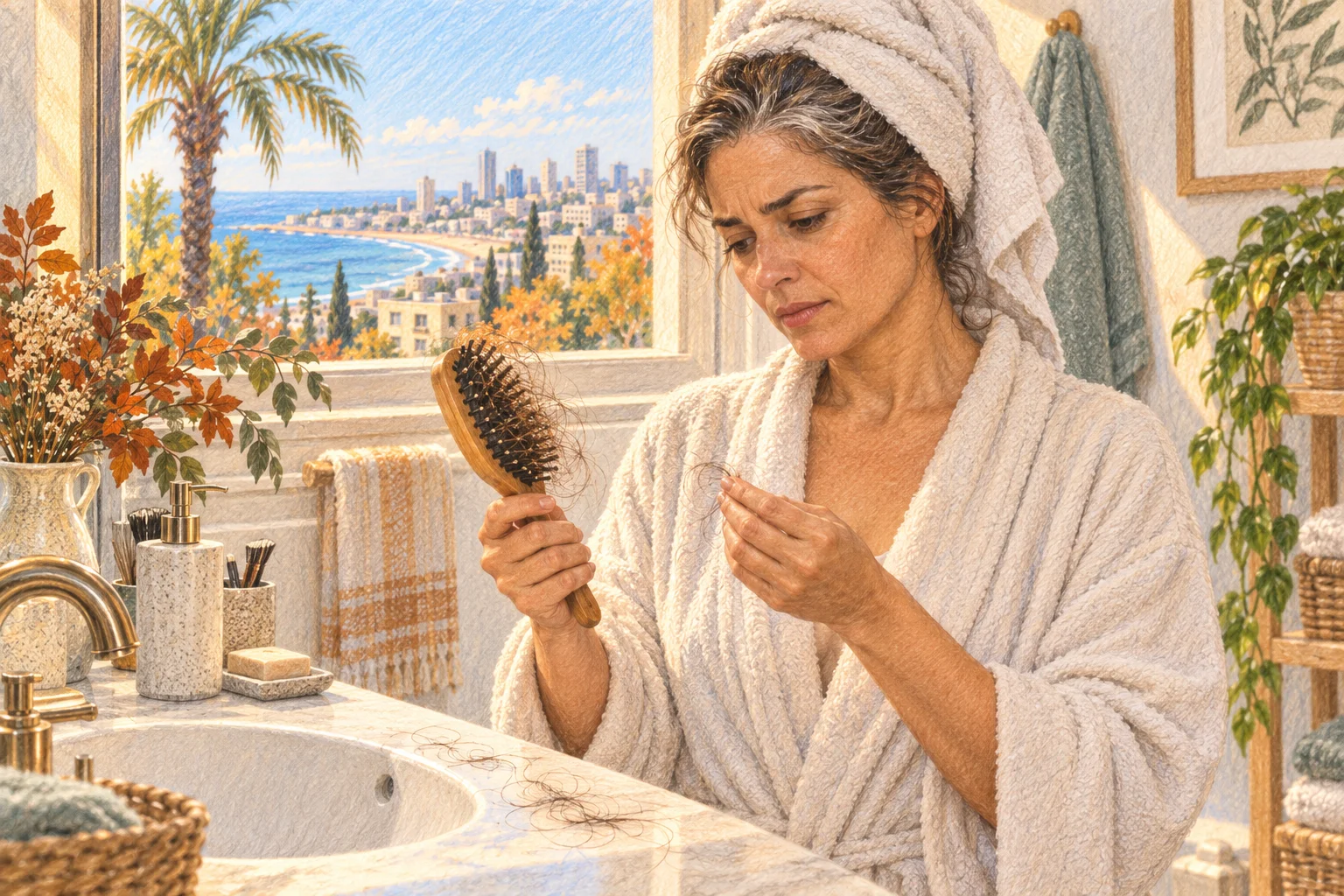
In autumn, this is often noticed not in front of the mirror, but after a shower. There is more hair in the drain, the comb needs to be cleaned more often, the usual ponytail is gathered tighter — and a simple explanation appears: the season.
Author — Elena Gunko
For Israel, it sounds especially convincing. Several months of sun, heat, sea, pools, and air conditioners have ended, which means the hair is simply reacting to the summer. Sometimes the season really plays a role, but it does not automatically explain prolonged hair loss, a widened parting, or a gradual decrease in density.
What is visible in autumn could have started in the summer
Hair does not always react to changes in the body immediately. Several months can pass between severe stress, illness, high fever, sudden weight loss, surgery or childbirth, and noticeable increased hair loss.
Therefore, October hair loss sometimes needs to be mentally returned to July or August. The woman is already sleeping normally, the illness is over, the difficult period has passed — and the hair is just beginning to show the consequences.
The American Academy of Dermatology describes such a delay in telogen effluvium. Seasonal fluctuations were also observed in studies: for example, a study with data from 823 women showed a change in the proportion of hair in the telogen phase at different times of the year.
For Israelis, there is another factor here. NAnews — News of Israel | Nikk.Agency has already reported, why prolonged stress during war and anxiety can affect hair with a delay. If the difficult period was several months ago, it is easy not to associate it with what is happening now.
After summer, hair may not fall out but break
On the floor and in the bathroom, the difference is not always noticeable. For the hair itself, it is fundamental.
The Israeli summer means a lot of sun, and for many, also the sea, pool, coloring, hairdryer, straightener, and more frequent washing. After several such months, hair may become drier, harder to comb, and more likely to break along the length.
Therefore, it is worth looking not only at the quantity. If among the fallen hair there are many short broken fragments, the ends are dry and split, and the length has become noticeably worse, part of the problem may be precisely in the damage.
If, however, mostly whole long hairs are falling out and the overall density is decreasing at the same time, it is more difficult to explain everything only by the sea and sun.
“Autumn” is convenient because almost everything can be blamed on it
Women have several reasons for hair loss that easily coincide with the beginning of autumn.
This is the period after childbirth, changes in hormonal contraception, thyroid disease, iron deficiency, sudden changes in diet or weight, past illness, and prolonged stress. There is also a female type of androgenetic thinning, which develops gradually.
It especially easily goes unnoticed. Hair does not necessarily fall out in clumps: first, the central parting may slightly widen, then the volume of the ponytail may decrease, and the scalp begins to show more on photographs or under bright lighting.
Therefore, the calendar is useful as a hint, but not as a diagnosis.
Instead of counting hairs, look at your parting
A common guideline is 50–100 naturally shed hairs per day. But at home, this number helps less than it seems.
If the head is washed every three days, several days’ worth of shed hair will be in the shower at once. Long hair looks much more voluminous than short hair, and combing and hairstyles also change the picture.
It is easier to compare yourself with yourself at the beginning of summer. Has the ponytail become thinner? Has the parting widened? Has a zone appeared where the scalp has become more visible? Has the usual volume returned after washing and styling?
If visually nothing changes, temporary increased shedding looks like one situation. If the density gradually decreases — it is already another.
Vitamins at random do not answer the question “why”
In autumn, many start in about the same way: “anti-hair loss” shampoo, biotin, hair complex, then iron on the advice of acquaintances.
But hair loss is not one cause and not one pill. If a woman really has an iron deficiency or another substance, its correction may be necessary. If the reason is completely different, a random jar of vitamins will not eliminate it.
With iron, thyroid, and other possible systemic causes, it is more reasonable to go through a doctor and necessary tests. And the condition of the hair and scalp can be assessed separately.
When it is no longer worth waiting for winter
Several weeks of increased shedding without noticeable changes in density do not yet mean that something serious is happening. The situation is different if changes continue to accumulate.
The parting becomes wider, the ponytail thinner, noticeable thinning appears in a certain area. Or itching, redness, soreness, pronounced flaking of the scalp are added to the shedding.
Separately, it is worth paying attention to suddenly appeared bald patches or very rapid pronounced shedding. In such cases, waiting until December just to check the “seasonality” version makes little sense.
What to do first
It is useful to start not with a cosmetics store, but with the last two to three months. Were there any illness, high fever, severe stress, weight loss, dietary changes, childbirth, surgery, or medication changes?
After that, it is worth assessing the hair itself: is the density changing, is the parting widening, is the hair falling out whole or breaking, are there changes in the scalp?
If the problem continues, the next step is to find out the cause. In some cases, a doctor and laboratory examination will be needed, in others, the first noticeable question will be the condition of the hair or scalp.
Procedures come after this. For example, NAnews separately analyzed, what PRP for hair is, who such a procedure may be considered for, and why the choice should start with a consultation, not with a promise of results.
Autumn can indeed coincide with more pronounced shedding. But if the hair has objectively become different than two or three months ago, it is more useful to find out the reason than just wait for the season to change.
Abramsky Hair Health Center in Haifa
Abramsky Hair Health Center operates in Haifa with inquiries about hair loss and thinning, hair damage, and changes in scalp condition.
The center’s approach starts with an assessment of the hair and scalp, after which the further direction is determined. This may involve working with damaged hair and scalp, discussing available procedures, or recommending additional medical examination first.
The center is located at Ha-Histadrut Avenue, 44, Check-Post area, Haifa. More about the directions of work, diagnostics, and appointments can be found on the official website of the Abramsky Hair Health Center.