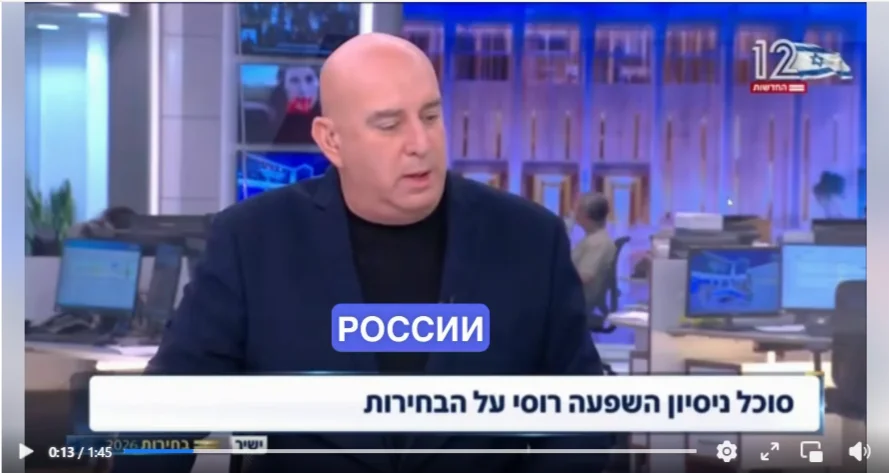
Two days before the Knesset elections scheduled for October 27, 2026, Israel’s Channel 12 reported on the prevention of an attempt at Russian interference in the election campaign. According to journalist Nir Dvori, it involves about 80 fake accounts linked to Russia. They were intended to be used to spread aggressive messages and incite conflicts among Israelis.
Author: Elena Gunko, NANews
But who was this operation supposed to help? Against which political forces was it directed? No answers were given on the air.
What Nir Dvori revealed about the Russian operation
On October 25, Channel 12 reported that a private cybersecurity company, collaborating with the Shin Bet — Israel’s General Security Service — thwarted an attempt at Russian influence on the upcoming elections.
According to the channel, the operation involved the use of fake social media profiles. Through them, it was planned to spread aggressive and provocative messages, intensifying the confrontation among Israelis.
The company reportedly took measures against approximately 80 accounts linked to the Russian campaign.
However, the report did not specify how many accounts were already active, how many were being prepared for use, what publications they managed to post, and whether all profiles were automated bots.
The company that discovered the operation was not named. Sources of information about the Russian affiliation of the accounts were not publicly disclosed.
These circumstances are also noted by The Times of Israel, which published a report on October 25 citing Channel 12.
Thus, it is about an attempt to influence public opinion through social networks. There is no information about hacking election systems or interfering with vote counting.
For whom or against whom were the Russian bots campaigning?
This is the main question that remains after Channel 12’s report.
Initially, 38 party lists were registered for the elections to the 26th Knesset. Some later withdrew from participation.
Among the main participants in the campaign are Benjamin Netanyahu’s Likud, Gadi Eisenkot’s Yashar, the joint list Be-Yachad of Naftali Bennett and Yair Lapid, Avigdor Lieberman’s Yisrael Beiteinu, Yair Golan’s Democrats, Shas, United Torah Judaism, Otzma Yehudit, Religious Zionism — Zehut, Ra’am, and the Joint Arab List.
These are political forces with different programs and positions on security, economy, religion, and state governance.
But which of them were supported or attempted to be discredited by the Russian accounts?
Nir Dvori did not report this.
The channel did not provide examples of publications that could establish the political orientation of the operation. It is unknown whether the accounts called for voting for a particular party, opposed specific candidates, or merely incited conflicts.
There is also no public information on how many real voters saw these messages.
Therefore, it cannot be claimed that Russian interference in the Israeli elections was carried out in the interests of any specific party or political bloc.
What Shin Bet officially confirmed
On October 22, three days before Nir Dvori’s report, Shin Bet announced the discovery and removal of accounts used for foreign influence on the elections.
The operation involved the cyber division of the State Prosecutor’s Office and the Central Election Commission — the body responsible for organizing elections and monitoring compliance with electoral procedures.
As Channel 12 reported, Israeli services identified a network of fake profiles and false publications. According to the channel, suspicious activity had been developing for several weeks.
However, in Shin Bet’s official statement on October 22, Russia was not mentioned. The service also did not specify the exact number of accounts, their content, and political orientation.
Therefore, it cannot be automatically assumed that the profiles removed by Shin Bet and the 80 accounts from the October 25 report are the same network.
Why Russian interference is dangerous right before voting
The elections on October 27 take place against the backdrop of sharp internal disputes.
Israelis are discussing the high cost of living, housing and food prices, the authorities’ responsibility for the Hamas attack on October 7, 2023, the creation of a state commission to investigate these events, the conscription of ultra-Orthodox yeshiva students into military service, and the safety of citizens, including children, in schools and on the streets.
There are already strong disagreements around such issues. For a foreign influence operation, it is enough to artificially intensify the confrontation using fake profiles and coordinated messages.
At the same time, sharp criticism of the government, disputes with the opposition, or emotional comments are not in themselves evidence of foreign interference.
On October 22, the Israeli Institute for National Security Studies (INSS), operating at Tel Aviv University, published a study on foreign activity in social networks before the elections.
In particular, researchers examined the Russian operation Doppelgänger — a campaign using fake news sites and accounts to spread prepared informational materials.
According to INSS, in October 2026, this Russian network operated in Israel’s information space simultaneously with campaigns related to elections in the USA and France.
The discovered materials touched on Israel-US relations, security threats, economic problems, and emigration.
At the same time, researchers did not find agitation for specific Israeli parties or candidates in the studied Russian publications.
INSS also reported that by October 19, verified accounts spreading these materials were blocked. However, data allowing the identification of the studied network with the 80 accounts from Nir Dvori’s report was not presented.
Warning about Russia was sounded back in August
NANews — News of Israel | Nikk.Agency
Back on August 3, 2026, Ukrainian President Volodymyr Zelensky publicly warned that Russia might use upcoming elections in partner countries, specifically mentioning Israel.
At that time, he spoke about possible hybrid operations, financial influence, and attempts at political destabilization.
Now, a day before the voting, information has emerged about a specific thwarted operation.
However, Channel 12’s report does not confirm that Russian accounts financed candidates, collaborated with Israeli parties, or received assignments from local politicians.
What remains unknown a day before the elections
On October 27, Israelis will elect 120 Knesset deputies. To form a government, support from at least 61 deputies is usually required.
On the eve of the voting, four significant gaps remain in the report on the Russian operation: the content of the publications, their political orientation, audience reach, and the organizers of the specific network are not disclosed.
Based on the published data, it is impossible to determine whether Russia sought to ensure support for a particular party, weaken its opponents, or primarily increase distrust among voters.
It is also not proven that the detected attempt at interference changed anyone’s political preferences.
Russian interference in the Israeli elections became the subject of a national television report two days before the voting. However, voters were not told for whom or against whom the detected accounts acted.
This is a fundamental question for which there is currently no public answer.