
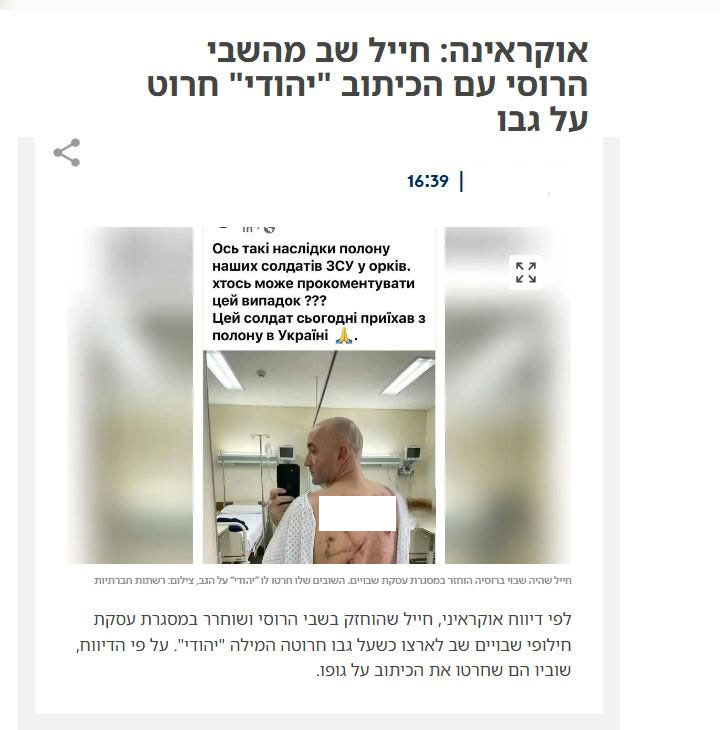
On October 24, 2026, the Israeli newspaper Israel Hayom published a report about a Ukrainian serviceman allegedly returned from Russian captivity with the word “JEW” carved on his back. A photograph of the man with numerous skin injuries quickly spread on the internet. Even former NASA astronaut Terry Virts published it, and the Israeli publication featured the story in the headline. Later, NANews recorded the disappearance of the note from the Israel Hayom website, and on October 25, verification results appeared indicating possible use of artificial intelligence in creating or altering the photograph.
Author: Anton Pshedynsky
But the main thing in this story is not just the origin of the photograph.
Why was the internet so ready to believe that Russian soldiers could carve the word “JEW” on a prisoner’s back? Because torture, abuse, and mistreatment of Ukrainian prisoners of war have already been documented multiple times by international organizations. Another report of atrocities by Russian invaders did not seem incredible: it fit into the well-known picture of the war that Russia is waging against Ukraine.
From the exchange of 270 Ukrainians to a photograph on social media
On October 23, 2026, Ukraine returned 270 citizens from Russian captivity — 261 servicemen and nine civilians. Most had been in captivity since 2022, after the start of the full-scale Russian invasion, although the war has been ongoing since 2014. Among the released were 221 defenders of Mariupol, including 72 participants in the defense of ‘Azovstal’, and five servicemen who survived the explosion in the Olenivka colony in July 2022.
Two of the released were captured back in 2018 and 2020. The age of the returned servicemen ranged from 24 to 63 years, among them were 38 officers and 223 soldiers and sergeants. According to official data from the Ministry of Defense of Ukraine, taking into account this exchange, 9,996 Ukrainians have already been returned home.
It was against the backdrop of the return of these people that a photograph of a man, presumably in a hospital ward, appeared on social media. On his exposed back, skin injuries and the large Russian word “JEW” are visible. Publications claimed that the man was freed from Russian captivity, and the inscription on his body was left by the captors. However, the name of the serviceman, his unit, place of detention, and circumstances of the injuries were not confirmed by anyone.
One of the most famous spreaders of the photograph was Terry Virts — a former NASA astronaut, commander of the International Space Station, and retired USAF colonel. He published the image on Threads and X, using it to criticize US President Donald Trump and his special envoy Steve Witkoff for what he considered favorable assessments of the Russian leadership. On October 24, the Ukrainian publication ‘Mezha’ reported on this publication but immediately warned: the origin of the photograph, the identity of the man, and his connection to the October 23 exchange are not independently confirmed.
And yet the image spread. It looked like another testimony of abuse that freed Ukrainian servicemen had been recounting for several years. For many users, the story was so plausible that the question of the origin of the specific photograph took a back seat.
Israel Hayom published the story, and then the material disappeared from the site
On October 24, the story reached one of the largest Israeli daily publications — Israel Hayom (‘Israel Hayom’). Journalist Neta Bar (נטע בר) published a note with the headline “אוקראינה: חייל שב מהשבי הרוסי עם הכיתוב “יהודי” חרוט על גבו” — “Ukraine: soldier returned from Russian captivity with the inscription ‘Jew’ carved on his back.” The newspaper also posted the photograph, citing social media as its source.
The text used the phrase “לפי דיווח אוקראיני” — “according to a Ukrainian report.” In other words, Israel Hayom retold the story without providing its own independent confirmation. The newspaper did not name the victim, did not provide medical documents, and did not report on the verification of the photograph. However, the categorical headline could well have created the impression among readers that the alleged torture had already been established.
After publication, NANews recorded that the Israel Hayom material disappeared from the site.
For Israelis, the story had special significance. The word “Jew,” presumably used as a mark of humiliation, inevitably evokes associations with anti-Semitic persecution and the historical memory of the Jewish people. Even if the image turned out to be genuine, the nationality of the victim would still need to be established: the anti-Semitic nature of the alleged crime would be determined primarily by the actions and intentions of its perpetrators.
NANews — Israel News | Nikk.Agency
October 25: fact-checkers found signs of AI processing
On October 25, the Austrian fact-checking organization Mimikama published a study of the photograph. The author of the verification, Tom Vannenmacher, presented the results of several artificial intelligence detection tools, indicating possible creation or alteration of the image. The Hive service assessed the probability of AI origin at 99.5%, and Sightengine at 98%. The SynthID tool additionally reported the detection of a digital watermark associated with Google AI technologies.
However, Mimikama itself emphasized the limitations of the study. The verification results were obtained in the form of screenshots, not through independent analysis of the original file. Moreover, detecting signs of AI does not yet allow establishing whether the image was completely created or only certain details were altered — for example, the inscription or traces of injuries. Fact-checkers also noted the unusually readable inscription in the supposed mirror reflection but acknowledged that this could be explained by subsequent reflection of the entire photograph.
There are also limitations of the verification tools themselves. As early as October 21, the British organization Full Fact reported cases where SynthID mistakenly identified presumably real photographs as created or altered by artificial intelligence. After the fact-checkers’ appeal, Google updated the system. Therefore, the figures of 99.5% and 98% cannot be perceived as definitive proof of the complete forgery of the image.
Nevertheless, the origin of the photograph remains unconfirmed, and the signs of digital interference are serious enough not to consider it reliable evidence of a specific crime. But here arises the reverse side of the story: why was even a dubious image so convincing? Because real evidence of mistreatment of Ukrainian prisoners existed long before this photograph appeared.
Why the world was ready to believe
In December 2025, the Office of the United Nations High Commissioner for Human Rights published the results of interviews with 187 Ukrainian servicemen released from Russian captivity. Of them, 185 detailed torture and mistreatment: severe beatings, electric shocks, suffocation, dog attacks, forced retention in painful positions, and humiliation. Another 141 respondents, or 75% of this group, reported sexual violence. These figures relate to specific respondents, not all Ukrainian prisoners of war.
The UN characterized the torture and mistreatment of Ukrainian prisoners by Russian authorities as a widespread and systematic practice. In subsequent reports, international observers continued to record violations, including torture and executions of captured servicemen. All this is contained in the official materials of the UN Human Rights Monitoring Mission in Ukraine, based on the testimonies of the released and investigations.
That is why the internet believed the photograph. Not because its authenticity was convincingly proven, but because the Russian army and the prisoner detention system had already given the world numerous reasons to take reports of such atrocities seriously. After documented beatings, sexual violence, abuse, and deaths in captivity, the story of an inscription carved on a human body did not seem impossible.
This is the most terrifying paradox: it was not the photograph that made the stories of Russian torture plausible, but the already documented torture that made the dubious photograph plausible. This explains the trust in the image but does not confirm its authenticity. The scale of previous crimes cannot serve as proof of every new accusation.
Israeli connection: Jewish defenders of Ukraine and the fight for prisoners
For Israel, the fate of Ukrainian prisoners of war is not a foreign story. Back in May 2022, Jewish serviceman Vitaly Barabash with the call sign “Benya,” who was at the surrounded ‘Azovstal’, appealed to then Israeli Prime Minister Naftali Bennett, the Knesset, and Israeli society for help in saving the defenders of Mariupol. Another serviceman helped the severely wounded fighter read the appeal. Barabash emphasized that among the defenders of the plant were Jews connected to Israel by a common history and fate. NANews detailed this in the material ‘We ask you for salvation’.
In September 2026, the Chief Rabbi of Ukraine Moshe Reuven Asman also reported on efforts to involve American, Israeli, and international Jewish organizations in the release of Ukrainian prisoners. Representatives of the organization ‘Voyatsky Vyzyvil’, which unites the families of prisoners of war and missing defenders of Mariupol, participated in this. NANews wrote more about these efforts in the article ‘Moshe Asman connects Washington, Israel, and the Jewish world to the fight for Ukrainian prisoners’.
Thus, the Israeli connection with Ukrainian prisoners arose long before the photograph with the word “JEW”. Among the defenders of Ukraine, there are indeed Jews, and their families and public representatives have been trying for years to draw the attention of the international community. These real stories deserve the attention of the Israeli press regardless of the fate of one controversial image.
Main conclusion: the photograph is dubious, the crimes are real
As of October 25, the following sequence of events has been established: Ukraine indeed returned 270 citizens from Russian captivity; Terry Virts spread the photograph with the claim of a carved inscription; the Ukrainian publication ‘Mezha’ warned of the inability to confirm the image; Israel Hayom published the story, after which its note’s availability changed; Mimikama presented verification results, revealing signs of AI processing.
But the identity of the man, the origin of the photograph, the connection to the October 23 exchange, and the circumstances of the inscription remain unknown. There is no independent confirmation that Russian soldiers actually carved the word “JEW” on the back of a specific prisoner. It is also currently impossible to establish who created or altered the image and for what purpose.
And yet this story says a lot about the perception of Russia’s war against Ukraine. When reports of atrocities are repeated for years and repeatedly confirmed by international investigations, society is psychologically ready to believe even a new, unverified story. The internet, famous people, and journalists can accept another image as truth not because they want to deceive anyone, but because the violence depicted on it corresponds to already known facts.
Perhaps the photograph with the word “JEW” was created or altered by artificial intelligence. But the torture of Ukrainian prisoners of war is not artificial intelligence and not an internet fabrication. They have been repeatedly documented by the UN. And if the world was ready to believe another story of atrocities by Russian invaders, the reason is primarily that too many such atrocities have already been recorded over the years of war.
Anton Pshedynsky, NANews — Israel News | Nikk.Agency. Information as of October 25, 2026.