
A memorial plaque has appeared in the active Lukyanivska detention center for a man who was interrogated and beaten here for refusing to renounce Judaism. The story of Rabbi Levi Yitzchak Schneerson today unites Kyiv, Dnipro, Mykolaiv, Kamianske, Kazakhstan, and the entire Chabad world.
Where they tried to break him: a memorial to Rabbi Levi Yitzchak Schneerson was opened in the Lukyanivska detention center.
Memorial plaques are usually installed on the facades of houses, in universities, synagogues, or museums. In Kyiv, a commemorative sign appeared in a much more grim place — inside the active Lukyanivska detention center.
It was here in the spring of 1939 that NKVD officers brought Rabbi Levi Yitzchak Schneerson — the chief rabbi of Yekaterinoslav-Dnipropetrovsk, an outstanding scholar of the Torah and Kabbalah, the father of the future Seventh Lubavitcher Rebbe Menachem Mendel Schneerson.
The plaque was unveiled on August 3, 2026, on the 20th of Av, 5786 — the yahrzeit, or anniversary of the death of Rabbi Levi Yitzchak according to the Jewish calendar. It has been 82 years since his death in Soviet exile. Now inside the institution where he was deprived of freedom, it is officially recorded: before the Soviet system stood not a criminal, but a religious leader persecuted for serving his people.
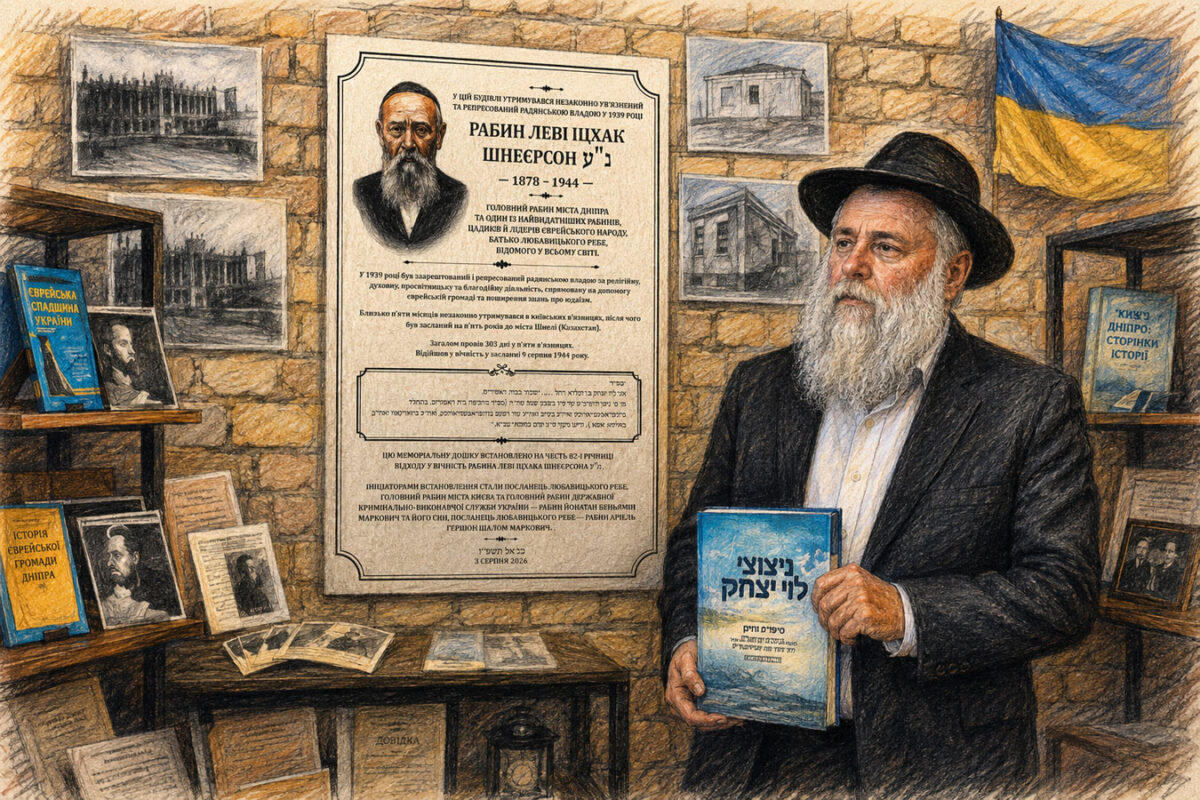
The prison chief acknowledged the injustice.
The ceremony was attended by the head of the Lukyanivska detention center, his deputy, the chief rabbi of Kyiv Yonatan Markovich, and his son, Rabbi Ariel Markovich, who coordinates assistance to Jews in Ukrainian penal institutions.
Yonatan Markovich is also involved in religious work in the penitentiary system of Ukraine. Together with his son, he spent several months obtaining permission to install a permanent plaque inside the regime facility, which continues to be used as a detention center.
The significance lay not only in the unveiling itself. The head of the institution publicly acknowledged that Rabbi Levi Yitzchak ended up here not for a real crime. His imprisonment was a consequence of Soviet policy to destroy independent religious life.
Along with the plaque, the detention center’s library received the book “Nitzotzei Levi Yitzchak” — a collection based on his commentaries on the Torah. It is expected that Jewish inmates will be able to familiarize themselves with the book.
The very choice of location changes the meaning of the memorial. It is not a commemorative sign installed far from the events. It is located where the man was interrogated, beaten, and tried to be forced to renounce spiritual responsibility.
What is on the memorial plaque
Here is the full translation of the plaque’s text from Ukrainian:
In this building in 1939, illegally detained and repressed by the Soviet authorities
RABBI LEVI YITZCHAK SCHNEERSON
1878–1944The chief rabbi of the city of Dnipro, one of the most outstanding rabbis, tzaddiks, and leaders of the Jewish people, the father of the world-famous Lubavitcher Rebbe.
In 1939, he was arrested and repressed by the Soviet authorities for religious, spiritual, educational, and charitable activities aimed at helping the Jewish community and spreading knowledge about Judaism.
He was illegally detained in Kyiv prisons for about five months, after which he was sent to a five-year exile in the city of Shieli in Kazakhstan.
He spent a total of 303 days in five prisons.
He passed away in exile on August 9, 1944.
In the central part of the plaque is an inscription in Hebrew from Rabbi Levi Yitzchak himself. It states that he was imprisoned in Dnipropetrovsk, Kyiv, Kharkiv, and Almaty, spending a total of 303 days in five prisons.
The lower part of the plaque:
This memorial plaque is installed in honor of the 82nd anniversary of the passing of Rabbi Levi Yitzchak Schneerson, may the memory of the righteous be blessed.
The initiators of the installation were the emissary of the Lubavitcher Rebbe, the chief rabbi of Kyiv, and the chief rabbi of the State Penitentiary Service of Ukraine, Rabbi Yonatan Binyamin Markovich, as well as his son, the emissary of the Lubavitcher Rebbe, Rabbi Ariel Gershon Shalom Markovich.
20th of Av, 5786
August 3, 2026
Arrest at three in the morning
Rabbi Levi Yitzchak Schneerson was arrested by NKVD officers around three in the morning on March 28, 1939, at his home in Dnipropetrovsk. The next morning he was transferred to Kyiv and placed in the Lukyanivska detention center.
The arrest was preceded by a broader campaign. In Kyiv, Kharkiv, and Dnipropetrovsk, at least twelve Hasidim were detained. According to Chabad org, Soviet authorities might have been preparing a show trial against the religious underground, but later Levi Yitzchak’s case was singled out for separate proceedings.
Formally, he was accused of anti-Soviet agitation, creating a religious network, and ties with foreign intelligence. NKVD documents claimed that his son was allegedly the chief rabbi of Warsaw and a Polish agent.
This was fiction. The future Lubavitcher Rebbe was neither the chief rabbi of Warsaw nor a Polish intelligence agent.
But the Soviet investigation did not necessarily require real evidence. An influential rabbi who continued to openly defend Jewish laws, support the families of the arrested, and maintain religious institutions was already perceived by the regime as a threat.
The matzah the rabbi refused to declare kosher
One of the most famous episodes preceding the arrest was the dispute over matzah production.
Soviet enterprises produced matzah, but the authorities expected to receive official confirmation of its kashrut from the chief rabbi. Rabbi Levi Yitzchak refused to put his name on such a document until the production truly met the requirements of Jewish law.
He did not agree to a compromise even under pressure and achieved compliance with the necessary conditions.
However, it would be too simplistic to claim that the rabbi was arrested only because of the matzah. This episode became part of a long-standing confrontation. Rabbi Levi Yitzchak organized assistance for the families of imprisoned Jews, supported the distribution of matzah, participated in the creation of an underground mikvah, and continued to teach the Torah in a state that declared religion a relic of the past.
For the NKVD, the problem was not a separate religious ceremony. The problem remained the person himself, capable of uniting the community and convincing others not to abandon their identity.
Five prisons and interrogations lasting 16 hours
In the following months, the prisoner was transferred between five Soviet prisons. Interrogations could last 15–16 hours.
On October 4, 1939, he was sentenced to five years of internal exile. Rabbi Levi Yitzchak was sent to the village of Chiili, now Shieli, in the Kazakh steppe.
His wife, Rebbetzin Chana Schneerson, voluntarily came to her husband. They lived in harsh conditions, faced food shortages, illnesses, and the lack of the most basic things.
Even in exile, Rabbi Levi Yitzchak continued to work on commentaries on Jewish texts. Since there was no ordinary ink, Rebbetzin Chana made it from herbs, roots, and plants. Her husband recorded his thoughts in the margins of the few books he had with him.
After her husband’s death, Chana preserved these volumes. Later, the manuscripts ended up in the USA and were published with the participation of their son — the Lubavitcher Rebbe.
In early 1944, the seriously ill rabbi was allowed to move to Almaty. He died on August 9, 1944, 20th of Av, 5704, at the age of 66. He was buried in the Jewish cemetery of the city, which is now called Almaty.
In 2020, Kazakhstan recognized the burial site of Rabbi Levi Yitzchak as a national heritage site.
The chief rabbi of Yekaterinoslav during the years of religious destruction
Rabbi Levi Yitzchak Schneerson was born in 1878. After marrying Chana Yanovsky, the couple lived in Mykolaiv, where their three sons were born. The eldest was Menachem Mendel Schneerson — the future Seventh Lubavitcher Rebbe.
In 1908–1909, Levi Yitzchak became the chief rabbi of Yekaterinoslav. In Soviet times, the city was named Dnipropetrovsk, and since 2016 it has been called Dnipro.
He led the community for about thirty years: he survived World War I, the revolution, the establishment of Bolshevik power, and the consistent destruction of independent Jewish institutions.
After the forced departure from the USSR of the Sixth Lubavitcher Rebbe Yosef Yitzchak Schneerson in 1927, Levi Yitzchak remained one of the most authoritative rabbis in the Soviet Union. It was during this period that the usual work of a rabbi turned into a daily risk.
Conducting a religious lesson, helping to build a mikvah, raising money for a needy family, or demanding kosher production meant challenging the state.
Kyiv installed a plaque, Dnipro preserved living memory
Almost simultaneously with the Kyiv ceremony, commemorative events took place in Dnipro.
A men’s farbrengen was held in the central synagogue “Golden Rose.” Rabbi Moishe Leib Weber spoke about Levi Yitzchak’s service to the Jewish people, Soviet persecutions, and his loyalty to the Torah. Participants sang Hasidic nigunim and gathered for a traditional meal.
A women’s farbrengen was held in the educational space “Kolel Torah.” It was attended by the deputy secretary of the Dnipro rabbinical court Avraham Yosef Yitzchak Karshenbaum. He spoke about Levi Yitzchak’s work in Yekaterinoslav and the preservation of his spiritual heritage.
A farbrengen is not an ordinary official ceremony. It is a Hasidic gathering during which participants study the Torah, tell stories about the righteous, sing nigunim — melodies without words — and discuss how spiritual ideas should manifest in actions.
Therefore, Kyiv and Dnipro chose two different but complementary ways of remembrance. In Kyiv, the rabbi’s name was returned to the space of a state institution. In Dnipro, his legacy continued within the community he once led.
Mykolaiv and Kamianske: memory not limited to big cities
In a publication by the Federation of Jewish Communities of Ukraine, which the editorial staff of NAnews — News of Israel reviewed, it is also reported about commemorative meetings in Mykolaiv and Kamianske.
For Mykolaiv, this story has special significance. Here, after the wedding, Levi Yitzchak and Chana Schneerson lived. Here, in 1902, their eldest son Menachem Mendel — the future Seventh Lubavitcher Rebbe — was born.
At the meeting in Mykolaiv, the rabbi of the city and region Sholom Gottlieb spoke. Participants studied Levi Yitzchak’s commentaries on the Torah and Zohar, sang nigunim, gave tzedakah, and talked about good deeds as a practical continuation of memory.
In Kamianske, a men’s farbrengen was held by participants of the “Golden Age” program. This is an important detail: it is not only about international conferences, influential rabbis, or large community centers. History is passed on during small meetings where elderly participants tell it to the next generations.
Thus, a map of memory emerges, passing through several cities:
- Dnipro — the place of Levi Yitzchak’s thirty-year service;
- Mykolaiv — the city of the family’s life and the birth of the future Lubavitcher Rebbe;
- Kyiv — the place of imprisonment and interrogations;
- Kamianske — an example of preserving the heritage of a small regional community;
- Almaty — the place of exile, death, and burial.
KGB apology and plaque decades later
The Soviet state long did not acknowledge responsibility for the persecution of the rabbi.
Only in August 1991, in the last months of the USSR’s existence, did the Ukrainian KGB officially recognize the illegality of its predecessors’ actions. Chabad representatives were given the case documents, which were then delivered to New York to Menachem Mendel Schneerson.
Additional materials were handed over by Ukraine in 1993 and by Kazakhstan in 1999.
However, archival recognition and a memorial plaque serve different purposes.
The archive establishes a fact. The plaque returns the person to the physical space from which they tried to erase him.
That is why the ceremony in the Lukyanivska detention center has significance beyond the history of Chabad. State institutions bear responsibility not only for preserving documents. They decide which names remain visible and what language society uses to describe repressions.
Why this story is important for Israel
For the Israeli reader, the name Schneerson is most often associated with the Seventh Lubavitcher Rebbe and the worldwide network of communities, educational institutions, and Chabad emissaries created under his leadership.
But the story of the Kyiv plaque reminds us: this global system did not grow in a historical vacuum. Behind it is the experience of a family that went through Soviet bans, arrest, prisons, exile, and forced emigration.
Ukraine in this story is not a distant backdrop. Here served the Rebbe’s father, here Menachem Mendel Schneerson himself was born, here his early experience was formed, and here the Soviet system tried to destroy the religious environment from which one of the most recognizable Jewish movements of modern times later emerged.
For NAnews — News of Israel, it is fundamentally important to see in such events not just another protocol gesture, but part of a shared Israeli-Ukrainian memory.
What is confirmed, and what we do not yet know
The editorial staff verified the information from the Kyiv Chabad community with publications from Chabad.org, i24NEWS, materials from the Jewish communities of Dnipro, and previously published biographical documents.
Confirmed are the date of the plaque’s unveiling, the location of the ceremony, the participation of Yonatan and Ariel Markovich, the presence of the detention center’s leadership, the transfer of the book to the library, and the public acknowledgment of the injustice of the imprisonment.
At the time of preparing the material, the editorial staff did not find a separate open statement from the Ministry of Justice of Ukraine or the State Penitentiary Service with the names of the participating detention center leaders. In the organizers’ publications, the director and his deputy are mentioned without names.
NAnews did not attend the ceremony and does not have its own photographs from the regime facility. The published images come from JCC Kyiv and Chabad-related sources.
This limits the ability to independently verify every detail of the ceremony but does not change the main confirmed fact: a permanent memorial sign is installed inside the very active detention center where Rabbi Levi Yitzchak Schneerson was held in 1939.
Jewish life in Ukraine did not stop under Russian missiles
The unveiling of the memorial plaque in the Lukyanivska detention center should be viewed not only as a restoration of historical justice. It is another testament that, despite Russian aggression, daily air raids, missile and drone strikes, Jewish life in Ukraine has not disappeared and has not turned solely into a memory of the past.
In Kyiv, a memorial to a repressed rabbi is being installed. In Dnipro, men’s and women’s farbrengens are held. In Mykolaiv, commentaries on the Torah and Zohar are studied. In Kamianske, participants of community programs gather to talk about Jewish history and pass it on to the next generations. Synagogues, charitable centers, educational projects, chaplains, and community organizations continue to operate.
And all this is happening in a country that Russia continues to strike.
Russian aggression destroys homes, schools, hospitals, and religious buildings, forces people to leave their native cities, and creates a threat to all citizens of Ukraine, regardless of their origin and faith. But Putin’s missiles could not stop prayers, Torah study, Jewish holidays, or community work.
Moreover, Ukrainian Jews today remain not passive observers of the war. They serve in the ranks of the Ukrainian Defense Forces, work as military chaplains, engage in volunteering, provide vehicles and necessary equipment to units, help the wounded, hospitals, displaced persons, and the civilian population. The Federation of Jewish Communities of Ukraine has directly reported on Jews fighting in the ranks of the Armed Forces of Ukraine, as well as on the spiritual and material support of Ukrainian servicemen.
Therefore, the participation of the Ukrainian state in preserving Jewish memory cannot be perceived only as a formal demonstration of tolerance. The permission to install a permanent plaque inside an active regime facility, the participation of the detention center’s leadership, and the acknowledgment of the illegality of Soviet persecution show: Jewish history is considered part of Ukraine’s own history.
The state is not doing a favor to some separate community. It recognizes the contribution of citizens of Jewish origin to the defense of the country and helps preserve the heritage of people whom the previous imperial system destroyed or persecuted.
This is especially symbolic today. The Soviet authorities declared independent Jewish religious life a threat and sent rabbis to prisons. Modern Ukraine, opposing new Russian aggression, opens a memorial plaque on the territory of the same prison to one of the repressed Jewish leaders.
Of course, one ceremony does not solve all problems and does not eliminate the need to combat anti-Semitism, preserve Jewish cemeteries, restore synagogues, and protect historical memory. But it shows the direction: Ukrainian Jews are not guests and not a separate historical minority existing alongside the state. They are part of Ukrainian society, Ukrainian history, and the country’s overall defense.
Today, Jewish communities help Ukraine withstand, and Ukraine creates conditions in which these communities can preserve their faith, culture, and own memory. This is one of the most important conclusions of the Kyiv ceremony: Russian aggression brought destruction but could not break the connection between Jewish life and modern Ukraine.
Memory returned to the place of imprisonment
In 1939, the Soviet system wanted to silence the rabbi. His name was replaced with a case number, his service was called anti-Soviet activity, and his connection with his own son was turned into a fabricated accusation of espionage.
In 2026, a plaque with his name was installed inside the same prison, and a book with his teachings was donated to the library.
The NKVD had cells, investigators, interrogations, and exile. Levi-Yitzchak Schneerson had a few books, homemade ink, and the conviction that renouncing his own faith would be a more severe defeat than prison.
Eighty-seven years after his arrest, it turned out that the Soviet system was able to take away his freedom, health, and the opportunity to return home. But it was never able to destroy what he was persecuted for.