
Russia’s war against Ukraine has become the largest testing ground for the trial and mass implementation of new unmanned warfare technologies. One of the most dangerous innovations of the past two years has been FPV drones, which receive commands not via radio channel, but through a thin fiber optic cable.
Such devices are almost impossible to stop with conventional electronic warfare means. Jamming frequencies do not break the physical connection between the operator and the drone, so the UAV continues to move towards the target and transmit a stable image even in conditions of intense radio interference.
In early June 2026, the Center for Defense Reforms prepared a report titled “Fiber Optics for FPV Drones: Production Capacities and Import Channels in the Russian Federation.” The document came into the possession of NANews.
The study by the Center for Defense Reforms is dedicated not only to the drones themselves but also to the entire hidden industrial system necessary for their production: optical fiber, quartz blanks, specialized coils, reinforcing materials, equipment, and international supply channels. The authors studied customs statistics, Russian state registers, manufacturers’ websites, trading platforms, and publications from open sources.
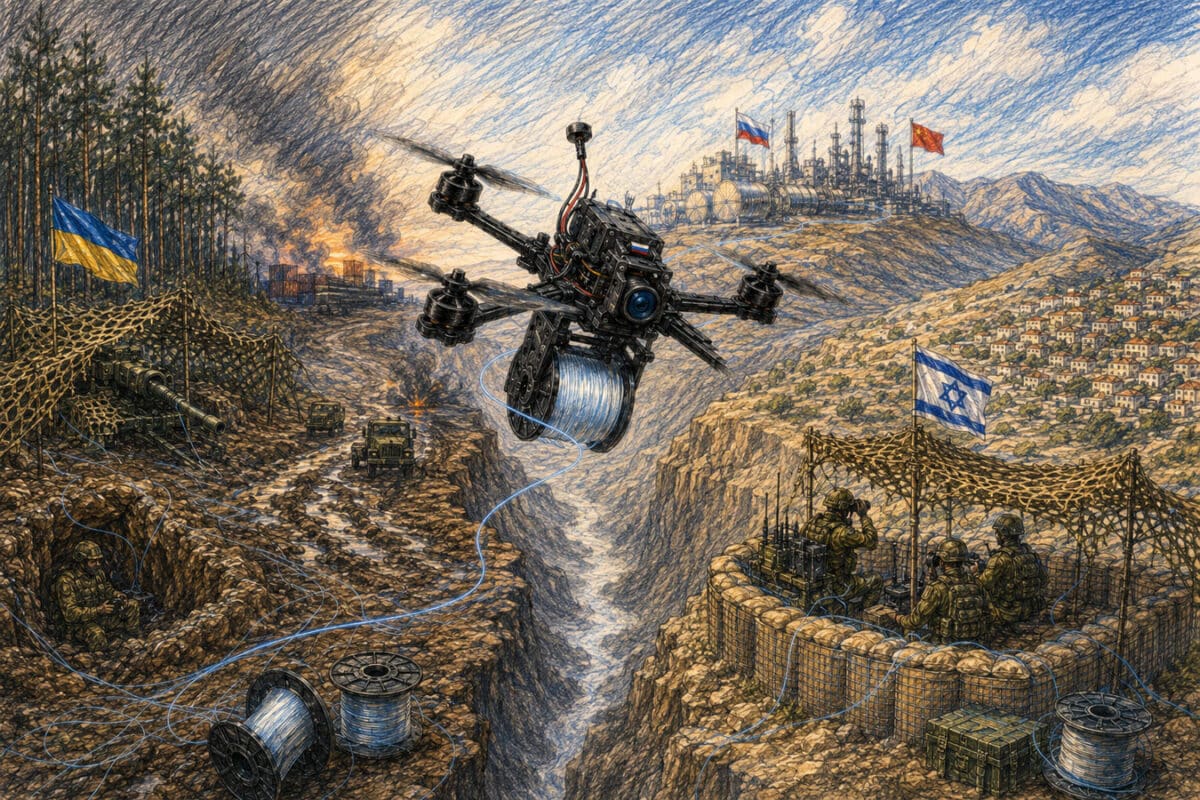
The main conclusion of the study is that Russia has managed to sharply increase the use of fiber optic FPV drones, but still critically depends on foreign technologies, primarily from China.
Why a fiber optic FPV drone is hard to stop
A conventional FPV drone transmits images and receives operator commands via radio channel. Electronic warfare means can detect the frequencies used, create interference, and deprive the device of control or video signal.
The scale of this vulnerability is shown by the estimate given in the report: from 70% to 90% of conventional FPV drones may not reach the target due to loss or suppression of radio communication. It was the saturation of the front with electronic warfare means that pushed the development of devices that maintain a physical connection with the operator through a fiber optic cable.
In a fiber optic system, a physical line of communication is maintained between the drone and the ground operator. During the flight, a coil with a thin cable tens of kilometers long unwinds behind the device. Through it, control commands and video signals are transmitted.
In addition to resistance to electronic suppression, such a system provides a stable picture and allows the device to operate in complex terrain, between buildings, in forest belts, and other places where radio communication may be unstable.
At the same time, the fiber optic FPV is not a fundamentally new type of drone. It is a modification of already existing platforms: a coil, transmitter, and necessary equipment are installed on a standard device if its payload capacity allows carrying additional weight.
The first known mention of Russia using such a device in open sources dates back to March 2024. At that time, a Russian FPV drone with a coil of approximately ten kilometers of cable was discovered. After the battles in the Kursk region, the scale of use began to grow rapidly.
Up to 60% of Russian FPVs in certain directions
According to estimates given in the report, in July 2025, devices with fiber optic control could account for about 15–20% of FPV drones used by the Russian side.
By early 2026, in certain sections of the front, their share, according to Russian sources, could reach 60%. This does not apply to the entire line of combat operations, but even local saturation with such devices can sharply complicate the movement of personnel, equipment, and supplies.
The usual range of such systems is most often estimated at about 20 kilometers. However, in November 2025, reports appeared about Russia using fiber optic devices with coils up to 50 kilometers long.
In February 2026, such a drone first reached the northern outskirts of Kharkiv. This means that the threat is gradually extending beyond the immediate front line and spreading to logistics routes, warehouses, transport, command posts, and civilian infrastructure.
“Prince Vandal of Novgorod” and 50,000 drones per month
The most famous Russian device of this class became the UAV “Prince Vandal of Novgorod,” abbreviated as KVN.
According to its manufacturer, in 2025, the production of this model increased to about 50,000 units per month. It is difficult to independently verify the stated volume, so it should be perceived precisely as a figure declared by the Russian side and used by the authors of the report for subsequent calculations.
If each device is equipped with a coil with ten kilometers of cable, the production of KVN alone requires about six million kilometers of fiber optics annually. When using coils of 20 kilometers, the need increases to 12 million kilometers.
And this is just one model. Russian sources also mention VT-40, “Hortensia,” “Ovod-Pro,” “Veles,” “Piranha,” “Skvorets,” and other developments. At the same time, the authors warn that the active combat use of some of them has not yet received sufficient independent confirmation.
The scale of supply to individual manufacturers is also evidenced by identified customs operations.
The company “Rustakt,” which the authors of the report call the manufacturer of the fiber optic FPV drone VT-40, imported cable worth approximately $660,000 in February–March 2025.
According to calculations by the Center for Defense Reforms, the three identified batches could contain about 300,000 kilometers of optical fiber. The authors separately warn that without invoices and exact technical specifications, this figure cannot be considered definitively confirmed. However, it shows the volume of disposable material that even one drone manufacturer can consume.
Up to 50 million kilometers of disposable cable
The overall need of the Russian FPV drone industry is estimated by the authors of the study at approximately 50 million kilometers of optical fiber per year.
This is not official statistics and not a definitively established figure, but an upper analytical estimate. It takes into account not only serial devices but also small manufacturers, volunteer and semi-handmade assemblies, testing, operator training, stockpiling, and the use of longer coils.
The report itself also provides a significantly lower Russian estimate. In March 2026, cable market participants stated that the total consumption of fiber optics in Russia is about 15 million kilometers per year, of which approximately 13 million are used for drone control.
The authors do not consider this data a reliable basis for accurate calculations, as they contradict earlier official estimates of the needs of the Russian telecommunications sector. However, even the lower estimate confirms that drone production has become an independent and major source of demand for fiber optics.
The scale becomes clearer when comparing military and civilian use.
In telecommunications networks, fiber optics are laid for years or decades. After installation, it remains part of the permanent infrastructure. In an FPV drone, ten, twenty, or even fifty kilometers of cable become a consumable material used during a single flight.
That is why the mass production of drones has created a completely new demand, comparable not to a single defense order, but to the needs of an entire national telecommunications industry.
If the authors’ upper estimate is close to reality, in 2025, Russia could acquire or use almost 60 million kilometers of fiber optics — about 10.5% of the world’s output. Previously, Russia’s share did not exceed 1%. According to calculations by the Center for Defense Reforms, up to 50 million kilometers, or more than 80% of Russian demand, could be related specifically to the production and use of FPV drones.
One large plant for all of Russia
Russia has enterprises and research centers capable of producing certain types of optical fiber. However, most of them operate in narrow segments: they produce products for lasers, sensors, gyroscopes, navigation systems, medical or scientific equipment.
Their capacities are insufficient for the mass production of cheap telecommunications fiber, which is used in long disposable coils of FPV drones.
The main and actually the only large industrial producer of such material is called by the authors the company Optic Fiber Systems JSC — “Optic Fiber Systems” — in Saransk.
The enterprise was created in 2008, and actual production was launched in 2015. The plant was built with the participation of foreign suppliers: the Finnish company Nextrom provided a technological license and created the enterprise turnkey, and German equipment from Sikora was used on the production line.
In 2019, the enterprise underwent modernization, after which its declared production capacity increased by one and a half times. The total investment amounted to 950 million rubles, with 500 million provided by the Russian state Industrial Development Fund. This underscores the strategic importance of the enterprise for the Russian authorities.
By 2023, the enterprise had six lines with a total capacity of about 4.3 million kilometers of fiber optics annually.
Thus, even before the plant was damaged, Russian own capacities significantly lagged behind the supposed demand. If the need of the drone industry really approached tens of millions of kilometers, Russia could not cover it with domestic production.
The strike on Saransk showed the vulnerability of the entire system
In the spring of 2025, a strike was carried out on the production site of “Optic Fiber Systems.” Later, Russian sources reported that production stopped, the equipment was seriously damaged, and it was impossible to quickly restore the enterprise’s operation.
The consequences were noticeable not only for the military industry. The Russian requirement for the mandatory use of domestic fiber optics in cable products was postponed for two years — until 2028. Among the reasons were the damage to equipment and the rapid depletion of reserves.
The situation showed how much the Russian system depends on one large enterprise. Disruption of the only large-scale producer affects simultaneously the production of drones, the cable industry, telecommunications networks, and military communication systems.
However, Russia’s dependence is not limited to the plant itself. Even before the strike, the enterprise did not have a complete technological cycle.
The main weak point — quartz preforms
Optical fiber is drawn from a high-purity quartz blank, called a preform. The quality of this blank determines the characteristics of the future fiber: transparency, strength, signal transmission stability, and the possibility of mass production.
Russia has scientific developments and certain technologies in the field of specialized optics, but the authors of the report did not find evidence of the existence of industrially mature production of quality telecommunications preforms in the necessary volumes.
Attempts to solve the problem have been made at least since 2018. In June 2023, the Russian Ministry of Industry and Trade announced a competition for work on the “Quartzite” project. Its goal was to create a domestic technology for the production of quartz blanks. About a billion rubles were planned to be allocated to the program, but no company submitted an application, and a contractor could not be determined.
Subsequently, Russia moved to create a new enterprise — the Saransk Optical Preform Plant. The company was registered in December 2024 with the participation of the Development Corporation of the Republic of Mordovia and the republican Ministry of Land and Property Relations.
Initially, its authorized capital was 500,000 rubles, but in September 2025, it was increased to 4.377 billion rubles. Such growth shows that the project went beyond declarations and moved to the stage of real state and investment financing.
In March 2026, the company announced a competition for the construction of optical fiber production and a preform plant at the address Lodygina Street, 13 in Saransk — the main site of “Optic Fiber Systems” is also located there. The contractor was chosen as the Moscow company PSK “Vysota,” and the total cost of the project, taking into account previous purchases, is estimated at about 12 billion rubles.
The organizational structure of the project remains non-transparent. The company Oplant, created as a subsidiary of “Optic Fiber Systems” for the implementation of the preform project, changed its registration from Mordovia to Moscow in September 2025. Its main activity is listed as rental and management of real estate, and the available reporting to the Center shows that the company’s income was mainly formed from the sublease of non-residential premises.
At the same time, the director of Oplant, Dmitry Tynyakin, holds the positions of deputy general director and chief engineer of “Optic Fiber Systems.” The authors believe that Oplant and the Saransk Optical Preform Plant functionally belong to one production project, although direct corporate ties between the structures are not always visible in open registers.
Building buildings, installing equipment, and registering an enterprise is much easier than achieving the constant production of quartz blanks of the necessary purity and quality. As of spring 2026, the authors of the study did not find signs that this task has already been solved.
How China replaced Japan
Before the full-scale Russian invasion of Ukraine, the main supplier of raw materials for the Saransk enterprise was the Japanese Sumitomo Electric Industries.
In 2021, the plant imported more than 61 tons of materials from the Japanese company for approximately $5.8 million. After 2022, the supply structure changed, and the enterprise reoriented to China.
After reorienting to Chinese suppliers, Optic Fiber Systems JSC imported almost 96 tons of raw materials with a total value of about $15.3 million. The last batch identified in the customs database is dated February 2025.
But China’s significance is much broader than supplying one plant.
According to customs data provided in the report, in 2022–2024, Russia imported about 1,330 tons of optical fiber from China worth over $72 million. This estimate does not include ready-made fiber optic cables and preforms, so it reflects only part of the real flow of goods.
Replacing China with another supplier is extremely difficult: according to the study, Chinese industry accounts for more than 60% of the world’s optical fiber production. Therefore, Russian dependence is explained not only by Beijing’s political willingness to support trade with Moscow but also by the concentration of global production capacities in China.
After the Saransk plant stopped, supplies began to grow rapidly. Citing The Washington Post, the authors report that in May 2025, about 119,000 miles of fiber optic cable were sent from China to Russia, in June — 130,000, and in August — already 328,000 miles.
China provides Russia not only with raw materials and ordinary fiber. The Russian drone industry gains access to specialized coils, lightweight cable solutions, reinforcing materials, Kevlar constructions, winding and testing equipment.
Formally, Beijing declares control over the export of drones and dual-use products. However, the authors of the study conclude that existing mechanisms do not prevent the supply of components that Russian enterprises can use in the production of military drones.
The problem lies in the distributed structure of supplies. It is not about one state contract and not about two large importers that can be quickly blocked, but about dozens of manufacturers, trading platforms, intermediaries, and small logistics channels.
Why this is critically important for Ukraine
For Ukraine, fiber optic FPV drones have become a direct threat to personnel, equipment, and supplies.
The mass spread of EW forced both sides to look for ways to bypass radio interference. Russia bet on a physical control line, turning fiber optics into a disposable combat resource. As a result, areas near the front line are literally covered with thin cables left after flights.
Countering such devices requires other solutions. Electronic suppression is not enough: it is necessary to detect the drone earlier, physically destroy it, mask positions, protect transport, and change the organization of logistics.
But the study also shows another side of the problem. The mass production of fiber optic FPVs has specific weak points:
| Chain element | Russia’s vulnerability |
|---|---|
| Optical fiber | Insufficient own capacities |
| Quartz preforms | Lack of a mature full cycle |
| Production | Dependence on one large enterprise |
| Equipment | Foreign technologies and production lines |
| Mass supplies | Critical role of Chinese companies |
| Specialized coils | Import of components and equipment |
That is why strikes on production facilities, control of international supplies, and sanctions against the entire network of intermediaries can have no less impact than the destruction of ready-made devices on the front.
Why Ukrainian experience already concerns Israel
The report by the Center for Defense Reforms is dedicated to Russia, Ukraine, and Chinese supply channels. NANews further examines its conclusions in the context of threats to Israel’s security. The analysis of the situation with Iran and Hezbollah is not part of the report itself.
The technology described in it has already appeared on the Middle Eastern battlefield.
The Israeli Institute for National Security Studies reported that Hezbollah used a fiber optic cable-controlled drone against IDF personnel. As a result of one of these strikes, Sergeant Idan Fuchs was killed. INSS emphasizes that small FPV drones can fly at low altitudes, use complex terrain, and penetrate through very small openings, and their low cost allows them to be used en masse.
The Alma Research Center in May 2026 named fiber optic FPVs as one of the main means used by Hezbollah against IDF units in southern Lebanon. According to the center, more than 80 explosive drones were launched over several weeks, about 15 of which reached their targets. As a result, four soldiers and one civilian were killed, and dozens of soldiers were injured.
This means that for Israel, it is no longer about a distant technology existing only on the Ukrainian front.
NANews — Israel News notes: Ukraine’s experience shows not only the capabilities of such drones but also the speed of their spread. Relatively little time passed between the first recorded use and the transformation of fiber optic FPVs into a mass tool.
Russia, Iran, and the risk of further technology spread
It cannot yet be claimed that Russian fiber optic control technology has already been directly transferred to Iran or Hezbollah. The presented report does not prove this, and open sources do not allow establishing the origin of each device used in Lebanon.
However, Russian-Iranian military-technical cooperation is an established fact.
In the annual threat assessment by US intelligence for 2025, it was stated that Iran has become a critically important military supplier to Russia, especially in the field of drones, receiving in return Russian technical support for its weapons, intelligence capabilities, and cyber operations.
Initially, Iran transferred ready-made Shahed drones, production documentation, and assembly technologies to Russia. Russia established its own large-scale production, improved designs, navigation systems, warheads, and tactics for mass use. This creates conditions for the reverse movement of experience and improvements.
At the same time, Iran uses the same international model of purchasing civilian and dual-use components that the Center for Defense Reforms identified in the Russian fiber optic chain.
In 2025, the US Department of the Treasury imposed sanctions on companies from China and Hong Kong that purchased components for Iranian UAV and ballistic missile programs. In July of the same year, restrictions were imposed on structures that provided technologies to the state-owned Iran Aircraft Manufacturing Industrial Company, which produces military aircraft and Ababil series drones.
In May 2026, the American agency reported on new procurement networks through which the Iranian military industry received servos, carbon fiber, honeycomb materials, and other products applicable in Shahed drones and missile programs. Chinese companies again appeared among the suppliers.
Thus, Russian and Iranian drone programs depend on a similar environment: civilian components, Chinese manufacturers, international intermediaries, and dual-use goods that are not always formally considered weapons.
Not a proven transfer, but a confirmed risk
The correct conclusion is not that Moscow has already transferred Russian fiber optic FPVs to Tehran or that every Hezbollah drone is made using Russian technology.
The main risk appears broader.
Russia receives a huge amount of practical data on the use of drones in conditions of a front saturated with electronic warfare means. It tests different spool lengths, device designs, operator tactics, obstacle avoidance methods, and methods of hitting protected targets.
Iran, in turn, has its own developed drone industry and many years of experience in transferring weapons, components, and technologies to related formations. American authorities have repeatedly pointed out that Iranian UAVs and missiles are spreading both to Russia and among organizations supported by Tehran in the Middle East.
Therefore, the likelihood of exchanging production solutions, components, and combat experience cannot be ignored. Especially since Hezbollah is already using the fiber optic control technology itself.
What Israel can learn from the Ukrainian experience
For Israel, the Ukrainian front is a source of practical information on how a new category of threats is developing.
Firstly, one cannot rely solely on electronic warfare. Systems designed to suppress radio communications and satellite navigation do not break optical cables.
Secondly, early detection means for small devices, physical interception, close protection of units, and engineering fortification of positions acquire special significance.
Thirdly, it is necessary to track not only ready-made drones. Supplies of thin single-mode fiber, lightweight spools, Kevlar cables, winding systems, testing equipment, and other components that may themselves appear as ordinary civilian products are important.
Fourthly, Ukraine and Israel can exchange data on the real use of FPV drones, the effectiveness of various protective means, and changes in enemy tactics.
For Ukraine, this is many years of experience in war conditions with dense drone use. For Israel, it is an opportunity to prepare faster for a threat already used by Hezbollah.
Sanctions should cover the entire chain
The authors of the report recommend expanding export control to single-mode optical fiber standards G.652D, G.657A1, and G.657A2 used in drones.
In addition to the fiber itself, control should apply to:
- specialized FPV spools;
- lightweight cable solutions;
- Kevlar and reinforced structures;
- winding equipment;
- coil testing and preparation systems;
- quartz preform production technologies.
The authors also propose abandoning the approach where sanctions are imposed only against one major importer. If dozens of companies are involved in the chain, closing one structure only redirects the flow through another intermediary.
For Israel, this is especially important. Export control should consider not only direct supplies to Russia or Iran but also the risk of resale, change of end recipient, and further transfer of components to armed formations associated with Tehran.
A new model of war has already arrived in the Middle East
Russia has been able to significantly increase the use of fiber optic FPV drones, but its success is based on an extremely vulnerable industrial model.
Within the country, there is effectively one large production center. There is no full-cycle production of quartz preforms. Domestic capacities do not meet the expected demand. A significant portion of raw materials, components, and equipment comes through China.
These weaknesses give Ukraine and its partners the opportunity to influence the Russian drone program not only on the battlefield but also at the level of production and logistics chains.
For Israel, the significance of the study is even broader. Fiber optic FPVs are already being used by Hezbollah, and Russian-Iranian military-technical cooperation creates a constant risk of exchanging new solutions and combat experience.
NANews — Israel News believes that the Ukrainian experience should be studied not after the threat becomes widespread on the northern border, but already now.
The war in Ukraine has shown how civilian fiber optics have become one of the most important consumables of modern warfare in just a few years. On the Ukrainian front, this technology has already changed logistics, position protection, and the role of electronic warfare. In southern Lebanon, it is beginning to create the same problems for Israel.
Who prepared the study
The report was prepared by the Center for Defense Reforms, a Ukrainian non-governmental organization working in the field of security and defense. It is registered in Kyiv as a public organization on February 12, 2016. The head of the Center in the Ukrainian state register is listed as Oleksandr Danylyuk.
The Center conducts research related to the reform of the national security sector, the defense industry, Russian hybrid threats, and international supply chains of dual-use products. The organization is not a subdivision of the Ministry of Defense of Ukraine or any other state structure, so its reports should be considered as independent analytical studies.
The Center for Defense Reforms is also part of the partner network of the Ukrainian representation of the German Konrad Adenauer Foundation, which cooperates in Ukraine with government institutions, universities, public organizations, and analytical centers.
In the study on fiber optics for FPV drones, the Center’s specialists focused not only on Russian drones but also on the industrial basis of their mass use. The authors studied Russian registers, customs data, manufacturers, trading platforms, and open publications to determine who produces optical fiber, where raw materials and components come from, and how much Russia depends on China.
