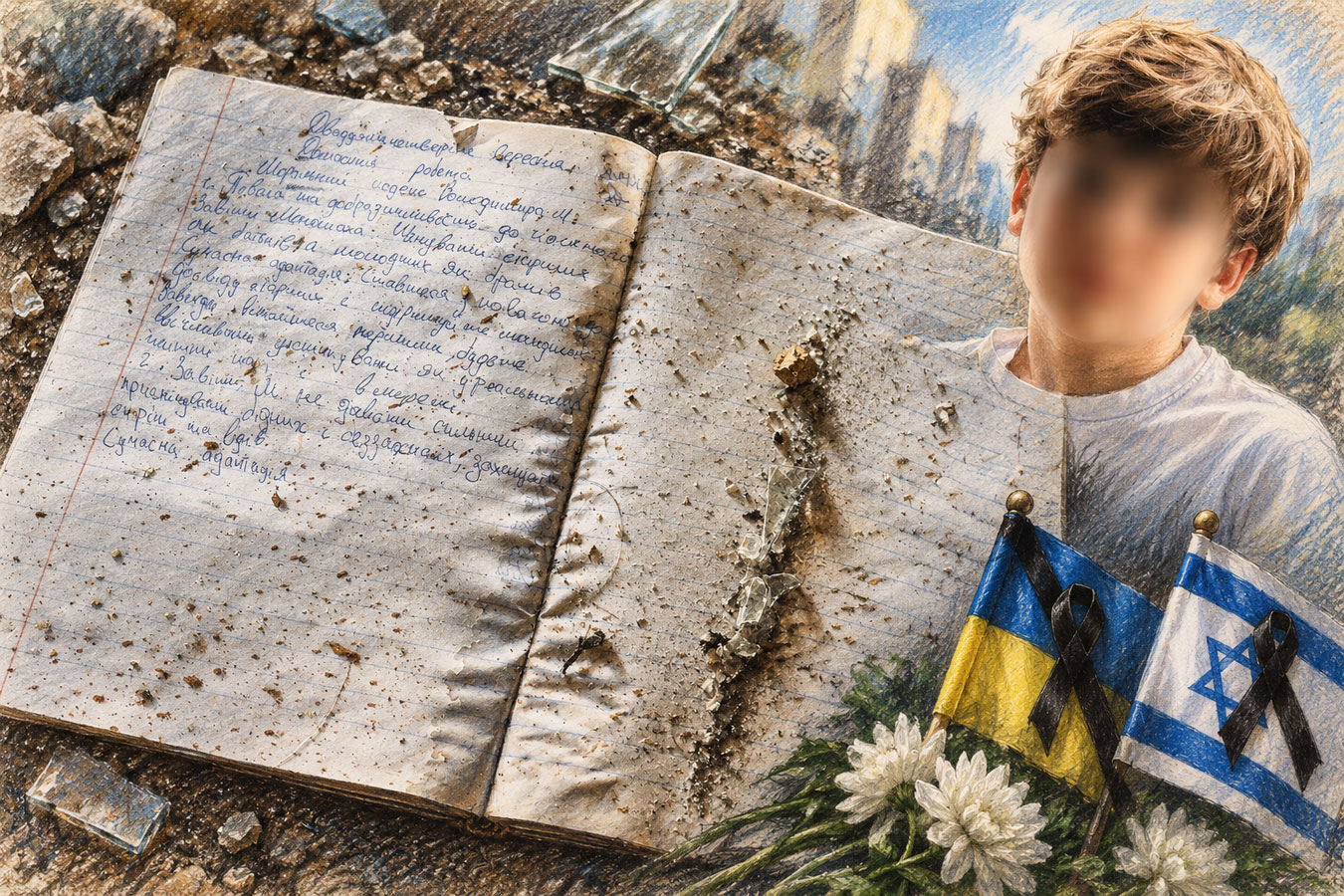
On the morning of September 25, 2026, 14-year-old Daniel Umansky was sitting in his room in Kyiv doing his homework. In his notebook, he was writing about Vladimir Monomakh and trying to explain how the moral principles formulated almost nine centuries ago might look today.
Author: Alexander Khmelnitsky
He wrote about respect for other people, helping orphans, and protecting those who are weaker.
Daniel did not have time to finish his work.
Around eight in the morning, a Russian drone struck a residential building in the Pechersk district of Kyiv. Daniel died in his room. His mother sustained a hand injury and was hospitalized. His younger brother, who was also in the apartment, survived.
A few days later, Ukrainian human rights activist, head of the Center for Civil Liberties, and Nobel Peace Prize laureate Oleksandra Matviychuk published a photo of Daniel’s unfinished work. According to her, the school notebook remained open among the apartment’s ruins, and traces of blood were visible on the pages.
Oleksandra Matviychuk is a Ukrainian human rights activist and lawyer, head of the Center for Civil Liberties in Kyiv. The organization is engaged in human rights protection, documenting war crimes, and issues of accountability for violations of international law. In 2022, the Center for Civil Liberties became one of the Nobel Peace Prize laureates along with Belarusian human rights activist Ales Bialiatski and the Russian organization ‘Memorial’.
Matviychuk noted that in the last minutes before the strike, Daniel was writing about helping the weak, respecting other people, and the responsibility of those who have power.
She saw terrible symbolism in this: a 14-year-old boy was trying to comprehend moral principles formulated many centuries ago in modern words — and did not have time to finish this work.
Why Daniel was writing about Vladimir Monomakh
For a reader in Israel, the name Vladimir Monomakh might not mean anything, although for the history of Kyiv, he is one of the key figures of the early 12th century.
Vladimir Monomakh was born in 1053 and belonged to the Rurik dynasty. From 1113 to 1125, he was the Grand Prince of Kyiv. His reign occurred during a period when Kyiv remained one of the main political and cultural centers of Eastern Europe. Monomakh tried to reduce internecine wars among princes, strengthen Kyiv’s influence, and organized campaigns against the Polovtsians.
But in Daniel’s story, Monomakh the politician is not as important as Monomakh the author.
Around the beginning of the 12th century, he created a work known as ‘Instruction to Children’. In it, the prince reflects on what a person with power and responsibility should be like: not lazy, helping the poor and orphans, caring for the weak, respecting other people, and being accountable for one’s actions.
That is why a modern Ukrainian schoolboy could receive such an assignment. ‘The Instruction of Vladimir Monomakh’ is studied in the Ukrainian school curriculum as one of the literary monuments of the Kievan Rus era. Daniel needed not just to retell the biography of an ancient prince but to think about what the moral rules formulated almost nine centuries ago mean today.
Hence his notes about respect for people, helping orphans, and protecting the vulnerable.
For an Israeli reader, there is another important historical layer here. Kyiv of that time was already connected with Jewish history.
Jewish presence in the city is recorded at least from the 10th century. One of the most famous testimonies is considered to be the Kievan Letter from the Cairo Geniza — a document in Hebrew related to the Jewish community of Kyiv and usually dated to about the 10th century. In it, community representatives appeal for help for a person who fell into debt bondage.
That is, organized Jewish life existed in Kyiv long before Monomakh became the Grand Prince.
In the 11th–12th centuries, the city was located on important trade routes between Eastern Europe, Byzantium, and more distant regions. Medieval sources and later studies associate a separate district of Kyiv with the Jewish population. In the chronicle tradition, the so-called Jewish Gates are mentioned — one of the city gates, the name of which is usually associated with the nearby Jewish quarter.
Individual representatives of the Jewish intellectual life of medieval Kyiv are also known, in particular, Moses of Kyiv, who is attributed to Jewish scholars of the 12th century.
At the same time, the life of the community was not peaceful. In 1113, after the death of Prince Sviatopolk Iziaslavich and just before Vladimir Monomakh came to power in Kyiv, riots broke out in the city. Among those who suffered violence were representatives of the Jewish community.
It turns out that Daniel’s school assignment inadvertently leads far beyond a regular literature lesson. Monomakh is not only a figure from Ukraine’s medieval past. Kyiv of his era was already a city where different peoples, religions, trade routes, and cultures intersected, including the Jewish community.
For the Ukrainian school, ‘Instruction’ is part of its own literary and historical heritage. For an Israeli reader, another layer is added: the Jewish history of Kyiv began long before modern times and already existed in the era Daniel wrote about.
On the morning of September 25, he was working on just such an assignment — trying to explain in modern words old concepts of responsibility, helping the weak, and respecting another person.
This work remained unfinished.
Where Daniel studied
After the first reports of the boy’s death, most Israeli publications referred to him primarily as a 14-year-old Israeli citizen who died in a Russian strike.
But gradually, details of his life in Kyiv became known.
Daniel studied in 8th grade at Lyceum No. 5 in the Pechersk district of Kyiv.
And this is known not only from reports about the subsequent visit of the Israeli ambassador.
In an official document of the Kyiv education system for the 2025/26 academic year, NANews found the entry ‘Umansky Daniel Zakharovich’, 8th grade, Lyceum No. 5 Pechersk district. The same document lists his result — 25 points. The full name, age, class, and district match the data of the deceased Daniel Umansky.
The official document of the Kyiv education system allows for more precise identification of the school than the first media reports, where its name was not mentioned.
Daniel had a biography that is difficult to describe with a single national identity.
He held citizenship of Israel and Ukraine. The family previously lived in Israel, where Daniel studied at the Tel Aviv school ‘Ahavat Zion’. Later, the parents moved with the children to Kyiv due to the father’s work. Grandparents and other relatives continued to live in Israel.
In Kyiv, Daniel already lived the life of a Ukrainian schoolboy — he attended the lyceum, studied with his classmates, and learned Ukrainian history and literature.
Later, his teachers will reveal another detail: Daniel especially loved the Ukrainian language and wanted to become a Ukrainian language teacher in the future.
Therefore, the definition ‘Israeli child who ended up in Ukraine’ oversimplifies the story. Israel was part of his life and family, but Kyiv was also his home.
The strike on September 25 and Israel’s reaction
The Israeli Foreign Ministry confirmed Daniel’s death on the day of the attack — a 14-year-old citizen of Ukraine and Israel died in a Russian strike on a residential building in Kyiv.
His mother was injured, and his younger brother was physically unharmed.
The Israeli Foreign Ministry condemned the Russian attack and expressed condolences to the family. The Israeli embassy and consular service contacted the relatives. Later, ZAKA, Jewish organizations in Ukraine, and Chabad representatives joined the assistance.
NANews previously detailed how Israel’s diplomatic position on Russian strikes on Ukraine changed — from direct condemnation of the Russian invasion to significantly more cautious rhetoric in certain periods.
Daniel’s story had another dimension for Israel: it was not only about a diplomatic reaction to a war in another country. An Israeli citizen — a child whose family continued to live between Israel and Ukraine — died in a Russian strike.
At first, it was unknown where the parents would decide to bury their son.
Later, the family decided to transport the body to Israel.
Babi Yar and the road home
On September 29, four days after Daniel’s death, events were held in Kyiv to mark the 85th anniversary of the beginning of the mass shootings at Babi Yar.
The ceremony was attended by Ukrainian President Volodymyr Zelensky, representatives of Jewish organizations, and diplomats from dozens of countries. Among them was Israeli Ambassador Roi Rosenblit.
For an Israeli reader, Babi Yar is one of the most well-known Holocaust sites in Ukraine. On September 29–30, 1941, the Nazis shot 33,771 Kyiv Jews there.
NANews detailed the 85th anniversary of the tragedy and how the Babi Yar memorial space is arranged today.
But in 2026, the ceremony had a completely different, modern context.
While Kyiv was remembering those who died eighty-five years ago, Israeli and Ukrainian structures were processing the documents necessary for transporting Daniel’s body.
NANews already wrote that during the events at Babi Yar, it became known about the preparation for his transfer to Israel.
After completing the necessary procedures, the teenager’s body was transported to Israel, where his grandparents live.
NANews — News of Israel | Nikk.Agency follows this story precisely because it spans two countries. The Russian war in Ukraine was never an event far from Israel for this family.
Parents said goodbye to their son in two languages
On October 1, 2026, Daniel was buried in Israel.
The funeral was attended by Knesset member Gilad Kariv, chairman of the Committee on Aliyah, Absorption, and Diaspora Affairs.
After the ceremony, Kariv said that the father and mother said goodbye to their son in two languages.
He wrote:
“Israel must stand on the side of the citizens of Ukraine.”
Here it is important to maintain political accuracy: this was a statement by an opposition member, not a change in the official position of the Israeli government.
It was Kariv who reported some details of Daniel’s Israeli biography — in particular, that before moving to Kyiv, the boy studied at the Tel Aviv school ‘Ahavat Zion’.
NANews detailed Kariv’s speech and Daniel Umansky’s funeral in a separate article.
The Israeli ambassador visited Lyceum No. 5
After the funeral, the story returned to Kyiv.
Israeli Ambassador to Ukraine Roi Rosenblit visited the school where Daniel Umansky studied.
The visit was reported by the Embassy of Israel in Ukraine. On October 2, details were published by JewishNews — a project of the United Jewish Community of Ukraine.
Rosenblit met with the lyceum’s director, teachers, Daniel’s classmates, and the school staff.
Teachers remembered him as a bright, kind, and sincere boy. It was from them that a detail emerged that allows us to see a very specific teenager behind the reports of the deceased ’14-year-old Israeli citizen’:
Daniel loved the Ukrainian language and dreamed of becoming a Ukrainian language teacher.
One of his classmates said:
“This should never have happened. I want this to be the last case where children die.”
Roi Rosenblit replied:
“We must do everything possible to ensure that no other child becomes a victim of this war.”
The visit was not limited to condolences.
The ambassador discussed with the director and her team the possibilities of further cooperation between the Embassy of Israel and the lyceum, including joint commemoration of Daniel’s memory.
It is not yet reported what form it will take — a memorial plaque, a school project, an event, or another format.
Kyiv between lessons and alarms
In the publication about Daniel, Oleksandra Matviychuk provides another figure: according to her data, there were 235 air alarms in Kyiv in September 2026 alone.
We provide this statistic specifically with reference to Matviychuk — a separate verification of the full number of alarms for the month within this material was not conducted by NANews.
But the events of the following days show the context itself.
After Daniel’s death, Kyiv was again subjected to Russian attacks. Buildings of the National Academy of Sciences of Ukraine, the Dobrobut medical center, and other civilian objects were damaged.
NANews analyzed these strikes in the material ‘There are no more rules’: Zelensky announced Putin’s order to lift restrictions on strikes.
For an Israeli reader, such a military everyday life is understandable without long explanations. The city cannot completely stop life every time: children continue to study, adults work, doctors receive patients. Sirens, shelters, and waiting for a possible strike exist simultaneously with lessons, homework, and ordinary family affairs.
So it was on the morning of September 25.
Daniel Umansky was sitting in his room answering a school question: what do responsibility, helping the weak, and respecting others mean today.
A Russian drone did not allow him to finish this answer.
Now at Lyceum No. 5, they are discussing how to preserve the memory of a boy who wanted to one day return to school not as a student, but as a Ukrainian language teacher.