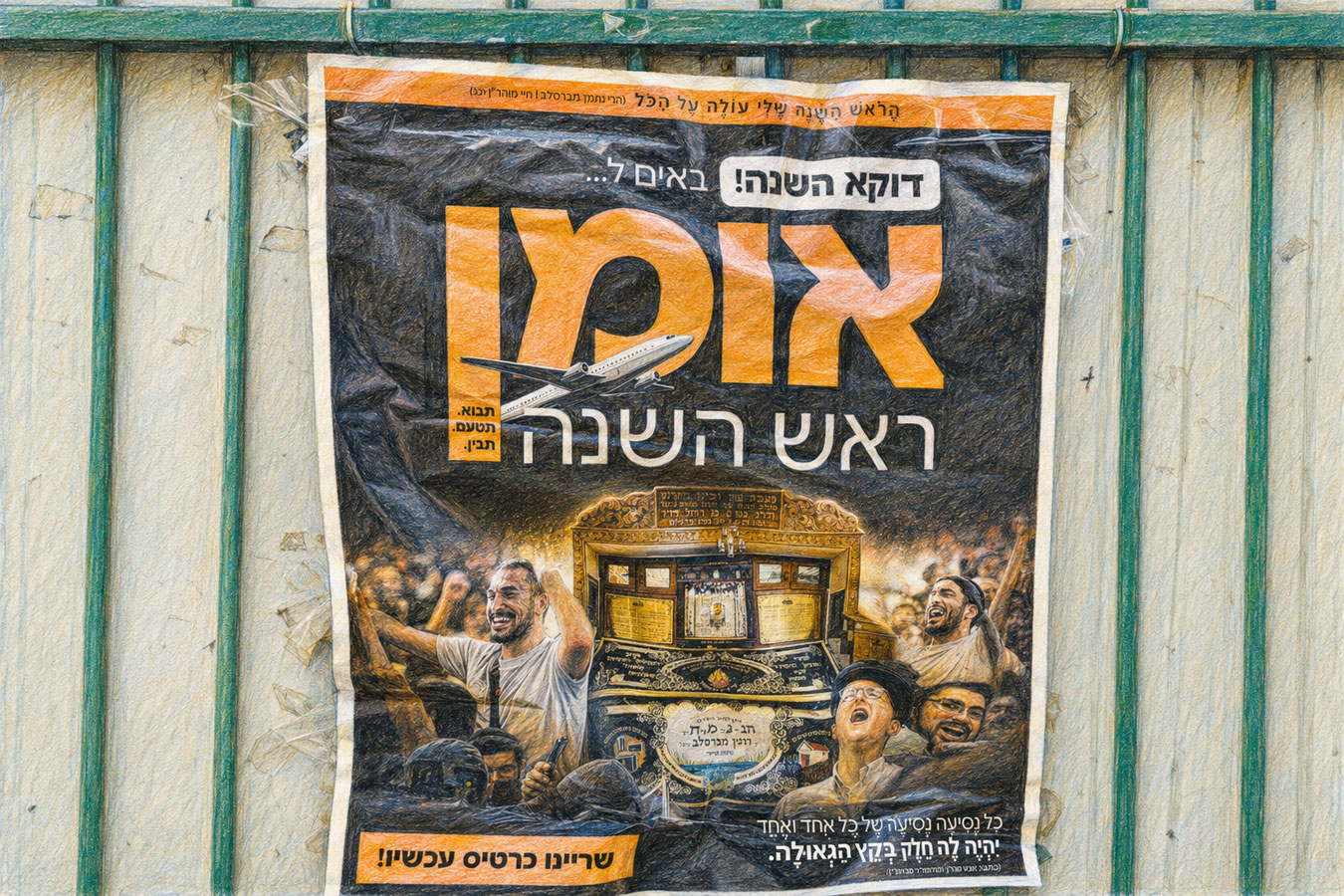
Israeli media reported on the preparation of a police and consular operation for tens of thousands of pilgrims who will travel to Uman via Romania, Moldova, and Poland. However, the exact number of police officers, diplomats, and trip participants has not yet been officially confirmed, and estimates from different sources vary significantly.
More than 40 Israeli police officers, dozens of diplomats, 45,000 pilgrims, and an operation costing hundreds of thousands of shekels. These data were published on August 24, 2026, by the Israeli publication Ynet, detailing the preparations for Rosh Hashanah in Uman, Ukraine.
The main part of this story is confirmed: Israel is indeed preparing a special operation, Romania is expected to become one of the main transit centers, and the Ukrainian police officially report joint work with Israeli colleagues. But the exact numbers — more than 40 police officers and dozens of diplomats — are currently only provided by Ynet.
Rosh Hashanah 5787 will begin on the evening of September 11 and end on September 13. Ukrainian services expect the mass arrival of pilgrims as early as September 6.
I, the author Elena Gunko, write about events connecting Israel, Ukraine, and the Jewish communities of both countries. For this material, I compared Israeli publications with reports from the National Police of Ukraine, the Vinnytsia Regional Military Administration, the State Service of Ukraine for Ethnopolitics, local authorities in Uman, and pilgrimage organizers. As a result, a more complex picture emerged than just news about sending several dozen police officers.
Why Israeli police work in Romania
Due to Russian aggression, Ukraine’s airspace is closed to civilian aviation. There are no direct flights from Israel to Kyiv, Odessa, or other Ukrainian cities. Pilgrims are forced to fly to neighboring countries and then spend many hours on buses, trains, and in queues at the border.
On August 19, i24NEWS journalist Ari Kalman reported that Romanian authorities asked Israel to send its police officers to major airports and transit points. The i24NEWS publication was retold by the Srugim website.
It is important to understand: these are not two independent confirmations. Srugim directly refers to the i24NEWS report, so the source of information about Romania’s request and the operation’s budget is essentially one.
It is assumed that Israeli police officers will help Romanian services communicate with passengers in Hebrew, regulate queues, and distribute people between buses and border crossings. They will not replace Romanian police and will not receive independent powers on the territory of another country.
The National Police of Ukraine separately confirmed preparations for joint service with Israeli police in Uman. Ukrainian law enforcement officers plan to control the area of Rabbi Nachman’s tomb, places of residence for pilgrims, bus routes, and access roads to the city.
However, neither the Ukrainian police nor published reports from Israeli state structures currently specify the number of dispatched personnel.
For comparison: in 2023, Israel sent about 20 police officers to Uman. In 2025, the National Police of Ukraine reported the arrival of no more than ten Israeli officers. If Ynet’s information is confirmed, it will be a sharp increase in the contingent.
The operation is estimated at 750,000 shekels, but the budget has not been published
According to i24NEWS, the Israeli Ministry of Foreign Affairs is creating a special operational headquarters to coordinate the trip and return of pilgrims. It should maintain contact with Romanian and Ukrainian authorities, monitor the movement of organized groups, and respond to transport or consular issues.
The cost of the operation is estimated at approximately 750,000 shekels. As reported, the Ministry of Foreign Affairs proposed that the Ministry of Internal Affairs, the Ministry of Transport, and other departments share the expenses.
This publication confirms Ynet’s wording about “hundreds of thousands of shekels,” but I have not found an open government budget. Nor has a full list of departments that agreed to allocate funds been published. Therefore, 750,000 shekels remain a journalistic estimate, not a final sum of state expenses.
The same applies to dozens of diplomats. The creation of a special headquarters is confirmed by an earlier i24NEWS report, but the exact number of its employees is only named by Ynet.
Why Israel is changing Moldova for Romania
In 2025, Moldova was supposed to be the main route for pilgrims. The Israeli government allocated 10 million shekels for infrastructure and transport solutions related to mass transit through this country. Moldova demanded payment for additional expenses arising from the arrival of tens of thousands of passengers.
This was a significantly larger amount than the current estimate of 750,000 shekels. But they cannot be directly compared. The 2025 funds were primarily intended for infrastructure and transport organization of the Moldovan route, while current expenses relate to police and interdepartmental coordination.
The decision on ten million caused a political dispute in Israel. Yair Lapid and Avigdor Lieberman criticized the use of state funds and linked the trip to Uman with the separate issue of young ultra-Orthodox men avoiding conscription into the IDF.
In 2026, according to Israeli publications, Romania is expected to become the main transit center. However, Moldova does not disappear from the routes completely: some flights and buses will still pass through its territory.
For readers of NANews — News of Israel, this is an important clarification. It is not just about the annual dispatch of police to Uman, but about the constant search for a new logistical scheme after the closure of Ukrainian airspace. Every year, Israel negotiates with a different combination of airports, border services, and transport companies.
How many pilgrims will actually come to Uman
Ynet provides a forecast of 45,000 people: about 35,000 from Israel and another ten thousand from other countries.
The official Vinnytsia Regional Military Administration reported on August 14, 2026, that more than 30,000 pilgrims are expected from Israel alone. The number arriving from other countries was still being clarified at that time.
The Regional Military Administration, or RMA, is a Ukrainian regional executive authority. During martial law, it coordinates police, border guards, transport, and civil protection measures. For an Israeli reader, the closest but legally inaccurate reference is a district administration with additional wartime powers.
Ukrainian public broadcasting “Suspilne” reports that Uman is preparing to receive about 40,000 people. Deputy Mayor Oleg Hanich explained that in normal years, the number of guests ranges from 25,000 to 35–40,000.
The Israeli publication Makor Rishon wrote about more than 45,000 pilgrims from Israel alone and referred to a coordination meeting in Vinnytsia. But the official message from the Vinnytsia RMA about the same meeting only mentions more than 30,000 Israelis. Therefore, the figure from Makor Rishon cannot be considered confirmed by an official Ukrainian source.
Comparison of publications gives such a cautious guideline: Ukraine is preparing for about 40,000 guests, while Israeli media allow for an increase in the total flow to 45,000. These are service forecasts, not final statistics of tickets sold or border crossings.
The scale can be assessed by previous years. In 2022, despite the war, more than 23,000 pilgrims came to Uman. In 2023, there were about 35,000, in 2024 — approximately 34,000, and in 2025, according to local authorities, already more than 40,000.
How Uman prepares hundreds of thousands of portions and knits kippahs
Behind police reports, it’s easy to lose sight of the city itself. Uman is not a temporary camp deployed by state services. Preparation for Rosh Hashanah changes the daily life of local residents for several weeks.
In August 2026, local entrepreneur Angela Levitskaya-Adamia told “Suspilne” that about 35 women have been knitting kippahs for pilgrims for almost a month. Craftswomen from Kherson joined the work. Kippahs are prepared in hundreds, with different colors and patterns made for different groups of visitors.
The largest local kosher canteen, according to its representative Alexander Sukhina, can simultaneously serve more than 12,000 people. For the holiday, they are preparing a stock of approximately 17.5 tons of disposable tableware and plan to produce 300–350,000 portions. Some products are brought from Israel and the USA.
These details better show the real size of the pilgrimage than abstract forecasts. In a few days, it is necessary to feed the population of a small Israeli city, accommodate it in hotels and private homes, deliver it from several countries, and take it to shelters during each air raid alert.
Pilgrimage also has a noticeable economic side. In 2024, about 34,000 guests paid Uman approximately 17 million hryvnias in tourist tax — about 1.56 million shekels at the official exchange rate of that period. About two million hryvnias, or approximately 184,000 shekels, were spent on organization, cleaning, and other city expenses. According to the deputy mayor, part of the remaining money was intended for assistance to the Ukrainian army, improvement, schools, and medical institutions.
Through which countries will pilgrims travel
Vinnytsia RMA confirms three main directions: airports in Romania, airports in Moldova, and railway routes through Poland. A significant part of the buses from Romania and Moldova will cross the Ukrainian border in the Mohyliv-Podilskyi district of Vinnytsia region.
Ynet also mentions Hungary, Slovakia, and Bulgaria. Hungary and Slovakia have a common border with Ukraine and can indeed be used for entry. Bulgaria does not have a common border with Ukraine. It can be a country of arrival, but passengers will still have to travel through Romania. Therefore, calling Bulgaria a point of crossing the Ukrainian border is incorrect.
The State Service of Ukraine for Ethnopolitics and Freedom of Conscience reports that 21 border points are planned to be used for entry and exit. The service also expects the arrival of 16 mediators — translators and intermediaries who will help Ukrainian law enforcement communicate with pilgrims.
This Ukrainian agency is responsible for the state’s interaction with religious organizations and national communities. There is no full equivalent with the same powers in Israel.
When choosing a ticket, it is not enough to check only the arrival airport. Two flights to the same city may use different ground routes and border crossings. It is on the bus part of the route and at the border that the most prolonged delays occurred in previous years.
Ukraine is preparing to receive, but advises not to come
The most important contradiction of this story is that Ukrainian authorities are simultaneously preparing for the pilgrimage and recommending against it.
The Ministry of Foreign Affairs of Ukraine warned that due to ongoing Russian aggression, the state cannot guarantee full safety for foreign citizens. Among the main problems are the insufficient number of shelters, limited medical capabilities of the city, and overload of ground crossings.
A curfew will be in effect in Uman from 00:00 to 04:00. During these hours, it is not allowed to be outside without special permission. Pilgrims are prohibited from launching drones and fireworks, photographing military objects, checkpoints, and critical infrastructure, transporting weapons or their imitations. In case of an air raid alert, it is necessary to go to a shelter.
Local authorities have obliged homeowners to provide shelter places for all accepted guests. If a private house accommodates 20 pilgrims, the owner must have a shelter for 20 people. But the published requirement does not yet prove that every landlord has fulfilled it and that each such facility has passed a full inspection.
NANews — News of Israel emphasizes the limits of the Israeli operation. Police and diplomats can help with queues, conflicts, loss of documents, or transport failures. They cannot protect people from Russian missiles and strike drones.
What is behind the $27 or $45 fee
On the Hebrew-language site of the payment organizers, it is indicated that the tourist fee can be paid in advance — $27, approximately 81 shekels at the exchange rate on August 24. After arriving in Uman, the amount will be $45, or about 134 shekels.
The payer receives confirmation with a barcode. Organizers warn that it may be checked upon entering the pilgrimage area. The reduced amount is explained by an agreement between the Union of Breslov Hasidim and the Uman municipality.
But the usual Ukrainian rate is calculated differently. According to information from Uman Travel, based on a city council decision, a foreign guest in 2026 must pay for each night:
- about 29 shekels when staying in a private house, apartment, room, or cottage;
- about 14.5 shekels when staying in an official hotel, hostel, or other registered facility.
In a hotel, this payment may be included in the accommodation cost. Children under 18, people with disabilities, and a few other categories are exempt from the fee.
Therefore, $27 is not a single Ukrainian rate for one night, but a special prepayment amount agreed upon by the pilgrimage organizers. The open instruction does not explain how many nights it covers and how it accounts for different types of accommodation. The increase to $45 when paying on-site also appears to be a condition of this mechanism, not a regular city tax rate.
Before paying, it is worth checking whether the fee is included in the hotel cost, whether it applies to a specific passenger, and for what period the confirmation is issued.
What needs to be checked before the trip
People currently trying to figure out how to get from Israel to Uman for Rosh Hashanah 2026 need more than just a plane ticket. They need to know the country of arrival, the carrier from the airport to the border, the specific border crossing, the address of residence, and the actual location of the nearest shelter.
Medical insurance should be checked separately. A standard Israeli tourist policy may exclude damage, treatment, or evacuation related to war. The mere fact of purchasing insurance does not mean it is valid during a trip to Ukraine.
As of August 24, the dates of the holiday, preparation for joint police work, the use of routes through Romania, Moldova, and Poland, the special headquarters of the Ministry of Foreign Affairs, and Ukrainian wartime restrictions are confirmed.
About 750,000 shekels, more than 40 police officers, dozens of diplomats, and 45,000 guests remain preliminary estimates by Israeli media. They may turn out to be accurate, but they cannot yet be presented as final data from state departments.
This is what distinguishes the current trip from ordinary religious tourism. Several countries are capable of organizing flights, buses, queues, meals, and police escort. But none of the participants in the operation can cancel the war in Ukraine and guarantee that tens of thousands of people will not find themselves under an air raid alert or a Russian strike.