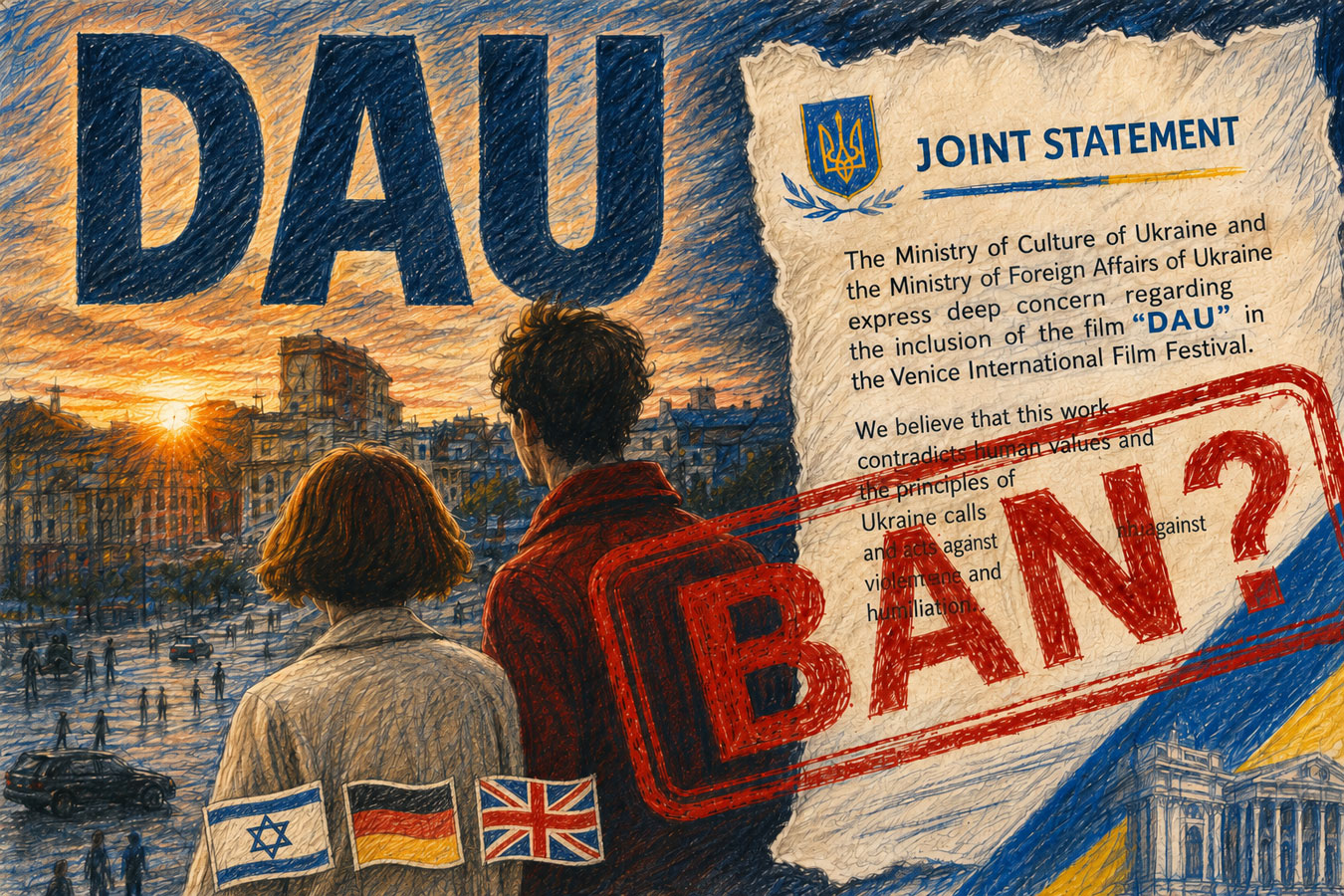
Ukraine opposed the participation of DAU director Ilya Khrzhanovsky in the main competition of the 83rd Venice Film Festival. Khrzhanovsky was born in Moscow, but today, according to his own data, he is not a citizen of Russia: he holds citizenships of Israel, Germany, and the United Kingdom, and renounced his Russian passport in protest against Russia’s policies and the war against Ukraine. This is why a contradiction arises in the very first sentence of this story: Kyiv speaks of Russian cultural influence, while Russia officially considers the director himself a ‘foreign agent.’
For Ukraine, this dispute is not just about cinema and not just about Khrzhanovsky. After the full-scale Russian invasion, Kyiv consistently proceeds from the fact that the war is waged not only with missiles and tanks: simultaneously, Russia tries to maintain its presence in European culture, return artists and projects associated with it to international platforms, and gradually restore the feeling that dealing with the Russian state ‘as usual’ is possible again. Therefore, Ukraine views the appearance of DAU in the main competition in Venice through a broader framework — military aggression, cultural influence, and subsequent international legitimization do not exist separately for Kyiv. In this logic, the question is not ‘is this a good film?’, but ‘does a prestigious European festival help normalize people, money, and cultural ties formed within the Russian system?’
For those searching for ‘Ukraine demands to remove DAU’, ‘Ilya Khrzhanovsky Venice 2026’, or ‘Russian funding for DAU’, a clarification is needed immediately: in the joint statement of the Ministry of Foreign Affairs and the Ministry of Culture of Ukraine, there is no literal demand to ban the film. Kyiv writes that it does not call for censorship, but asks international cultural platforms not to legitimize projects it considers connected with the Russian state.
The 83rd Venice International Film Festival is one of the oldest and most prestigious film festivals in the world, organized by La Biennale di Venezia; films in the main competition compete for the ‘Golden Lion’. In 2026, it will be held from September 2 to 12 on the Lido island in Venice, Italy.
I, Elena Gunko, started analyzing this story not to justify Khrzhanovsky or argue with Ukraine. I was interested in something else: does the short formula ‘a Russian project received European legitimization’ withstand the test of dates. Not completely. But the director’s own version also requires adjustments.
What exactly Ukraine presents
On August 17, 2026, Ukrainian agencies called the inclusion of DAU in the main competition in Venice a reason for ‘deep concern’. As arguments, they cited former financier Sergey Adonyev, conductor Teodor Currentzis, Khrzhanovsky’s work on a project with Russian billionaires, and the filming of DAU in Kharkiv from 2008 to 2011.
But the dispute began before the world premiere. Venice lists DAU as a 195-minute film produced by Germany, France, and Sweden; the first public screening is scheduled for September 9. This means that Ukraine is currently assessing primarily the origin of the project and the biographies of the people around it, rather than the content of the new film.
It is important for me here not to substitute one question for another. Ukraine has the right to ask about the project’s money and connections. But the answer to this question is not yet equal to the answer to what is in the film.
DAU indeed had Russian money — but not only that
DAU began in the mid-2000s as a project about Soviet physicist Lev Landau and then grew into a huge artistic experiment. The main filming took place in Kharkiv from 2008 to 2011; various films and installations were later created from the accumulated material.
In 2015, Screen Daily wrote that the Russian Ministry of Culture demanded through the court to return 22.5 million rubles previously allocated for the production of DAU, plus about 8 million rubles in interest. In the same material, the project was called a co-production of Russia, Sweden, Germany, and France, and among the structures that supported it was the State Agency of Ukraine for Cinema — a Ukrainian state structure supporting film production.
Here I disagree with Khrzhanovsky’s maximally broad formula that the Russian state ‘did not finance the film’. But first, it is important to understand where this formula came from.
On August 21, 2026, four days after the joint statement of the Ministry of Foreign Affairs and the Ministry of Culture of Ukraine, Ilya Khrzhanovsky published on his Facebook page a large public response to the Ukrainian agencies.
The director consistently dismantled their claims in ten points and posted the text immediately in three languages — English, Ukrainian, and Russian. At the beginning of the publication, he thanked the Venice Biennale and the festival’s artistic director Alberto Barbera for their support, and then stated that the Ukrainian statement contains factual errors and distortions of the history of DAU’s origin, its funding, relations with the Russian state, and his own biography. The Ukrainian version of the response begins in the same publication separately, followed by the Russian one.
It is in this response that Khrzhanovsky claims that the Russian state did not finance the film and did not participate in its creation. The publication appeared on August 21 — this is also confirmed by Italian media, which quoted his Facebook post on the same day.
And here I have a reservation. If we are talking about the entire history of DAU, there was Russian state funding. However, if Khrzhanovsky is speaking specifically about the completion of the 2026 version and its current production structure, I have not found direct confirmation of Russian state funding for this version.
Khrzhanovsky himself formulates this even more narrowly: for the past seven years, according to him, DAU has not received money from the Russian state, Russian state institutions, companies associated with the state, or private investors currently living in Russia. Sergey Adonyev, as the director claims, financed the large artistic project DAU from 2008 to 2019 but did not pay for the completion of the film selected for the Venice competition.
Adonyev is currently under US sanctions. The American OFAC registry indicates his Russian and alternative Israeli citizenship, Israeli passport, and address in Herzliya. For me, this is another reminder: a passport proves little here; dates of money and real connection with the current production are needed.
Currentzis, Kharkiv, and old claims to DAU
Ukraine separately points to Teodor Currentzis. He received Russian citizenship in 2014 and worked for many years within the Russian cultural system. But Khrzhanovsky draws attention to the chronology: most scenes with Currentzis were filmed from 2008 to 2011 when he was a citizen of Greece. The director also acknowledges: Currentzis did not publicly support the war, but he also did not publicly oppose it.
The dispute with Kharkiv is even more complex. Ukraine believes that the city is shown through a Soviet lens that erases its Ukrainian identity. Khrzhanovsky responds that the closed ‘Institute’ was specifically created as a Soviet world, and the film’s theme is the destruction of personality by a totalitarian system.
The project also has a heavy prehistory. In 2020, Ukraine investigated the circumstances of the participation of children from a Kharkiv orphanage in the filming of DAU. Later, the production was closed: investigators reported that they found no signs of a criminal offense. For me, this is an important boundary — ethical questions about the project’s methods remain, but the investigation cannot be turned into a proven crime.
How ‘Babi Yar’ appeared in the dispute — and why Israel cannot be forgotten here
The Ukrainian statement reminds that Khrzhanovsky led a cultural project funded by Russian billionaires associated with the Kremlin. The director himself clarifies: it is about the Babi Yar Holocaust Memorial Center in Kyiv, where he was the artistic director.
Yes, among the donors were Mikhail Fridman and German Khan. But the center’s supervisory board was headed by Natan Sharansky; the events marking the 80th anniversary of the Babi Yar tragedy in 2021 were attended by the presidents of Ukraine, Israel, and Germany. The Ukrainian state publicly interacted with the center at that time.
That is why I would not call the entire project ‘Kremlin’ without reservations. There were Russian money and disputes around Khrzhanovsky’s concept, but there was also an official Ukrainian-Israeli line.
For NANews — News of Israel, this is not an accidental historical insert. We wrote in detail about how the Soviet authorities displaced Jewish memory of Babi Yar in the material ‘Soviet Ban on Memory’. We also talked about the current ‘Research Space’ in Babi Yar and separately analyzed why the history of the Holocaust in Ukrainian cities remains little known. These materials show why the dispute over who shapes the memory of Babi Yar is not foreign to Israel.
Khrzhanovsky today — a citizen of Israel and a Russian ‘foreign agent’
In the Ukrainian statement, Khrzhanovsky is called a director from an aggressor state. He was born in Moscow, and the early history of DAU is closely linked to the Russian cultural environment. But legally, the situation today is different.
Khrzhanovsky writes that he renounced Russian citizenship in protest against the war and is a citizen of Germany, the United Kingdom, and Israel. He recalls supporting Ukraine after the annexation of Crimea in 2014 and speaking out against the full-scale Russian invasion. Russia has listed him as a ‘foreign agent’.
I do not consider the status of ‘foreign agent’ a universal justification. A person can conflict with the Russian state and maintain old connections with people from the Russian elite. But if the current state network of influence is being discussed, the attitude of the Russian authorities themselves towards the director cannot be excluded from the analysis.
Director’s son Andrey Kh: from Russia to Israel, and then to Palestinian activism
There is another character in Ilya Khrzhanovsky’s Israeli story — his son Andrey Khrzhanovsky, born in 1998, known on social media as Andrey X or Andrey Kh. And his path turned out to be perhaps even more paradoxical than his father’s.
In February 2022, Andrey came from St. Petersburg to Israel to visit his grandparents. His return ticket was for February 24 — the day Russia launched a full-scale invasion of Ukraine. He did not return to Russia, applied under the Law of Return, and received Israeli citizenship. Before that, Andrey studied anthropology at University College London, engaged in journalism, and participated in Russian opposition activities. In the first months after the invasion, he said he raised money for Ukrainian charities and wrote for ‘Novaya Gazeta’.
But quite soon, the center of his activity was no longer Russia and Ukraine, but the Israeli-Palestinian conflict. Andrey began traveling to Palestinian villages in Judea and Samaria — the West Bank in international terminology — and filming clashes between local residents and settlers and the IDF. Later, he practically moved there: in an interview with NEWSru.co.il, he said he lives among Palestinians and collaborates with organizations of so-called ‘protective presence’. The Irish Times in 2025 described him as an independent journalist and activist who is filming a documentary about the Palestinian village of Ras al-Auja and funds his work, including through donations from subscribers.
Andrey calls what is happening in Judea and Samaria ‘ethnic cleansing’, Israel — a system of ‘apartheid’, and the war in Gaza — ‘genocide’. These are his political definitions, not established facts in this article and not the position of NANews. Moreover, in a 2025 interview, he stated that he rejects the Zionist model of the state and believes that the existing political system should be radically changed. At the same time, he does not intend to renounce Israeli citizenship.
And he began to conflict with the Israeli authorities quite specifically.
In October 2024, the military detained him and several other journalists on the way to the Nablus area. Khrzhanovsky later claimed that the detainees were beaten, kept blindfolded, and left in the sun for several hours. This is precisely his version of events. Among the group was American journalist Jeremy Loffredo from The Grayzone, who previously worked at RT and was detained in Israel after publishing about the locations of Iranian missile falls.
This episode had a completely unexpected continuation. The Russian-speaking activist association ‘Compass’, with which Andrey was associated, after the story with Loffredo, excluded Khrzhanovsky himself. The organization explained the decision by saying that cooperation with a journalist from a publication it considered connected with the pro-Russian information environment contradicted its principle of rejecting any imperialism — including Russian.
For our article, this is an especially curious detail. While Ukrainian agencies today discuss possible Russian networks around the father, the son was already excluded from an ultra-left association for contact with a journalist whom his own associates considered connected with the pro-Russian agenda. The world of the Khrzhanovskys clearly resists attempts to neatly categorize it politically.
The loudest Israeli episode occurred in December 2024. Andrey published a video from Sderot, where he stuck a sticker with the Palestinian flag and the inscription Free Palestine on an object that simultaneously served as a memorial to IDF Captain Shilo Cohen, who died on October 7, 2023, in battle in Kibbutz Be’eri. After complaints and public reaction from politicians, Andrey was detained in Tel Aviv.
The police requested to extend his arrest for five days. Judge Sabina Cohen disagreed: she pointed out that the sticker itself did not pose a threat to public safety and was within the limits of freedom of expression. The court ordered Khrzhanovsky’s release, although it set bail at 15,000 shekels and banned him from visiting memorial sites for a month. The father of the deceased officer publicly called Andrey’s act malicious.
This was far from the only conflict with law enforcement. In a September 2025 interview with NEWSru.co.il, Andrey himself said that 13 administrative and criminal cases had been initiated against him, some of which had already been closed by that time. Among the remaining proceedings, he mentioned a case after an action at the Russian embassy in Tel Aviv, when he poured red paint on the building in protest against the war in Ukraine, as well as a civil lawsuit for 160,000 shekels from a settler accusing him of defamation. These are Khrzhanovsky’s figures and descriptions, not data from a single official registry, so they should be presented as such.
By 2025–2026, Andrey had turned this activity into a full-fledged media project. He regularly shoots videos from Palestinian villages, publishes them for an international audience, and appears in European media. In June 2026, The New Arab described him as a journalist and activist who has been documenting the actions of settlers and the Israeli army in the West Bank for over two years.
About Andrey himself, NANews has already reported. And a related topic — why part of the ultra-left anti-Israeli rhetoric can intersect with the Russian information agenda — NANews — News of Israel separately analyzed in the material about the slogan Free Palestine and the ‘Kremlin axis’.
I specifically do not make the political views and actions of the son an argument against Ilya Khrzhanovsky. That would be a typical manipulation by the principle of guilt by association. Moreover, father and son do not agree politically on everything: Andrey himself said that Ilya Khrzhanovsky does not share his position, although he supports him as a son.
But for the family’s biography, this line is important. The father renounced Russian citizenship, opposes the war, and became a Russian ‘foreign agent’. The son did not return to Russia after the Russian invasion, received an Israeli passport — and then became one of the most prominent Russian-speaking ultra-left critics of Israel itself.
This proves nothing about the funding of DAU.
But it clearly shows why the Khrzhanovsky family cannot be described with a single word ‘Russian’.
How Khrzhanovsky became an Israeli citizen and what connects him with Israel
I did not find the exact date of Ilya Khrzhanovsky obtaining Israeli citizenship in reliable open sources. But it is known that he had an Israeli passport before the full-scale Russian invasion of Ukraine. In interviews, he said that he came to work in Kyiv on the Babi Yar Memorial Center already as an Israeli citizen and was processing a Ukrainian work permit with an Israeli, not a Russian passport.
Khrzhanovsky himself recalled that after receiving the Israeli passport, he asked acquaintances what he, as an artist, could do for Israel. Shortly after that, he was offered to participate in creating the concept of the Babi Yar Memorial Center, where he later became the artistic director.
At the same time, Israel did not become his only place of residence: Khrzhanovsky continued to work between Europe and Ukraine. On February 24, 2022, the war caught him in Israel, and after the invasion began, his elderly parents moved here. Today, his main base is considered Berlin, but Israeli citizenship in his biography is clearly not a formality.
Therefore, the formula ‘director from an aggressor state’ requires clarification: Khrzhanovsky was born in Moscow, but long before the current dispute, he had Israeli citizenship, and later renounced his Russian passport.
What remains after verification
After verification, I cannot call the Ukrainian statement unfounded. DAU had Russian state support, Adonyev indeed financed the project for many years, Currentzis is connected with the Russian cultural system, and there were serious disputes around Khrzhanovsky in Ukraine.
But I do not see a proven chain that would turn DAU 2026 into today’s project of the Russian state. For this, data on current money, control, management, or political order are needed. Old connections raise questions; they do not automatically answer them.
This is the main nuance. Ukraine looks at the entire twenty-year biography of DAU and sees the accumulated Russian infrastructure. Khrzhanovsky separates the current film from it and shows a new European production structure. Both sides choose a time frame that strengthens their argument.
After September 9, what almost all participants in the discussion currently lack will appear — the film itself. Then it will be possible to argue not only about passports, sanctions, old money, and Kharkiv as a filming location, but also about whether DAU really reproduces the Russian imperial lens or, as the director claims, shows the mechanism of totalitarianism.
Why Ukraine is fighting for culture at all
Here I understand Ukraine’s logic, even if I believe that specific accusations against DAU need to be checked much more accurately. The country has been living under full-scale Russian aggression for the fourth year and simultaneously observes how Russia continues to claim not only territories but also the right to determine what is considered ‘Russian’ in the history, culture, and memory of neighboring countries. Ukraine sees this as a continuation of the same imperial model: first political and military pressure, then appropriation of common history, language, artists, cities, and cultural heritage.
Therefore, for Kyiv, an international film festival is not a neutral showcase. When a film appears in the main competition in Venice, its author receives prestige, press attention, and symbolic return to the European cultural norm. This is what Ukraine calls the problem of legitimization: not necessarily direct Kremlin propaganda, but a gradual restoration of the acceptability of the Russian cultural environment while Russia itself continues the war.
There is also another reason. For decades, Russia represented Ukrainian writers, scientists, cities, and cultural achievements as part of a single ‘Russian’ or ‘Soviet’ space. After 2022, Ukraine reacts especially painfully to any situations where this framework, in its opinion, is reproduced without explanation that it is about Ukrainian territory and a separate Ukrainian history. That is why Kharkiv in DAU is not just a place of old filming for Kyiv.
But here I would still separate the principle and the specific case. Ukraine’s right to resist Russian cultural normalization is understandable to me. However, if a specific director or a specific film is called part of the current Russian network of influence, this already requires not a general logic of war, but specific evidence — modern money, control, institutional connection, or political order. This boundary in the DAU story seems important to me not to lose.
Sources: joint statement of the Ministry of Foreign Affairs and the Ministry of Culture of Ukraine; La Biennale di Venezia; public statement of Ilya Khrzhanovsky; Screen Daily; OFAC of the US Department of the Treasury; Suspilne Kharkiv; materials of NANews.